Air pollution shrinks BD life expectancy by seven years: study

Staff Reporter :
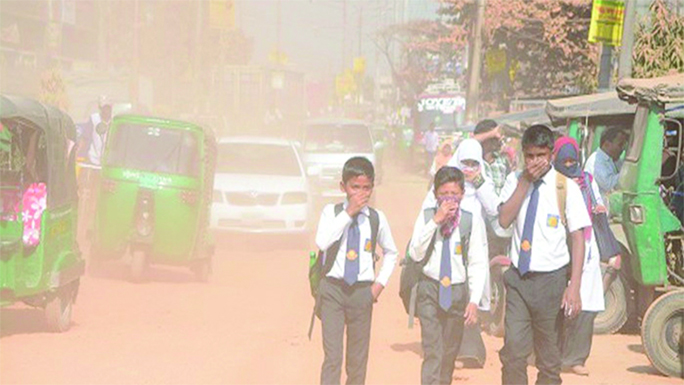
South Asian air pollution has impacted to the Bangladesh people’s life expectancy as it is shortening about seven years of living, the latest Air Quality Life Index (AQLI) said.
It also ranked Bangladesh as the world’s most air-polluted country and identified four new densely populated districts in addition to the capital Dhaka as the most vulnerable to air pollution-induced life loss.
Published on Tuesday, the latest AQLI measures that the air of the industrial district Gazipur contains 89.8 particulate pollutants (PM2.5) – the highest in Bangladesh – followed by 88.7 PM2.5 in Noakhali, 87.2 PM2.5 in Dhaka, 88.2 PM2.5 in Cumilla, and 81 PM2.5 in Tangail.
In the previous index, Dhaka, Chattogram, Khulna, Barishal and Mymensingh were the top five vulnerable districts.
If particulate pollution in Bangladesh was under control, or the concentration of PM2.5 remains within 5 micrograms per cubic metre (?g/m3) as per the World Health Organization (WHO) guidelines, residents in Gazipur, Noakhali, Dhaka, Cumilla and Tangail would gain more than eight years of life expectancy, according to the AQLI. The AQLI is released by the University of Chicago’s Energy Policy Institute.
Measured in terms of life expectancy, particulate pollution is the second greatest threat to human health in Bangladesh (closely following cardiovascular diseases), taking 6.8 years off the life of the average Bangladeshi, according to the index.
In contrast, tobacco use reduces average life expectancy by 2.1 years, while child and maternal malnutrition reduces average life expectancy by 1.4 years.
PM2.5, a fine particulate matter of 2.5 micrometres or less in diameter, is the most dangerous pollutant because it can penetrate the lung barrier and enter the blood system, causing cardiovascular and respiratory disease and cancers.
Despite a 2.1% dip in particulate pollution compared to 2020 levels, pollution in Bangladesh has hovered around 14 to 15 times the WHO guideline for the past decade.
Bangladesh, India, Nepal, and Pakistan-where 22.9% of the global population lives-are the top four most polluted countries in the world.
Between 2013 and 2021, particulate pollution increased by 12.4% in Bangladesh, following 9.5% in India, and 8.8 in Pakistan, the index shows.