
Yunus unveils 6-point global proposal to end hunger
Staff Reporter :
Chief Adviser and Nobel Peace Laureate Prof Muhammad Yunus on Monday told world leaders that hunger persists not because of lack of food but because of a “failed economic system powered by profit and inequality.”
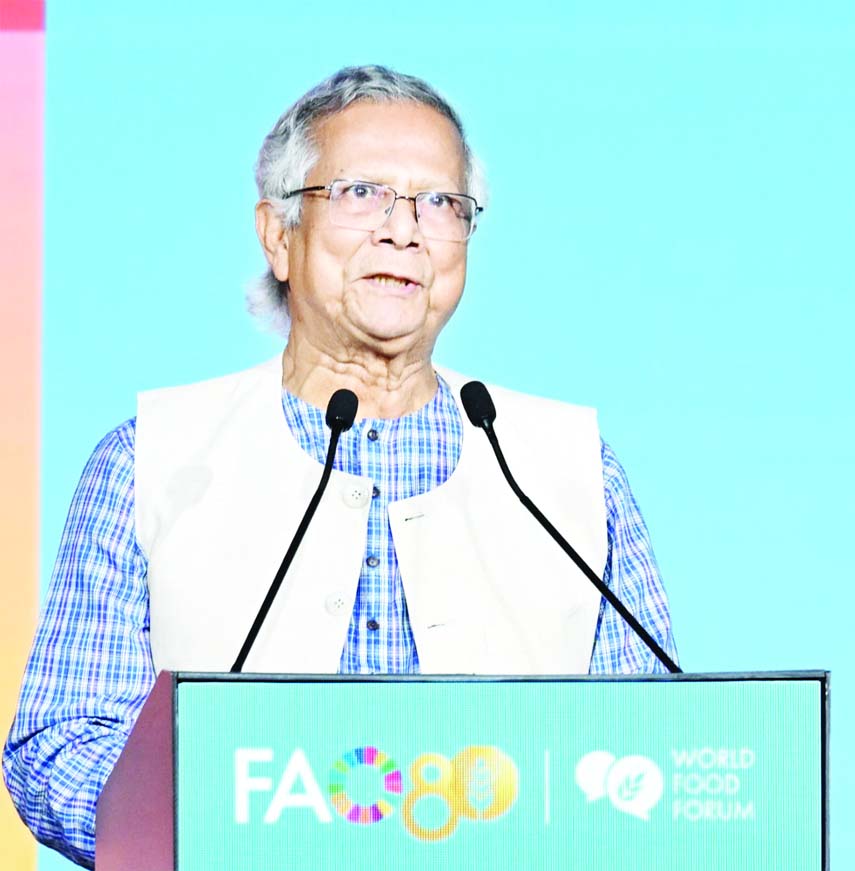
Speaking at the grand opening of the World Food Forum 2025 at the FAO headquarters in Rome, Yunus urged the global community to embrace systemic reform and presented a six-point proposal to break what he described as the “hunger-conflict cycle.”
Addressing an audience of heads of state, ministers, diplomats and youth leaders, Yunus said the world must move from talk to action if it is serious about eliminating hunger and building fair food systems.
“Hunger is not caused by scarcity.
It is caused by the failure of the economic framework that we have designed. In 2024, 673 million people went hungry while the world spent 2.7 trillion dollars on weapons.
This is not a failure of production – it’s a failure of the economic system. It’s a moral failure,” he addressed.
He called for urgent steps to reset global priorities and cooperation. Yunus proposed six key actions: end wars and ensure food access in conflict zones; fulfil financing commitments for the Sustainable Development Goals and support climate resilience for vulnerable nations; build regional food banks to stabilize supply during crises; empower youth entrepreneurs and local innovators through finance and infrastructure; remove export bans that distort food access and trade; and democratize access to agricultural technology for the Global South.
Yunus also renewed his call for a transformation of capitalism by introducing social business alongside conventional profit-maximizing companies.
He said social business, which reinvests profits to solve social problems, could unlock new agricultural innovation, fight rural poverty and bridge inequalities.
“The old system has failed billions. We must redesign it. We need businesses that solve problems rather than create them,” he told the forum.
Highlighting Bangladesh’s own journey, he said, “Despite our small land area, half of Italy, we feed over 170 million people, and also support 1.3 million Rohingyas who fled under violence in Myanmar.”
“We have become self-sufficient in rice – our staple. We are among the world’s top producers of rice, vegetables, and freshwater fish.
Our farmers have raised cropping intensity to 214%. We’ve released 133 climate-resilient rice varieties. We’ve mechanized farming, with subsidies of up to 70%. We’ve built a robust food distribution system,” he said.
He credited youth participation in rebuilding democratic institutions at home and said young people must be trusted as “job creators, not job seekers.”
He concluded by urging global investment in young entrepreneurs through social business funds, agri-innovation hubs and climate-smart enterprises.
“If we invest in youth, we will not only feed the world. We will change the world,” he said.
Yunus reaffirmed Bangladesh’s commitment to the FAO-led Global Alliance Against Hunger and Poverty under the G20 and repeated his vision of a “Three-Zero World” with zero wealth concentration, zero unemployment through entrepreneurship and zero net carbon emissions.
“This is not a dream. It is a necessity, the only way to save the world,” he added.
Addressing the audience, he said, “The pillars of this forum – Youth, Science, Investment – are not slogans. They are the tools we need to transform our food systems and our societies.”
“Today’s world has resources. It has the technology. It will have more mind-boggling technology. But we need the creative ideas to use this technology with appropriate business format to create a new world. If we can imagine it, we can create it,” he concluded.