
Yunus, Ishiba reaffirm shared vision for peace, prosperity
Diplomatic Correspondent :
Bangladesh and Japan have reaffirmed their longstanding bilateral relations through a renewed commitment to their strategic partnership, focused on peace, stability, and shared prosperity.
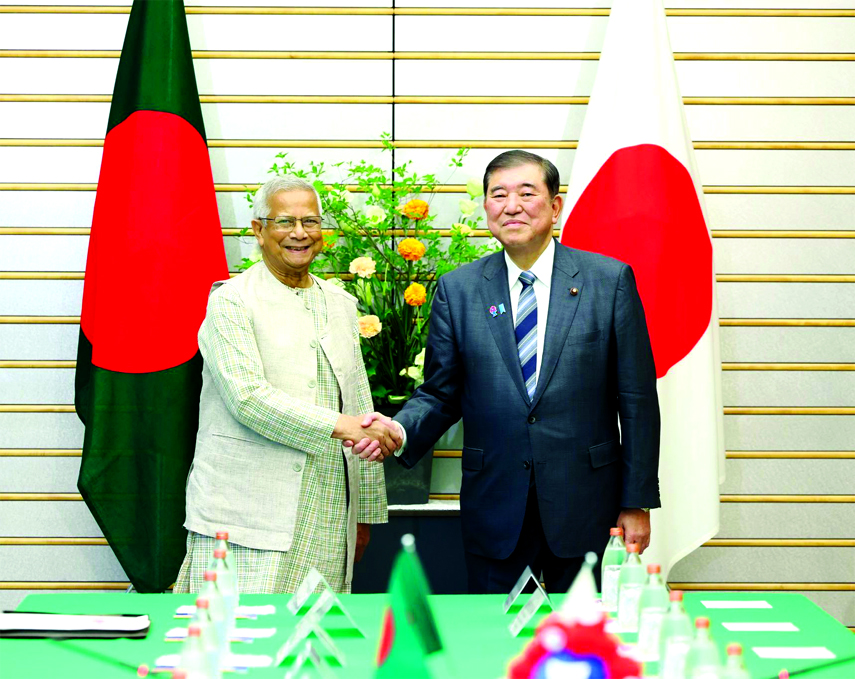
The development came during the official visit of Professor Muhammad Yunus, Chief Adviser to the Interim Government of Bangladesh, to Japan, where he met Japanese Prime Minister Ishiba Shigeru on Friday.
A series of significant agreements were signed during the visit, including multiple Memorandums of Understanding (MoUs) and a Memorandum of Cooperation (MoC), aimed at enhancing economic, technological, and energy sector collaboration between the two nations.
Japan announced it would provide Bangladesh with $1.063 billion in support, including a $418 million Development Policy Loan to support economic reforms and climate resilience, $641 million for upgrading the Joydevpur-Ishwardi railway to a dual-gauge double track, and $4.2 million in grants for scholarships.
At the “Bangladesh Business Seminar” in Tokyo, six key agreements were signed to boost investment and industrial collaboration.
The Japan Bank for International Cooperation and Bangladesh’s Ministry of Energy and Mineral Resources signed an MoU to strengthen energy sector cooperation. ONODA Inc and Bangladesh SEZ Ltd (BSEZ) signed a land lease agreement for ONODA’s facility to assemble and inspect gas meters in the zone. Bangladesh Naxis Co Ltd also inked a lease deal with BSEZ to manufacture apparel accessories.
Japanese firms Glafit and Musashi Seimitsu Industry, together with the Bangladesh Investment Development Authority (BIDA), committed to establishing a facility in Bangladesh for the production of battery-powered cycles and electric motorcycles. Cipher Core Co. Ltd. signed a $20 million MoU with CCL Co. Ltd. to launch a national pilot project in information security using Complete Cipher Technology developed by award-winning inventor Takatoshi Nakamura.
The initiative is expected to support Bangladesh’s ambition to become a quantum-resilient digital economy.
Further, JICA and BIDA agreed to work together on the early development of the Integrated Single Window Platform (ISWP), consolidating investment-related services into a unified digital platform.
Speaking at the signing ceremony, Dr Yunus congratulated the stakeholders and emphasised the importance of timely implementation. “Now it is our task to implement. I am moved,” he stated. Parliamentary Vice-Minister of Economy, Trade and Industry, Shinji Takeuchi, noted that more than 300 Japanese companies now operate in Bangladesh – a 75 per cent increase over the past decade.
In a joint statement, both nations reaffirmed their historic ties dating back to Bangladesh’s independence and reiterated their shared vision for a Free and Open Indo-Pacific (FOIP).
Prime Minister Ishiba expressed Japan’s full support for Bangladesh’s reform and peace-building efforts under the interim government. Professor Yunus extended gratitude for Japan’s sustained support, particularly under the Bay of Bengal Industrial Growth Belt (BIG-B) initiative and the Moheshkhali-Matarbari Integrated Infrastructure Development Initiative (MIDI).
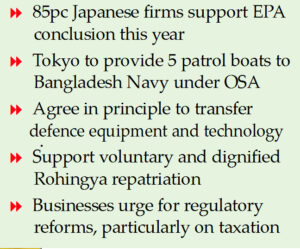
Both sides welcomed the agreements signed for development policy and railway infrastructure, and agreed to expedite negotiations for an Economic Partnership Agreement (EPA). They also reiterated their intention to enhance political and security cooperation, including early delivery of five patrol boats under Japan’s Official Security Assistance (OSA) and welcomed progress on the Agreement concerning the Transfer of Defence Equipment and Technology.
Cultural exchanges and movement of skilled personnel were also highlighted as areas of mutual interest. Prime Minister Ishiba lauded Bangladesh’s role in sheltering forcibly displaced persons from Myanmar’s Rakhine State, while Professor Yunus thanked Japan for its continued humanitarian support, including for those relocated to Bhasan Char. Both countries underscored the need for a sustainable and dignified repatriation solution through sincere dialogue among all stakeholders.
During a separate high-level roundtable with Japanese corporate leaders, Dr Yunus encouraged deeper business engagement with Bangladesh to help realise his vision for a “New Bangladesh”. He highlighted the interim government’s efforts to rebuild the nation and expressed confidence that past challenges could be overcome.
“We are committed to creating a New Bangladesh – one that breaks away from the failures of the past,” he said. Acknowledging ongoing challenges, he assured business leaders that reforms would provide a stable and welcoming environment for investors.
Norihiko Ishiguro, CEO of JETRO, pointed to Bangladesh’s steady investment potential, while Fumiya Kokubu of the Japan-Bangladesh Committee for Commercial and Economic Cooperation (JBCCEC) urged swift conclusion of the EPA and reforms to tax regulations. Japanese Ambassador to Bangladesh, Shinichi Saida, praised the interim administration for maintaining economic continuity amid political changes.
Professor Yunus concluded his visit by inviting Prime Minister Ishiba to Bangladesh at a mutually convenient time, thanking the government and people of Japan for their warm hospitality.