
War Crimes Tribunal sends 15 Army officers into prison
Staff Reporter :
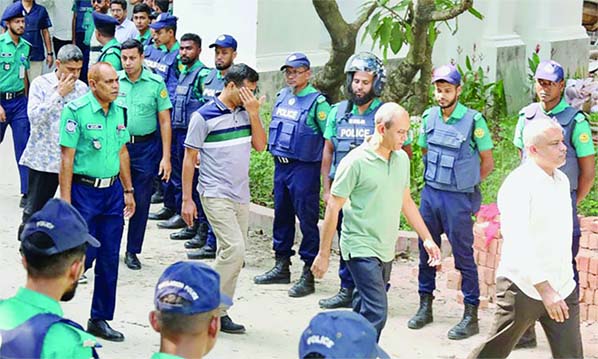
The International Crimes Tribunal-1 has ordered 15 army officers, accused in three cases of enforced disappearance and killings during the rule of the former Awami League government, to be sent to prison.
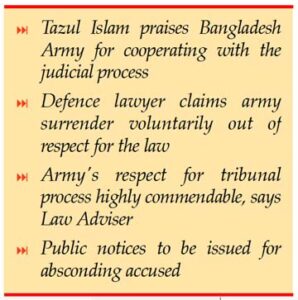
The tribunal also directed that public notices be issued in newspapers within seven days for absconding accused, including former Prime Minister Sheikh Hasina.
The order was delivered by a three-member bench headed by Justice Md Golam Mortuza Majumder, with Justice Md Shafiul Alam Mahmood and Judge Md Mohitul Haque Enam Chowdhury. Chief Prosecutor Mohammad Tazul Islam confirmed the decision following Wednesday’s hearing.
The officers sent to prison include several former senior RAB, DGFI, and BGB officials: Brigadier General Md Jahangir Alam, Brigadier General Tofayel Mostafa Sarwar, Brigadier General Md Kamrul Hasan, Brigadier General Md Mahbub Alam, Lt Colonel Md Mashiur Rahman Jewel, Lt Colonel Saiful Islam Suman, Colonel Abdullah Al Momen, Colonel Anwar Latif Khan (on retirement leave), Colonel KM Azad, Colonel Md Sarwar Bin Kashem, Brigadier General Md Mahbubur Rahman Siddique, Brigadier General Ahmed Tanvir Majahar Siddique, Major General Sheikh Md Sarwar Hossain, Lt Colonel Mohammad Redwanul Islam, and Major Rafat Bin Alam Mun.
The officers were presented before the tribunal shortly after 7 am. One of them is currently on retirement leave.
According to the Chief Prosecutor, the accused face charges in three separate cases – two relating to enforced disappearances and one linked to the July 2024 Rampura shootings that killed several demonstrators.
Tazul Islam said formal charges were submitted on 8 October and arrest warrants were issued thereafter. Law enforcement produced the 15 accused before the tribunal on Wednesday.
Ten of them were charged in a case concerning abductions at the TFI Cell, where 14 people were allegedly held and later disappeared. The court ordered their formal arrest and transfer to prison, setting 20 November as the next date for hearing.
A second case, known as the JIC case, involves allegations that 24 individuals were detained unlawfully. Thirteen officers were charged, and three appeared in court while the others remain fugitives.
The tribunal ordered the arrested officers to prison and scheduled the next hearing for 20 November, instructing that absconding suspects be notified through newspaper publication.
The third case concerns the Rampura incident on 18-19 July 2024, when Border Guard Bangladesh (BGB) personnel allegedly opened fire on protesters, killing 28 people.
The court ordered those accused in this case to be sent to prison and fixed 5 November for the next hearing, while directing that public notices be issued for two absconding officers.
Chief Prosecutor Tazul Islam praised the Bangladesh Army for cooperating with the judicial process and dismissed what he called “propaganda against patriotic officers”.
Regarding bail applications, he said defence lawyers were granted permission to sign power of attorney papers and may submit formal petitions later through the registrar’s office.
The prosecution previously submitted three formal charges to the tribunal – two concerning enforced disappearances and one concerning the Rampura shootings. Among the accused named in these cases are Sheikh Hasina, Tarique Siddique, and several senior officials of RAB, DGFI, and BGB.
On 11 October, Adjutant General Major General Md Hakimuzzaman of the Bangladesh Army told a press briefing at Dhaka Cantonment that 15 serving officers were in military custody following the issuance of the tribunal’s warrants.
He said the army had not yet received copies of the warrants or charge sheets but took the step voluntarily in respect of national law.
Hakimuzzaman noted that of about 25 officers named in the charges, nine were retired, one was on leave preparatory to retirement, and 15 were serving. He confirmed that the army had instructed them to report to cantonment custody by 9 October.
Only one officer, Major General Kabir, failed to appear and has been missing since 9 October.
On 12 October, the Home Ministry temporarily declared a building inside Dhaka Cantonment as a “sub-jail” to detain the accused.
Defence lawyer Barrister M Sarwar Hossain, representing the officers, told the tribunal that they had not been arrested but had “voluntarily surrendered” out of respect for the law.
He said the officers were law-abiding and confident they would receive justice. The defence submitted applications for bail, special communication privileges, and transfer to sub-jail custody. The tribunal heard the motions and will decide later.
Barrister Hossain claimed that the “real perpetrators”, including General Kabir, General Akbar, and Tarique Siddique, had fled the country.
He cited testimony from a former inspector general of police who allegedly said the incidents occurred under directives from the former Home Minister and Sheikh Hasina, not the officers now in custody.
Following the tribunal’s order, the 15 officers were taken from the Dhaka Cantonment sub-jail to formal prison custody.
Inspector General of Prisons Brigadier General Syed Md Motaher Hossain confirmed that the sub-jail remains under the supervision of the prison authorities, with security and daily provisions governed by prison regulations.
Family visits and outside food will be allowed only under existing prison rules and after inspection.
The tribunal’s next hearings in the three cases are scheduled for November 5 and 20.
Meanwhile, Law, Justice and Parliamentary Affairs Adviser Dr. Asif Nazrul has praised the manner in which army officers appeared before the International Crimes Tribunal (ICT), describing it as a remarkable demonstration of respect for the judicial process and the rule of law.
Speaking to reporters at the Secretariat on Wednesday, Dr. Nazrul said the conduct of both the army officers and the senior military leadership in facilitating their appearance before the tribunal reflects a positive institutional attitude toward accountability and justice.
“The way the army members came before the International Crimes Tribunal today – and the cooperation extended by senior military officials, including the army chief – is highly commendable,” he said. “Their respect for the rule of law and the judicial process is something we view very positively.”
Earlier in the day, 15 army officers were brought before the International Crimes Tribunal in Dhaka, where authorities also decided to keep them in a sub-jail following legal proceedings.
When asked about the government’s stance on keeping the officers in a separate facility, the law adviser clarified that the matter falls entirely under the jurisdiction of the Home Ministry.
“Decisions regarding why they have been placed in a sub-jail or where they will be kept are fully under the authority of the Home Ministry,” Dr. Nazrul said. “They will take whatever steps they deem appropriate. It is not within my jurisdiction to comment on that.”
His remarks come amid heightened public attention over the ICT’s proceedings and the military’s cooperation with the tribunal – a move many observers have interpreted as a significant show of institutional respect for Bangladesh’s ongoing commitment to justice and accountability.