
Voting ends peacefully in RUCSU, counting underway
Staff Reporter :
The voting for the Rajshahi University Central Students’ Union (RUCSU), 17 Hall Councils, and five Student Representatives to the Senate concluded on Thursday in a peaceful and festive atmosphere.
The long-awaited student elections, held after years of anticipation, witnessed a strong turnout across the campus.
Chief Election Commissioner Professor F. Nazrul Islam told reporters in the evening that around 69.83 percent of the total students cast their votes, with 63 percent turnout in female halls and 79 percent in male halls. “The election has been festive, fair, and transparent.
Observers have told us that they have never seen such a transparent election before,” he said.
Polling took place from 9 am to 4 pm across 990 booths under 17 centres in nine academic buildings.
The elections were conducted using the Optical Mark Recognition (OMR) method, a technology-driven system aimed at ensuring accuracy and transparency.
A total of 212 teachers served as presiding and assistant presiding officers, while 91 others acted as polling officers.
After the polls ended, counting of votes began at the Kazi Nazrul Islam Auditorium, where ballot papers were sorted and bundled by colour before being inserted into OMR machines for scanning.
The entire process was displayed live on a giant screen outside the auditorium for students and candidates to observe.
Election Commissioner Professor Mostofa Kamal Akanda said an expert team was supervising the OMR-based counting process.
“The ballots have been divided into 100 bundles, and each hall’s votes are being counted in three phases. We expect the entire counting and verification process to take 14 to 16 hours,” he explained.
“The process is fully open to all to reduce tension and ensure mental ease for candidates and students alike. We have adopted technology-based initiatives to guarantee transparency and flawlessness.”
Chief Election Commissioner Nazrul Islam said the university administration and law enforcement agencies had ensured an unprecedented level of security throughout the campus.
A three-tier security system was in place, involving 2,300 police personnel, 12 platoons of the Rapid Action Battalion (RAB), and six platoons of Border Guard Bangladesh (BGB). Both RAB and BGB also set up temporary camps on the university grounds.
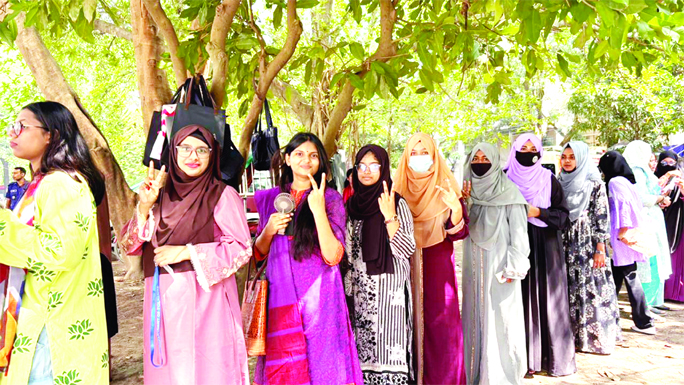
Since early morning, long queues of students were seen at polling centres, with voters casting their ballots amid music, banners, and a vibrant sense of participation. Many students expressed optimism about a new beginning in campus politics.
Rafiul Islam Zibon, a general secretary candidate from the Oikya Buddha Projonmo panel, told reporters he was satisfied with the peaceful conduct of the election and confident about his chances.
A total of 28,905 students were eligible to vote in the elections, including 17,600 from 11 male residential halls and 11,305 from six female halls.
Altogether, 903 candidates contested across different levels — 248 for RUCSU, 597 for Hall Councils, and 58 for Senate seats.
In the central RUCSU election, 18 candidates vied for the vice-president post, 13 for general secretary, and 16 for assistant general secretary.
For the Hall Councils, 61 candidates competed for VP, 58 for GS, and 57 for AGS positions. In the six female halls, 16 candidates each ran for VP and GS, while 15 contested for AGS. A total of 11 student panels participated in the elections.
As the night progressed, the OMR machines continued to process results under the supervision of election officials and observers, with final outcomes expected to be declared on Friday morning.
The 2025 RUCSU election marks a major milestone for Rajshahi University, reviving a long-dormant democratic tradition on the campus and drawing enthusiastic participation from thousands of students after decades.