
US tariff threat prompts ADB to cut Bangladesh growth forecast
Muhammad Ayub Ali :
Once hailed as a rising economic star in South Asia, Bangladesh now faces renewed turbulence, with steep US tariffs threatening to undermine its export-driven growth model.
The newly imposed duties, primarily targeting the ready-made garments (RMG) sector, pose a significant risk to one of the country’s key economic pillars.
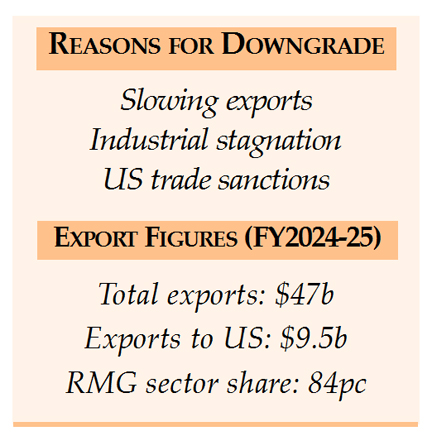
In its Asian Development Outlook (ADO) July 2025 update, the Asian Development Bank (ADB) issued a warning over Bangladesh’s slowing growth momentum. The deceleration is attributed to declining exports, stagnation in industrial output, and uncertainties surrounding US trade sanctions.
The ADB has revised down its GDP growth projection for FY2025-26 from its earlier April estimate of 5.1 per cent. While the updated figure has not been disclosed, the downgrade reflects growing pressure on the external sector, particularly in the wake of shifting US trade policies.
A major blow came in April 2025 when the United States – Bangladesh’s largest single-country export market – announced a 37 per cent countervailing duty on Bangladeshi exports, with the RMG sector bearing the brunt. Although later revised to 35 per cent, the tariff is scheduled to take effect from 1 August 2025.
Economist Professor Moinul Islam told The New Nation that the tariffs will undoubtedly have an adverse impact on GDP, given their direct effect on the country’s main export industry.
“I do not believe Bangladesh will achieve a favourable outcome through negotiations on this issue,” he said. “We must now prepare for the economic consequences of these duties by developing strategies to minimise the impact and enhance our resilience against such external pressures.”
Industry experts warn that the US-bound garment exports could decline by 15-20 per cent, endangering an industry that employs over 4 million people and contributes approximately 84 per cent of Bangladesh’s total export earnings.
According to the Export Promotion Bureau (EPB), Bangladesh exported $47 billion worth of goods in FY2024-25, with the US market accounting for $9.5 billion.
A sharp fall in this revenue stream could further deplete foreign exchange reserves and widen the trade deficit, already strained by high import costs and global economic instability.
In addition to external headwinds, domestic challenges such as rising production costs, energy supply disruptions, and weakening global demand have dampened industrial activity.
The ADB remains cautious on the near-term prospects for investment and employment. However, amid the challenges, there are signs of improvement on the inflation front.
According to the Bangladesh Bureau of Statistics (BBS), headline inflation fell to 8.48 per cent in June 2025-the lowest level since July 2022. This marks a considerable improvement from the 14.10 per cent peak in food inflation recorded in July 2024.
After remaining above 10 per cent for seven consecutive months, inflation has now dipped below that threshold. The ADB has maintained its average inflation forecast at 8.0 per cent for FY2025-26, supported by monetary tightening and the stabilisation of global commodity prices.
Despite this modest relief, the overall economic outlook remains fragile. The ADB underscores the urgency of export diversification, structural reforms, and robust trade diplomacy -especially with major partners like the United States – to shield the economy from future external shocks.