
US seeks ‘Framework Agreement’ with BD
Special Correspondent :
During recent tariff negotiations in Washington, the United States proposed the establishment of a broader “framework agreement” with Bangladesh that would address its evolving security concerns, officials and experts have revealed.
Sharing the development with the media on Sunday, Energy Adviser Fouzul Kabir Khan said Commerce Adviser Sheikh Bashir Uddin, who led the Bangladesh delegation during the tariff talks in Washington DC last week, will elaborate on the issue when he returns home.
Analysts point to the deepening bilateral dynamics, where Washington seeks Dhaka’s strategic alignment-particularly in the Indo?Pacific region-to counter increasing Chinese influence through infrastructure investment and local acquisitions.
A senior trade official noted that U.S. negotiators have highlighted the importance of Bangladesh increasing local value addition-from a 40% threshold-to reduce dependency on Chinese inputs, underscoring the national security implications tied to trade.
M. Humayun Kabir, former ambassador to the U.S. and president of the Bangladesh Enterprise Institute, described the framework proposal as extending far beyond trade.
“They want us to align with their Indo?Pacific Strategy,” he said. He urged Dhaka to
establish clear national priorities, noting that seeking full decoupling from China is unrealistic given Bangladesh’s current trade and industrial landscape.
Security expert Major General (retd) ANM Muniruzzaman emphasized that U.S. strategic concerns are squarely China-focused.
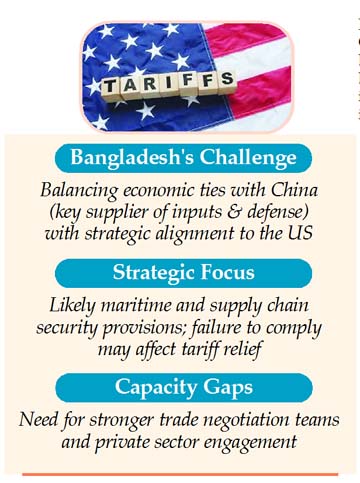
He anticipates specific provisions in the framework may address maritime security, but warned that rejecting U.S. security demands could jeopardize tariff relief.
He also criticized Bangladesh’s negotiating preparedness, citing the absence of private-sector expertise and inadequate delegation composition as key shortcomings.
Muniruzzaman further cautioned: “That would be very difficult-almost impossible [to avoid China].” He noted that China remains Bangladesh’s largest source of trade and defense equipment.
The emerging framework proposal signals Washington’s intent to deepen strategic ties beyond commerce, emphasizing a geopolitical reorientation amid Sino-U.S. rivalry.
As Bangladesh navigates these pressures, national leaders must weigh short-term economic gains against long-term sovereignty and alliance positioning.