From Protest to Martyrdom: Unfinished journey of Osman Hadi

Abu Jakir :
A nation does not often pause in unison. But on Saturday afternoon, Bangladesh did.
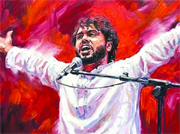
As the body of Sharif Osman Bin Hadi was lowered into the ground beside the grave of National Poet Kazi Nazrul Islam, grief moved like a quiet tide-heavy, collective and unresolved. Thousands stood shoulder to shoulder at his janaza. Millions more mourned elsewhere, bound by the same ache. Hadi was 32.
He was laid to rest at 3:50pm, following a funeral prayer held earlier at the South Plaza of the Jatiya Sangsad Bhaban. The janaza was led by his elder brother, Abu Bakar Siddique. From early morning, students, activists and ordinary citizens streamed into the area through security archways, many clutching nothing but slogans, tears and silence.
To call Hadi a political activist would be insufficient. To call him a leader would still fall short. For his followers-and for many who never met him-Hadi was a moral disturbance in a society long trained to normalise injustice.
When injustice becomes ordinary, someone inevitably arrives to make it uncomfortable. That discomfort was Sharif Osman Hadi.
He was not the symbol of any political party. He did not rise through patronage or dynastic privilege. Instead, he stood as a reminder that resistance could still be ethical, that protest could still emerge from conscience rather than calculation. Hadi was not merely a name; he was a position-against fascism, against authoritarianism, against submission.
His rise was not sudden. In interviews and public statements over the years, Hadi consistently framed politics as a moral question, not simply a struggle for power.
“The biggest crisis of the state is not economic,” he once said.
“It is moral. Without moral repair, no development can last.”
This insistence on ethics-rare in a political culture shaped by expediency-made him resonate deeply, particularly with the young.
Hadi never contested an election. He refused to wear a party badge. Pressed repeatedly on why he did not formally align himself, he answered plainly in early 2025:
“If I choose a party, I insult the people. The people will decide who is honest and who is not.”
His personal life reflected the same principles. He rejected luxury, privilege and spectacle. To him, sacrifice was not a slogan but a discipline.
“You cannot become a revolutionary by eating leftovers,” he said.
“Courage comes from a life without greed.”
That refusal to accumulate-wealth, fear or compromise-made him dangerous to those who thrive on silence. A man with nothing to lose cannot be easily intimidated.
Hadi also spoke openly about death. Not with despair, but with preparation. His words carried what many would later describe as a philosophy of martyrdom-quiet, deliberate and unsettling.
On July 31, 2025, he uttered a line that now echoes like prophecy:
“I didn’t grow fat by eating haram money, so I won’t need a special coffin.
In a simple box, with halal blood and a smiling face, I will present myself before Allah.”
It was not theatrics. It was a summation of how he lived.
When Sharif Osman Hadi was shot in broad daylight on a busy street in Dhaka on Friday, December 12, the shock travelled faster than the ambulance that carried him. Hospital corridors, police briefings and breaking news alerts could not contain the meaning of the moment.
For millions of Bangladeshis, the attack felt personal.
The shooting came amid a country still unsettled by the July 2024 uprising, which ended 16 years of authoritarian rule under Sheikh Hasina. That movement-driven largely by students and politically unaffiliated youth-redefined protest in Bangladesh. It rejected traditional party binaries and demanded dignity, accountability and participation.
Hadi was a product of that moment.
A Dhaka University-educated activist shaped by student politics, he articulated the language of the uprising with rare clarity. His speeches, widely circulated on social media, spoke of insaf-justice with dignity-at a time when the public was exhausted by elite bargains and hollow promises.
He did not speak for the people as much as from among them.
The July uprising had already produced martyrs. It had also left behind unresolved trauma. Hadi’s insistence that those sacrifices must lead to accountability forged a bond that went beyond ordinary political loyalty. When he was attacked, that bond fractured into grief and rage.
“We are Hadi,” people chanted on the streets and online. It was not metaphorical. It was declarative.
Hadi himself had once explained why voices like his were silenced:
“Those who fear questions are the ones who fire bullets.
When they cannot answer with logic, the bullet arrives.”
Many believe his killing was not an isolated crime but the act of a mindset-one that sees dissent as treason and conscience as a threat. Justice, therefore, demands more than the trial of a single gunman. It demands accountability for the structures and ideas that make such violence possible.
Yet even in death, Hadi refuses to be confined to mourning.
His body has been buried, but his words circulate freely. His name is spoken not as nostalgia, but as instruction. In every question raised, every refusal to look away, he returns-not in form, but in principle.
Because Sharif Osman Bin Hadi taught something dangerously simple: Standing against injustice is the highest form of devotion.
And that lesson, like conscience itself, does not die.