
Ukraine-Russia War and the Zelensky Dilemma: What Next?
Prof. Dr. Zahurul Alam :
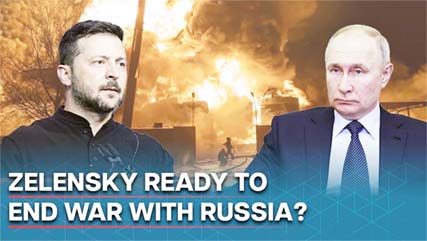
As 2025 unfolds, the war between Ukraine and Russia is unlikely to see dramatic reversals. But it may be defined by incremental shifts, tactical gambits, and diplomatic maneuvering. At the center of this uncertain horizon is Volodymyr Zelensky.
His holding political leadership, legitimacy of his presidency, public perceptions, economic comfort he may offer to the Ukrainians, and political calculus may help determine whether Ukraine consolidates resistance, opens pathways to negotiation, or fractures under pressure.
The battlefield at present offers few signs of an imminent breakthrough. Russian forces have claimed nearly 5,000 km of territory in 2025 alone. This is demonstrative of the fact that Moscow still retains operational initiative. But these gains have come amid fierce Ukrainian resistance and persistent disruption of Russian logistics.
On the other hand, Russia is not using its full military strength against Ukraine. There are inherent strategic, political, and logistical reasons for that restraint.
Firstly, Russia is not determined to initiate a total war escalation, rather they are trying to avoid such escalation, since that might trigger NATO intervention, especially if Russia uses weapons of mass destruction.Russia seeks to avoid a direct war with NATO while keeping the conflict regional.
Secondly, Putin takes into serious consideration domestic impact of such war, which may warrant for mass mobilization, which in turn may provoke unrest. Partial mobilization in 2022 already faced resistance.
In addition to that, a total war economy would damage Russia’s internal stability. The Kremlin plans to prolong the war to bring Ukrainian public sentiment against radical actions or initiatives of Zelensky.
Thirdly, Russia is judiciously preserving its resources keeping reserves ready for unforeseen threats, including on other borders. As we have witnessed so far Russia is rotating forces and relying on Wagner-like proxies or conscripts in many areas.
Putin appears to be playing the long game: grinding Ukraine down while betting on Western fatigue and political shifts. He also foresees that using overwhelming force could further isolate Russia diplomatically and undercut its narrative of a “liberation” mission.
Russia’s logistics, command, and supply chains have limits. Early failures in 2022 exposed deep structural weaknesses.So while Russia has a larger military on paper, using its full strength would carry risks outweighing the benefits: both militarily and politically.
Given above Moscow’s strategy has shifted toward targeting energy infrastructure, systematically seeking to plunge Ukrainian cities into cold and darkness as winter approaches. In response, Ukraine, with U.S.
intelligence support, is increasingly striking back at Russian energy assets: imports, refineries, pipelines, etc., aiming to degrade the economic base that underpins Russia’s war effort. However, Russia undoubtedly overwhelms Ukraine, while latter taken as an isolated entity in war, without massive external support.
In addition, there is a great risk of leadership change in Ukraine. A replacement is not yet evident. So, if Zelensky leaves or is forced from office, whether via domestic unrest, political defeat, or worse, the consequences could be severe: i) There will be loss of narrative consistency. A successor would struggle to command the same global resonance. ii) A threat of internal divisions will occur subsequently. Ukraine’s politics already show signs of strain. Public trust in institutions has declined sharply: the Verkhovna Rada is now trusted by only 13% of citizens (down from 35% in 2022); confidence in the president remains modest. iii)The diplomatic uncertainty will escalate. Peace talks or interim deals offered to a weaker leadership could be more extractive or coercive. iv) And there will certainly be Western hesitancy.
Allies may pause support if legitimacy is in flux, delaying weapon deliveries or financial aid.Even so, Zelensky’s presence does not guarantee victory. He is a linchpin, not a silver bullet.
The trajectory of the war in the next year will largely be shaped by external actors. Their actions (and inaction) may tilt outcomes more than battlefield heroics.
The U.S. remains the principal military backer. The more it provides advanced munitions, intelligence, and logistics, the better Ukraine’s odds of resisting Russian thrusts. For instance, Ukrainian drone and missile strikes on Russian energy facilities are increasingly aided by U.S. route planning and signal intelligence.
Yet every new step, especially supplying long-range systems such as Tomahawk-class missile crisis escalation. The Kremlin has warned that such deliveries could provoke a direct confrontation.
The U.S. is thus caught between urgency and restraint!Moreover, Washington now pressures European allies to define their obligations in postwar security. The U.S. has already sent questionnaires to NATO capitals, asking what they can commit in military hardware and troop contributions.
Europe must sustain both military aid and political unity. Yet fatigue, internal politics, and competing crises (migration, energy, inflation, etc.) threaten to erode momentum.
The EU’s Readiness 2030 plan,targeting roughly €800 billion in defense investment is designed to strengthen Europe’s strategic autonomy and reduce dependence on the U.S. If Europe can operationalize it, Berlin-Paris-Warsaw axis gains leverage in shaping any settlement.
Moreover, European support for converting frozen Russian sovereign assets into Ukraine funding, recently agreed by the UK, Germany, and France, signals commitment: Ukraine may receive new funds from immobilized Russian wealth.
On the other hand, Moscow retains a structural advantage in proximity, energy leverage, and industrial depth, but sanctions and attrition bite. Yet Russia increasingly relies on allies like Iran (for drones) and China (for trade lifelines) to stretch its capacity. Also, Kremlin strategy of pushing for ceasefires with terms favorable to Russia, or trying to incentivize Ukrainian fragmentation or leadership turnover may adversely affect Zelensky’s position, changing the whole war scenario.
Least probable unless a political shock (leadership crisis or financial collapse) forces Ukraine or Russia to accept a deal. If it comes, Zelensky may demand security guarantees, return of occupied lands, and international monitoring. Some indication of this is emerging: Moscow has recently agreed to allow Article-5style guarantees (NATO), though the implementation remains vague.
If Zelensky remains in power, he will likely try to steer toward the latter, making concessions only with enforceable guarantees and strong Western insurance. Without him, Ukraine may splinter, making peace more onerous or imbalanced.
In 2025, Russia-Ukraine relations will not snap back to stability, nor will one side secure an outright victory. Rather, the struggle will be fought in attritional battles, diplomatic proving grounds, symbolic gestures, and leadership endurance.
Zelensky is not the sole determinant, but he is a critical axis. He provides narrative cohesion, diplomatic legitimacy, and moral resonance. Yet he also faces constraints. Ukraine’s fate will hinge on whether he can harness that capital without being overwhelmed by it.
The world powers: USA, Europe, Russia, and rising centers like China will steer outcomes by how much they sustain or withdraw support, how credibly they propose security guarantees, and how they manage escalation. For Ukraine, the next year will test whether resilience can transform into settlement, or whether endurance alone will define survival.
(The author is Dean, School of Business, Canadian University of Bangladesh.)