
Trump’s Diplomacy: Why it worked in Gaza but failed in Ukraine
Yasir Silmy :
US President Donald Trump’s ability to negotiate deals while others fail has been a defining feature of his political career. However, this diplomatic perspective has a shortcoming that has been revealed by the realities of global conflict. Even if Trump was successful in negotiating a ceasefire and a hostage agreement in Gaza, his attempts to put an end to the conflict in Ukraine have repeatedly fallen short. This demonstrates that Trump’s ability to close deals is a transactional strategy that depends on broad goals and enormous leverage.
The strength of the bonds binding the enemies to Washington and the Oval Office’s determination to tighten them determine the difference between the two wars, one in which a partial peace was reached in Gaza and the other in which the carnage is still ongoing in Ukraine.
The Gaza Plan: Overwhelming Leverage and a Transactional Shift
The success in Gaza was fundamentally built on disproportionate US leverage over Israel, a factor entirely absent in the Ukrainian conflict. The United States is not merely Israel’s ally; it is its lifeblood.
Decades of commitment to Israel’s Qualitative Military Edge (QME) mean that Washington supplies the crucial weapons, intelligence, and diplomatic immunity, particularly the veto at the United Nations that underpins Israeli security. As international relations experts note, if the US truly loses patience, Israel is forced to pay attention. This dependence provides the ultimate bargaining chip.
Furthermore, the military situation on the ground provided a necessary prerequisite for negotiations. Israel’s sustained, devastating military action severely weakened Hamas, forcing the militant group to come to the table simply to survive and secure the release of its own prisoners. This imbalance of military power, where one side faced existential pressure, created a window for diplomacy that does not exist in the more balanced Ukrainian theater.
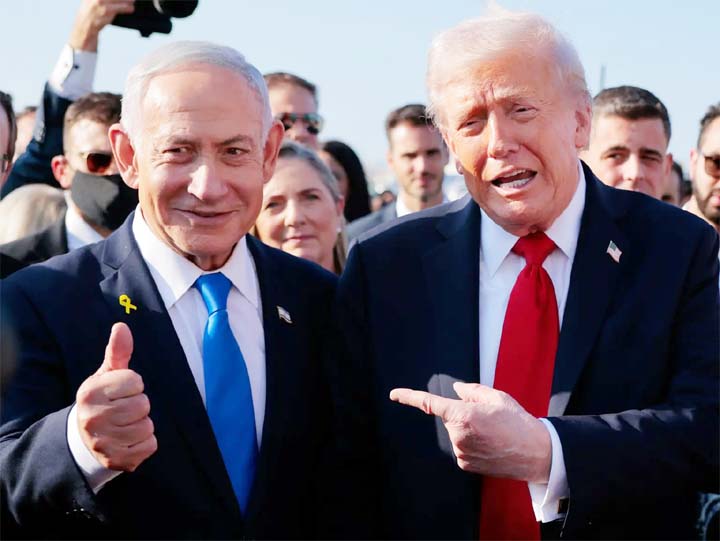
However, the most telling aspect of the Gaza success was the subjective shift in Trump’s political will. For much of the conflict, the President had been reluctant to pressure Prime Minister Netanyahu, maintaining the traditional U.S. stance of unconditional support. The pivot came only when an Israeli operation threatened to undermine American interests beyond the immediate conflict zone.
The strike on Hamas leadership in Qatar, a key US ally and host to critical American financial interests, was conducted without U.S. consultation, risking the complete collapse of relations with vital Gulf Arab partners. At this point, pressure ceased to be about brokering peace and became about stabilizing a regional alignment crucial to the President’s broader foreign and financial policy objectives. Trump went hard against Netanyahu not for the sake of humanitarian relief, but because Israel’s actions had directly threatened the foundational interests of the US and its key Mideast security architecture. This transactional deployment of leverage yielded the ceasefire.
The Ukrainian Deadlock: Weak Chains and Mixed Signals
The Ukraine conflict is a stark contrast to the Trump-led deal, as both objective and subjective conditions are missing. Trump’s lack of leverage over Moscow, Russia’s non-dependence on Washington for military supply chain, intelligence, and UN diplomatic protection, has made traditional pressure tools ineffective in stopping the Ukraine War.
Western sanctions have not been effective in pushing Moscow towards peace as Russia has shifted its trade to China and India, and trade between the US and Russia is limited. The war remains a stalemate, with neither side gaining a decisive military advantage, and Russia is not facing imminent collapse. Ukraine, despite receiving Western aid, lacks the overwhelming superiority needed for peace talks, making the incentive for genuine peace talks minimal.
On the other hand, inconsistent political will is the subjective failure in Ukraine. Even with limited leverage, analysts argue that the President had opportunities to raise the cost of the war significantly but repeatedly failed to act decisively. This demonstrated a lack of consistent political will that allowed Russia to weather the storm. Trump’s approach to the conflict has been a study in mixed signals:
Empty Threats: The President frequently threatened sanctions against Russia or imposed tariffs on countries buying Russian oil, but these threats were rarely implemented. Tariffs against India’s Russian oil purchases failed to decrease imports, and a congressional bill for 100% tariffs on Russian goods was scrapped, indicating weakness and reducing U.S. deterrence credibility.
Inconsistent Aid: US military aid to Ukraine was often halted or made conditional, with the administration attempting to shift the burden of supply onto NATO allies. This hesitation-driven by a stated desire to avoid escalation or a broader war served to limit the cost of the conflict to Russia rather than increasing it.
Experts suggest that while the US and Western allies have the ability to raise the costs to Moscow by supplying more advanced weapons, this was not done forcefully enough under either the previous or current administration to fundamentally change President Putin’s calculation. The failure in Ukraine is a failure of sustained, aggressive pressure.
So the comparison between Gaza and Ukraine proves that President Trump’s foreign policy is not guided by ideology but by transactional efficiency.
In Gaza, he found the ideal environment: an almost total dependency on the part of one combatant (Israel) and a strategic catalyst (the threat to Gulf stability) that made the deployment of US leverage financially and geopolitically worthwhile. The conditions were ripe, and the pressure was applied with surgical force.
In Ukraine, the conditions were hostile: the primary adversary (Russia) was largely self-sufficient, the war remained balanced, and the diplomatic tools available were insufficient to overcome the inertia of a deeply entrenched, large-scale conflict. Without overwhelming leverage, the dealmaker’s threats dissolved into rhetoric, and the war was left to sputter on.
Ultimately, the peace in Gaza was bought with the currency of absolute dependency, while the failure in Ukraine highlights the enduring limits of American power when facing a determined, independent adversary unwilling to capitulate. Success and failure are two sides of the same strategic coin, revealing a foreign policy designed to protect U.S. interests where they are strongest, while maintaining a stance of pragmatic indifference where the costs of success are too high.
(The writer is the Chairman-in-Charge, Department of Journalism and Media Studies, BGC Trust University Bangladesh. Email: [email protected])