
Trump refutes US role in Bangladesh regime change
Staff Reporter :
The Trump administration has denied any involvement in regime change in Bangladesh following the mass uprising led by students in July and August.
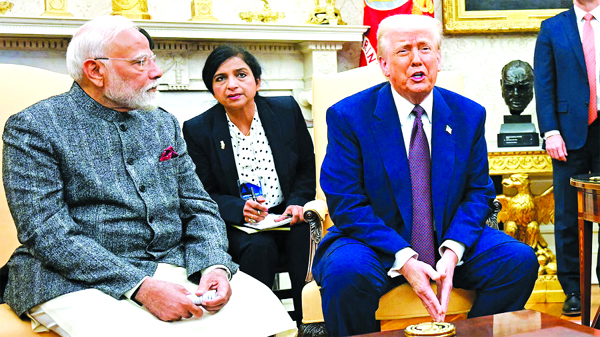
During a joint press conference with Indian Prime Minister Narendra Modi in Washington on 13 February, President Donald Trump dismissed claims of US interference.
Responding to a journalist’s question, Trump stated, “There was no role for our deep state. This is something that the Prime Minister (Modi) has been working on for a long time-hundreds of years, frankly. I’ve been reading about it.”
Trump further clarified that his administration does not wish to interfere in Bangladesh’s internal affairs, stating that the crisis between Bangladesh and India is a matter for the Modi government to address independently.
“But I will leave Bangladesh (issue to explain) to the Prime Minister (Modi) ,” he added.
The Trump-Modi meeting had attracted significant attention from South Asian countries, particularly given the political transition in Bangladesh.
The previous government, led by former Prime Minister Sheikh Hasina, was ousted following mass protests, and she has since taken refuge in India.
Speculation had been rife regarding how Trump would engage with Modi on issues concerning Bangladesh and India, particularly given the strong influence India exercised over Bangladesh during Hasina’s tenure.
However, Trump made it clear that his administration would not extend support in the same manner, emphasising that India must manage its own affairs regarding Bangladesh.
Commenting on the discussions between the two leaders, Indian Foreign Secretary Vikram Misri told reporters, “On the statement regarding Bangladesh… this was a subject of discussion between the two leaders.” He further noted that Modi had shared his views and concerns regarding recent developments in Bangladesh.
“We hope that the situation in Bangladesh will progress in a direction that allows for constructive and stable relations with them.
However, there are concerns, and the Prime Minister shared those concerns with President Trump,” Misri added.
Since the change in government in Bangladesh, relations between Dhaka and Delhi have deteriorated.
The interim government, led by Professor Muhammad Yunus, has requested India to extradite Sheikh Hasina to face multiple charges, including culpable homicide.
The Ministry of Foreign Affairs has submitted all necessary documents through diplomatic channels, though India has yet to respond. The Bangladeshi government has indicated that it will continue to await India’s reply.
Meanwhile, a recent United Nations report detailing mass killings allegedly carried out under Hasina’s administration has drawn further international scrutiny.
The fact-finding investigation was conducted independently by the UN, lending credibility and transparency to its findings.
The report outlines allegations of human rights violations, including the misuse of state institutions and security forces against civilians who opposed the government.
The revelations have placed additional pressure on India, given its previous close ties with Hasina’s administration.
As Bangladesh moves forward under new leadership, the response from regional and global actors will be crucial in shaping the country’s political and diplomatic trajectory.