
Success of any organisation needs synergy: Dr Islam
Reza Mahmud:
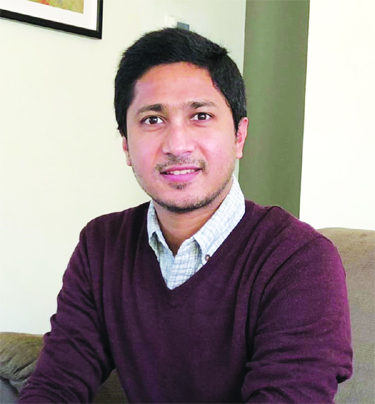
Md Rashedul Islam, PhD, a Bangladeshi origin university teacher in America had a recent talk with several Bangladeshi journalists. He is an Assistant Professor of Industrial and Organizational Psychology of Valdosta State University in Valdosta, Georgia, USA.
He is working on Organizational Psychology beyond his university.
The expert shared his views over organisational success.
Dr. Islam explains that, in the context of organizational dynamics, the concept of synergy functions differently in groups and teams. While synergy in a group can sometimes be neutral or even negative, in a team, it is invariably positive. He notes that accountability in a group tends to be primarily individual, whereas in a team, it encompasses both personal and mutual responsibility. Additionally, the skills within a group are often varied and randomly distributed, but in a team, the skills are complementary, designed to enhance collective performance. He elaborates on the term “synergy,” defining it as the mutual interaction or cooperation among individuals, organizations, or components, where the combined result surpasses the sum of individual contributions. For instance, if a team has three members, each with an individual impact of X, the total individual impact would be 3X. However, if their collaboration produces results greater than 3X, that phenomenon exemplifies synergy. Dr. Islam highlights several reasons why the concept of teams has gained widespread popularity. Teams can achieve goals that single individuals cannot, adapt quickly to changing circumstances, and be formed, re-centered, or dissolved rapidly. They also help democratize organizations, foster employee participation, and cultivate a collaborative mindset. Addressing the common criticism that a team’s performance suffers due to a single uncooperative member, Dr. Islam emphasizes that research indicates multiple factors influence team performance beyond individual personality. Key determinants include team coordination, cooperation, reasoning, collective effort, diversity, members’ cognitive abilities, collective intelligence, personality traits such as conscientiousness, agreeableness, extraversion, and emotional stability, knowledge of team members, workplace stress, social interaction, peer influence, and flow experience. Flow experience, he explains, is a state in which individuals become deeply immersed in a task, losing awareness of other thoughts and time while feeling profound satisfaction. When multiple team members experience flow simultaneously, it can spread throughout the team, significantly enhancing performance. Research suggests that flow experience alone can account for approximately 12% of team performance. Dr. Islam also elaborates on workforce diversity, noting that it extends far beyond nationality. Diversity can be age-based, with employees ranging from 20–65 years; type-of-work-based, with individuals working online, in-person, or in hybrid modes; and personality-based, encompassing traits such as agreeableness, conscientiousness, emotional stability, extraversion, and openness to experience. The existence of numerous forms of diversity makes forming highly effective teams a significant challenge. To maximize team performance, Dr. Islam asserts that the formation of the “best” team is essential. In assembling such teams, he emphasizes the importance of factors including cognitive abilities, collective intelligence, mutual interdependence, conscientiousness, agreeableness, the ability to cooperate, and social interaction. In conclusion, Dr. Islam underscores that understanding these dynamics and carefully considering these factors can substantially enhance the performance and effectiveness of teams in any organizational setting.”