
Stability & Reform A half-year of interim government
Abu Jakir :
The interim government, led by Nobel laureate Dr Muhammad Yunus, completes six months in office today (Saturday) following the fall of the Sheikh Hasina administration on 5 August.
During this period, the Yunus government has received overwhelming support both domestically and internationally. Major global powers, including the United States, the United Kingdom, China, and Russia, have extended full diplomatic backing to the administration.
The interim government has introduced several significant reforms aimed
at restructuring the state and laying the foundation for a ‘New Bangladesh.’
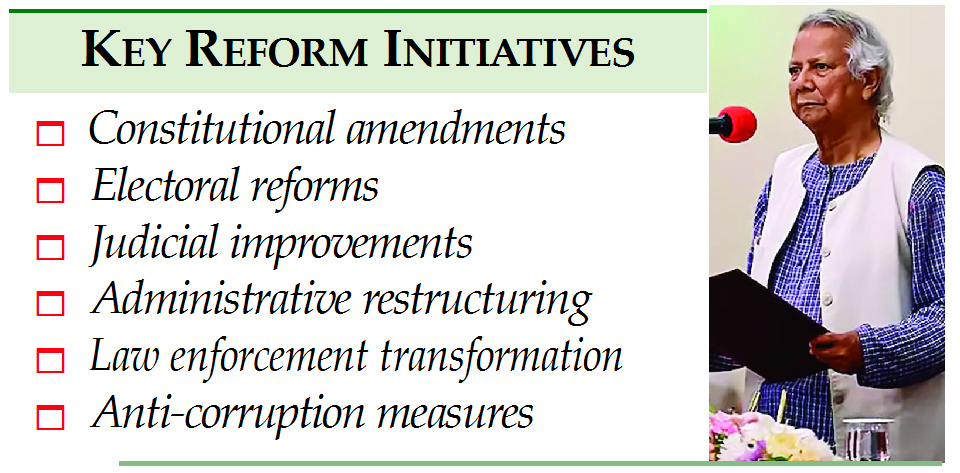
A notable achievement has been the formation of six reform commissions, focusing on constitutional am endments, electoral reforms, judicial improvements, administrative restructuring, law enforcement transformation and Anti-corruption measures.
While some commissions have already submitted preliminary reports, comprehensive recommendations are expected by 15 February.
The government plans to engage in dialogues with political parties to build consensus on the proposed reforms, with an agreement likely to be finalised by July.
Despite these efforts, public opinion on the reforms remains divided. Some analysts believe that the commissions’ recommendations align with popular expectations, while others express concerns about law enforcement and governance challenges.
Syeda Rizwana Hasan, Adviser on Environment, Forests, and Climate Change, stressed the need for political consensus to ensure successful reform implementation. She warned that failure to implement reforms could lead to public resentment and future instability.
“Society recognises the need for reforms. Political parties must acknowledge the sacrifices made during the mass uprising and commit to systemic changes,” she stated.
The collapse of the 15-year-long Awami League rule was triggered by mass student-led protests, culminating in Sheikh Hasina’s resignation on 5 August. Dr Yunus assumed office as the head of the interim government on 8 August and has since worked towards stabilising the governance structure.
Foreign Affairs Adviser Md Touhid Hossain noted that the government has successfully reassured international allies about Bangladesh’s trajectory.
“Initially, there was significant scepticism among our foreign partners regarding the transition. However, over the past six months, we have largely convinced them that Bangladesh is on the right track,” he remarked.
One of the government’s primary initiatives was the establishment of the six reform commissions, announced by Dr Yunus in his 11 September national address. These commissions commenced operations in early October and are expected to deliver their final recommendations by mid-February.
The National Consensus Commission, led by the Chief Adviser, will then initiate formal discussions with political parties.
Reforms in public administration have been a key focus, with proposals advocating for significant changes in bureaucratic structures. Former Secretary Abu Alam Shahid Khan observed that some recommendations, particularly regarding civil service promotions, may face resistance.
“If the civil service, police, and judiciary can function independently, many systemic problems will be resolved. However, we must first decide whether we genuinely want this independence,” he argued.
Security remains a major concern. Following the fall of the Awami League government, many police stations across the country were left vacant. The interim government has since worked to reactivate law enforcement, bringing about some improvements. Additionally, new uniforms for the police, Rapid Action Battalion (RAB), and Ansar forces have been introduced.
However, former Inspector General of Police Nurul Huda noted that while efforts have been made, major improvements in policing efficiency remain limited.
“A historic shift has taken place, and operational effectiveness has declined. The government is trying to restore capacity, but results remain limited,” he stated.
Despite progress in governance reforms, the interim government faces economic hurdles, including rising inflation, a fragile banking system and a widening budget deficit.
Progress in addressing these economic issues has been slow, and the government has faced criticism from social and print media regarding its handling of the economy.