
Solar power brings a ray of hope amid energy crisis
Reza Mahmud :
The demand for solar energy in Bangladesh is rising rapidly, driven by industrial growth, volatility in the fossil fuel market, and the growing need for environmental protection.
From households to factories, and even in agriculture across remote areas, renewable energy is gaining widespread acceptance.
Supportive government policies and the availability of modern technologies have given new momentum to this shift, making solar power a vital element in ensuring the country’s long-term energy security.
Experts highlight that solar power, as the most promising renewable energy source, is addressing the electricity shortage, strengthening energy independence, and promoting eco-friendly growth.
Once viewed as a lifeline for off-grid communities, solar power is now becoming an essential part of the national grid.
Energy experts expressed optimism over copping huge potentials of producing solar power. They stressed for taking adequate measures immediately to catch the potentials.
When contacted, eminent energy expert Badrul Imam told The New Nation on Monday, “The weather of Bangladesh is suitable to produce huge solar power, but there are lacks of sufficient initiatives from the authorities.”
The experts suggested to take immediate measures to cope the unabated natural opportunities to expand our energy producing capability.
Revolution in Industry and Agriculture: Industry leaders say that installing rooftop solar panels has become an effective way to guarantee uninterrupted electricity and lower production costs.
Many large factories in the textile and garment sectors now meet a substantial share of their energy needs through solar power.
This not only reduces energy bills but also helps maintain international environmental standards.
Net Metering Facility: To accelerate rooftop solar adoption in factories and homes, the government introduced a net metering system. Under this policy, users can sell surplus electricity to the national grid after meeting their own consumption needs.
This has quickly gained popularity, especially in the industrial sector.
A senior official at the Sustainable and Renewable Energy Development Authority (SREDA) explained that industrial and commercial establishments can now trade excess power with the grid, which has significantly boosted private investment in solar energy.
Bangladesh is already generating several hundred megawatts through this mechanism.
Rahimafrooz Distribution Limited (RDL), a pioneer in solar panels and batteries, has expanded into manufacturing IPS (Instant Power Supply) systems with both lead-acid and lithium batteries.
These units, which can be charged from both the grid and solar panels, are helping users cut electricity costs.
Industry Perspective: Nawaz Abdur Rahim, Head of Sales and Marketing at RDL, said, “In Bangladesh, solar power is emerging as a strategic solution for industries and agriculture alike.
Rooftop solar panels ensure reliable power while reducing operational expenses, giving businesses a competitive advantage. Generators are gradually being replaced by solar-based alternatives.
Rahimafrooz has already set up a 100 kW Battery Energy Storage System (BESS) at BUET to store solar energy, and we’ve also launched smaller BESS units for homes and small businesses that are receiving excellent feedback.”
He added, “Solar-powered irrigation pumps are helping farmers cut costs, boost yields, and adopt sustainable practices. With net metering and advanced technologies, solar energy is set to play a vital role in cost-effective and environment-friendly growth.”
Amjad Hossain, a farmer from Gaibandha, shared, “Earlier, I spent a huge amount on diesel every season for irrigation. Now, with my solar pump, my costs are almost zero. I can irrigate my fields during the day using sunlight.”
Government Targets and Major Projects: The government has set a target of producing 40% of the country’s electricity from renewable sources by 2041, with solar energy as the leading contributor. Several large-scale solar parks are already under construction through public and private partnerships.
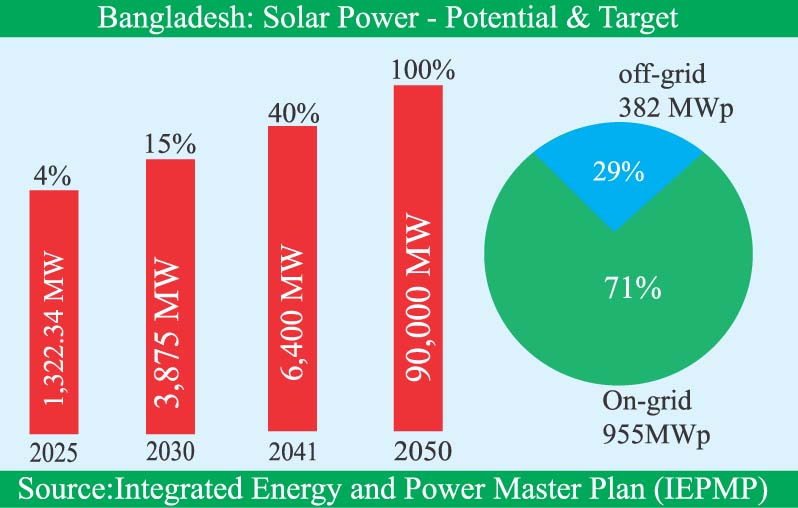
As per the Integrated Energy and Power Master Plan (IEPMP), Bangladesh currently (2025) produced about 4pc of its power from solar sector which is 1,322.34 MW.
It has target to produce 15pc of its power from solar by 2030 projected to 3,875 MW, and 40 pc by 2041to produce 6,400 MW. It has target to produce total of its power from solar and others renewable sources by 2050 which will be 90,000 MW.
Notable projects include: Teesta Solar Limited (200 MW), Gaibandha – the largest in Bangladesh. Mymensingh Solar Power (50 MW), Sirajganj Solar Park (68 MW) and Kaptai Floating Solar Plant (7.4 MW). Reduced dependence on fossil fuels: Solar energy cuts reliance on imported gas, oil, and coal, enhancing energy security.
Falling costs and rising efficiency: Global solar panel prices have dropped 80-90% over the past decade, while efficiency has improved, making solar installations more profitable.
Rural electrification: The Solar Home System has delivered power to over 6 million households, making it one of the world’s most successful solar programs.
Agricultural benefits: Solar irrigation pumps lower farming costs while reducing environmental pollution.
Environmental gains: Solar power supports Bangladesh’s climate goals by cutting carbon emissions and advancing clean energy adoption.
Challenges and future prospects: Nawaz Abdur Rahim further said, “One key challenge for solar adoption is ensuring strict implementation of mandatory installation rules.
At times, short-term cost-cutting undermines quality. Greater transparency and accountability are essential to build consumer trust, ensure safety, and maximize the benefits of solar energy.”
Overall, solar energy is not only a solution to Bangladesh’s electricity crisis but also a driving force for sustainable, eco-friendly, and economically sound growth in the future.