Seed Sovereignty: Farmers, Women, and the Struggle to Reclaim Bangladesh’s Seeds
By Syed Navid Anjum Hasan :
Seeds are the soul of agriculture. Inside each tiny grain lies the beginning of life, the promise of food, the dreams of farmers, and the strength of a nation. But the story of seeds has changed.
What once sat safely in clay pots inside farmers’ homes is now locked away under corporate control.
Companies like Monsanto, Bayer, Syngenta, and Cargill decide what grows in our fields, when it’s planted, and even how much a farmer must pay for it.
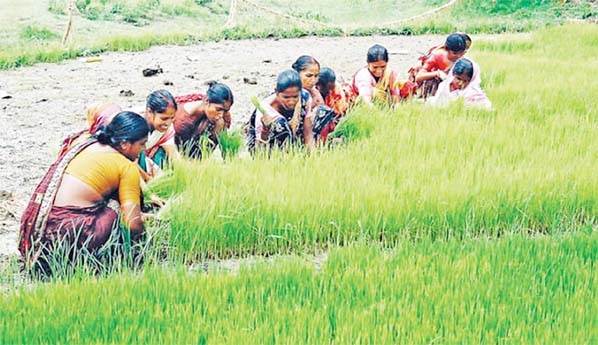
In rural Bangladesh, women were historically the custodians of seeds. They selected, dried, preserved, and exchanged them, passing knowledge across generations.
This feminine wisdom was the backbone of the country’s agricultural culture. But the “Green Revolution” nearly erased these traditions. High-yielding hybrid seeds replaced native varieties, and Bangladesh lost thousands of indigenous rice types.
Today, rice is identified not by name or cultural identity but by codes such as BRRI dhan-49 or BRRI dhan-63. Against this backdrop, several farmers are leading a quiet revolution to reclaim seed sovereignty.
In Sariakandi, Bogura, Ansar Ali, leader of a Research Initiatives Bangladesh, RIB’s Participatory Action Research (PAR) farmer group, has turned daily field experience into actionable research.
“Seeds are our soul,” he says. “When farmers lose control over seeds, they lose their freedom,” he added, “but we observe which seeds survive and which fail. That is the real expertise.”
Under his leadership, local farmers now conserve more than 15 indigenous seed varieties. Every session exchanged and training in organic farming to the local farmers.
Ansar Ali’s work demonstrates that grassroots leadership and participatory research can revive traditional knowledge while strengthening community resilience.
In Rajshahi’s Tanore upazila, a farmer named Yusuf Molla has devoted half a century to preserving lost rice varieties.
With support from the NGO BARCIK, he established the Barendra Seed Bank, safeguarding nearly 300 rice varieties collected from across Bangladesh. Many of these seeds are now used in government research institutions.
After his passing, younger brother Zahidul Islam continues to manage and expand the seed bank.
In the salinity-affected lands of Shyamnagar, Satkhira, peasant woman Alpona Rani Mistry has created a remarkable home-based seed bank.
She preserves 22 types of beans, 8 leafy greens, 10 varieties of chili, over 100 medicinal plants, 50–60 vegetable varieties, and 22 uncultivated plant species.
Her collection of more than 400 varieties provides nutrition and biodiversity to the entire village.
“Corporate seeds may yield crops,” she says, “but they kill the life of the soil.
My seeds keep both soil and people alive.” Her efforts inspire other local women to conserve and exchange seeds in their communities.
These stories highlight three different geographies: Rajshahi’s droughts, Satkhira’s salinity, and Bogura’s declining soil fertility but they share a single theme: the struggle for seed sovereignty.
Agroecology is not just a farming technique; it is a philosophy of social and cultural resistance.
However, corporate interests are still served by market mechanisms and governmental policies. Once the center of public seed production, the Bangladesh Agricultural Development Corporation (BADC) is now all but extinct.
Corporations set the prices for hybrid seeds, which farmers are forced to purchase and only last for one season.
Dependency on commercial seeds has replaced the Green Revolution’s promise. A new threat looms in the form of the gene revolution.
Genetically modified crops such as Bt brinjal, Golden Rice, and Bt cotton are marketed as “environmentally friendly,” but corporations are using them to claim ownership of the country’s genetic resources.
This shift means that control is no longer over seeds alone it is over genes themselves, erasing centuries of farmers’ knowledge and heritage.
The issue of seeds is not just agricultural, it is existential. Losing control over seeds means losing autonomy on one’s own land. Bangladesh may be food self-sufficient, but in terms of seeds, it is dependent trapped in a silent form of bondage. Yet there is hope.
Farmers like Ansar Ali, Yusuf Molla, and Alpona Rani Mistry show a path forward through seed preservation, community exchange, and women’s leadership.
With government support, local seed houses in every union could empower farmers and women to conserve and revive indigenous varieties.
Universities and research institutions working hand-in hand with farmers could spark a new revolution, the revolution of freedom. It is time to implement a “Seed Justice Policy”: where seeds remain in farmers’ hands and policies protect their rights.
Seeds are not just tools of cultivation, they are symbols of sovereignty. Reclaiming our seeds is reclaiming our soil, our culture, and our dignity.
The future of Bangladesh hinges on one fundamental question: Who owns our seeds? As long as the answer remains the farmer, the country’s soil, agriculture, and food freedom will endure.
(The writer is a Development Worker).