
Second United Nations World Social Summit concluded with a Commitment toward Social Protection
Staff Reporter
The Second United Nations World Social Summit (WSSD2) concluded in Doha, Qatar today, reaffirming a global commitment toward Universal Social Protection (USP), aimed at ensuring financial security for every individual throughout life.
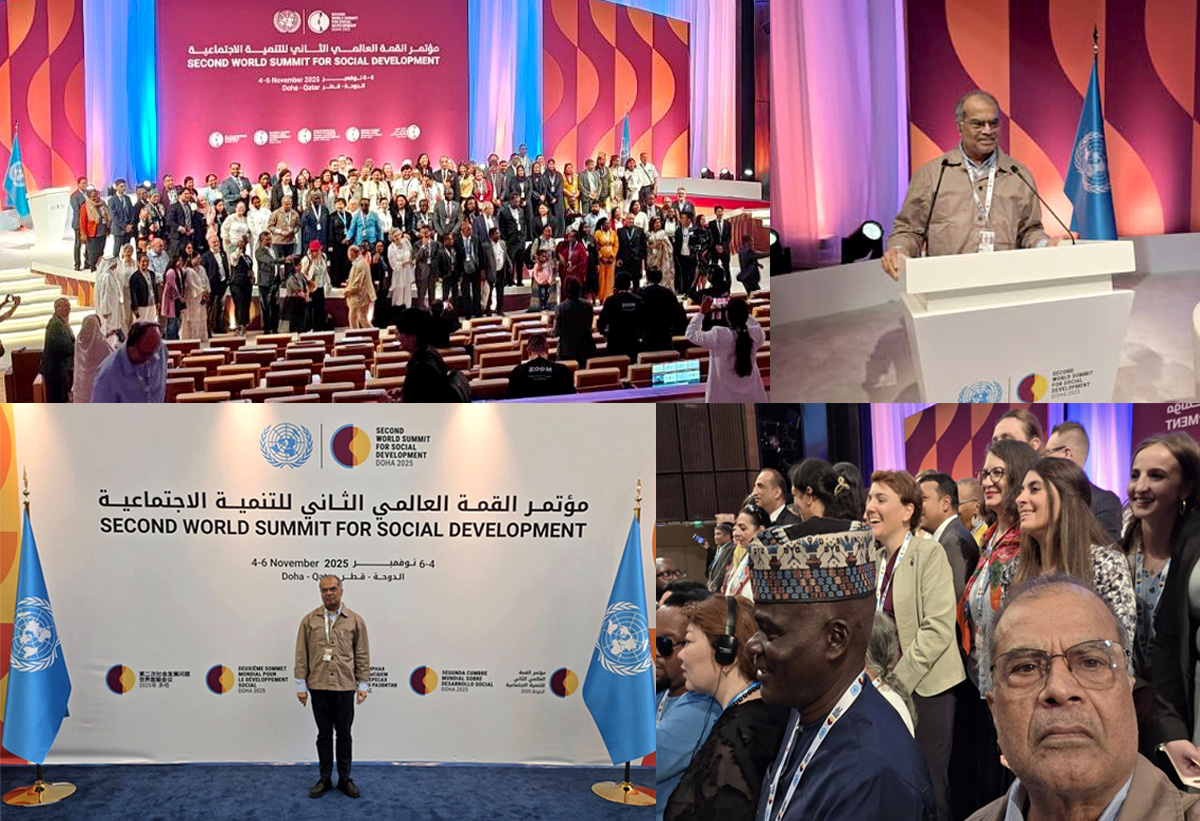
Rezaul Karim Chowdhury, Executive Director of COAST Foundation, participated in the summit’s civil society forum and various sessions, particularly those focused on social protection, often referred to in Bangladesh as safety nets or social security, said a press release.
He discussed the concept of USP, emphasizing the importance of studying and promoting it in Bangladesh, and expressed his intention to encourage colleagues to develop advocacy campaigns in positive engagement with political forces.
Currently, the Bangladeshi government allocates around 19 to 23 percent of its national budget to safety net programs.
According to an ESCAP publication, universal social protection provides unconditional income transfers to protect individuals during key life-cycle and labor market contingencies.
These include health services such as medical care and maternity support, childhood support for children, income support for working-age adults in cases of sickness, unemployment, maternity, disability, or workplace injury, and survivorship or old-age support for older persons.
Chowdhury highlighted several guiding principles of USP. He noted that the individual, rather than the household, should be recognized as the primary rights holder and beneficiary.
Eligibility criteria should be simple and objective, designed to verify the experience of a life-cycle or labor market contingency.
Income transfers should aim primarily to prevent poverty by addressing common risks, thereby reducing the need for reactive, last-resort support.
Furthermore, basic income transfers addressing life-cycle contingencies should be unconditional.
He also explained the spectrum of social protection coverage, ranging from poverty-targeted programs that provide benefits only to the poorest, to affluence-tested programs where all except the wealthiest receive support, and benefit-tested programs that provide assistance only to those not covered by social insurance but can complement universal systems when carefully combined with contributory benefits.
At the most inclusive level is the universal approach, in which everyone experiencing a life-cycle contingency receives benefits, regardless of income or wealth.
Concluding his participation, Chowdhury expressed hope that colleagues and civil society in Bangladesh would continue to study universal social protection and develop campaigns to advance it in cooperation with political actors.
The summit underscored a global consensus that inclusive and comprehensive social protection systems are essential for poverty reduction, social security, and sustainable development worldwide.