
Saudi skills rule stalls Bangladeshi migration flow
Gazi Anowar :
Saudi Arabia, the largest destination for Bangladeshi migrant workers, has recently introduced a mandatory skills certification requirement for most work visa categories, significantly complicating the migration process.
Effective from 19 June, the Saudi embassy in Dhaka has enforced the rule under the kingdom’s Skill Verification Programme, with domestic workers being the only exception.
Over the past five months, approximately 71 per cent of Bangladeshi overseas workers have migrated to Saudi Arabia, underscoring the kingdom’s central role in Bangladesh’s labour export strategy.
However, the sudden enforcement of this new regulation has disrupted the flow of migrant workers and increased migration costs for thousands.
Under the new policy, workers must register online and pay a $50 fee to sit for a two-part certification exam comprising theoretical and practical components.
Many candidates, despite repeated attempts, are struggling to pass the test, leading to delays, financial hardship, and growing uncertainty among aspiring migrants.
The Skill Verification Programme was introduced in February 2023 following a memorandum of understanding between Saudi Arabia’s Takamol agency and Bangladesh’s Bureau of Manpower, Employment and Training (BMET).
Initially covering only five occupations, the certification requirement has since expanded to 33 categories.
Although it was initially announced that the $50 testing fee would be subsidised by Takamol, workers are currently bearing the cost themselves.
Examinations are conducted at designated Technical Training Centres (TTCs), with theoretical tests held online and practical assessments evaluating technical proficiency. Certificates, once issued, remain valid for five years.
Engineer Md Golam Kabir, Principal of the Barisal TTC, clarified that local centres are only responsible for administering the tests. “We conduct the exams, but Takamol evaluates and issues the certifications. If a candidate fails, we have no control over the outcome,” he explained.
The policy shift has drawn concern from recruitment agencies and industry stakeholders, who warn of a potential loss of access to the Saudi labour market.
“Even general labourers such as cleaners must now pass a computer-based test – most are unfamiliar with digital systems,” said Ali Haider Chowdhury, former Secretary General of the Bangladesh Association of International Recruiting Agencies (BAIRA).
“Not a single visa has been issued in the past three weeks. Without urgent government action, we risk losing this vital labour market,” he added.
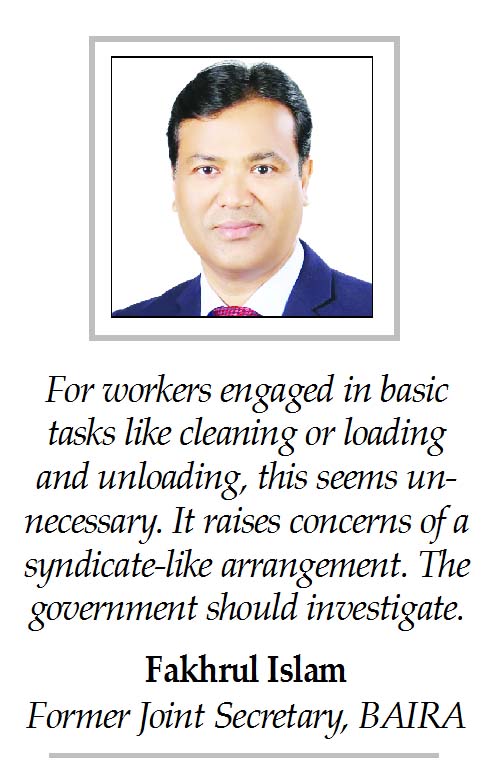
Fakhrul Islam, another former Joint Secretary of BAIRA, criticised the new requirement as excessive and questioned why certification is being administered solely through one company.
“For workers engaged in basic tasks like cleaning or loading and unloading, this seems unnecessary,” he said. “It raises concerns of a syndicate-like arrangement. The government should investigate.”
The $50 fee per test attempt – managed by a single authorised entity – has fuelled further criticism over monopolisation and the disproportionate financial burden on low-skilled workers.
However, a more balanced view was offered by Tipu Sultan, also a former Joint Secretary of BAIRA. “Saudi Arabia remains our largest and most critical labour market – we currently have no alternative.
While certification may be justified in some sectors and could lead to higher wages for workers, the government should engage in discussions to exempt roles where certification is less relevant,” he said.
Asked about the fairness of charging $50 through a single agency, Sultan declined to comment.
The new requirement, implemented by Takamol under the Skill Verification Programme, now covers 33 job categories and is mandatory for securing work visas. Candidates must pass both practical and theoretical assessments.
Critics argue that applying this standard across all roles – including low-skilled ones – may exclude many workers lacking digital literacy or formal training, thereby increasing migration costs and reducing Bangladesh’s competitiveness in the Gulf job market.
BMET officials, however, suggest that in the long term, skill certification could enhance wage prospects and reduce recruitment fraud. Certified workers are reportedly more likely to find employment and earn nearly double compared to uncertified counterparts.
Nonetheless, until the process becomes more affordable and accessible, thousands of potential migrants may continue to face significant obstacles in entering the Saudi workforce – jeopardising one of Bangladesh’s most critical sources of remittance income.
With over 60 per cent of Bangladesh’s migrant labour force heading to Saudi Arabia, experts warn that without immediate policy-level intervention, the country risks losing a key labour market and a major pillar of its foreign exchange earnings.