
Rooftop Gardens: A Youth-Led Initiative for Community Resilience
Dr. Md. Tarequzzaman :
A youth-led initiative to combat climate challenges and promote urban greening through a rooftop gardening project has had a significant positive impact.
The central challenge addressed is the severe lack of green space in urban slum areas, which contributes to extreme heat and environmental degradation.
The project, initiated by the non-profit organization breaking the silence (BTS) and supported by the Tdh Foundation, aimed to empower young people to become agents of positive change in their community by providing them with the knowledge and resources to create sustainable rooftop gardens.
Breaking the Silence, an organization dedicated to child rights, youth empowerment, and climate change, implemented the “Sports for Protection, Resilience, and Transformation” (SPiRiT) project.
This initiative engaged 1,000 children and youth in the Mirpur 12, Bouniabad, and Beguntilla slum areas.
Following sports sessions, the youth identified key community issues, including a lack of trees and suitable fields.
This led to the formation of the Youth Led Initiative (YLI), where young people developed plans to address these problems.
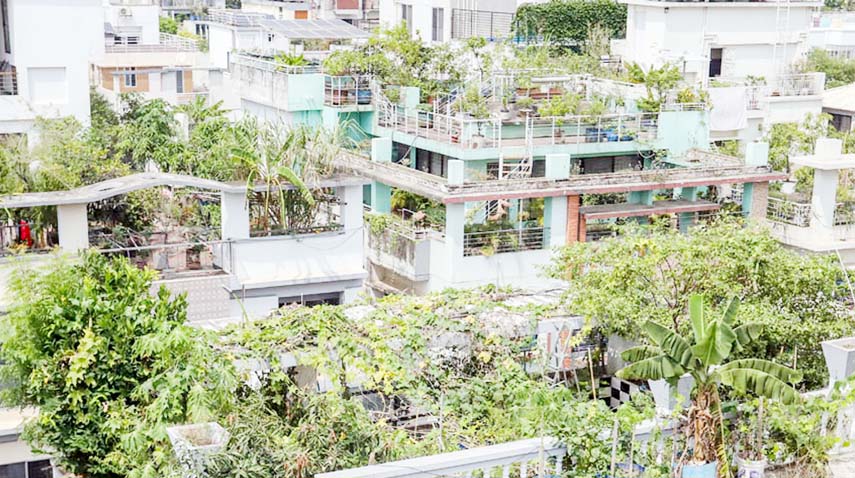
The rooftop garden project emerged as a direct response to the community’s environmental concerns and the lack of ground space for tree plantation.
The initiative began with a group of young people and the community members to discuss the idea of rooftop gardening.
They successfully convinced several building owners to participate, securing access to 20 rooftops for the pilot phase.
A key stakeholder in this early stage was Parveen Begum, an active community member who opened her rooftop for the project.
BTS played a crucial role by providing the initial training on tree plantation and nurturing techniques to participants like Parveen Begum.
This collaborative approach, involving youth leaders, community members, and a supporting organization, was essential for the project’s successful launch.
The rooftop gardening initiative has proven to be a highly effective model for community development. The primary issue of a lack of green space is being directly addressed, which helps mitigate the effects of urban heat and improves air quality.
The project’s strength lies in its bottom-up, youth-led approach, which ensures community buy-in and sustainability. By training community members like Parveen Begum, the initiative has created local champions who can independently manage their gardens and inspire others.
The focus on growing various vegetables, fruits, and medicinal plants also contributes to food security and health awareness within the community.
The project extends beyond environmental benefits to substitute a sense of empowerment and ownership among participants.
The case of Parveen Begum is a testament to this. Before the initiative, she lacked the knowledge to cultivate plants, but after receiving training from BTS, she now has a thriving garden with 16 types of plants.
Her experience of nurturing trees and harvesting vegetables provides her with a deep sense of self-satisfaction and mental peace.
This personal transformation highlights how the initiative is not just about planting trees, but about cultivating a deeper connection between individuals and their environment.
Parveen Begum’s story illustrates the potential for the project to create a ripple effect. Inspired by her success and new-found knowledge, she has begun to share her experience with her neighbors, encouraging them to start their own gardens.
This peer-to-peer education and encouragement is a powerful tool for scaling the project beyond the initial 20 rooftops. It demonstrates how a single, well-supported initiative can activate a network of community members, leading to a broader movement of environmental consciousness and action.
While successful, the initiative faces potential challenges, such as ensuring long-term sustainability, securing a continuous supply of resources (seeds, soil), and addressing issues like water management and the structural integrity of the rooftops.
To ensure the project’s longevity, it is recommended that the youth leaders develop a formal plan for resource procurement, perhaps by establishing a community fund or a small social enterprise selling excess produce.
They should also create a network for knowledge-sharing and problem-solving among all rooftop gardeners to address future issues.
The youth-led rooftop gardening initiative is a powerful example of a community-based solution to climate challenges.
By empowering young people and providing them with the necessary training and resources, Breaking the Silence, with support from the Tdh Foundation, has enabled significant positive change.
The project has not only successfully introduced green spaces into a dense urban environment but has also empowered individuals like Parveen Begum, fostering a sense of pride, self-sufficiency, and community spirit.
This case demonstrates that grassroots action, when guided by a clear vision and supported by external partners, can lead to sustainable and transformative outcomes.
(The author is Deputy Director, Breaking the Silence (BTS))