
Rohingya crisis hits as WFP aid cut in BD
Al Mamun Harun Ur Rashid :
The slashing of food assistance for the Rohingyas by the United Nations’ World Food Programme (WFP) would have severe consequences for both the refugees and the host country, experts said.
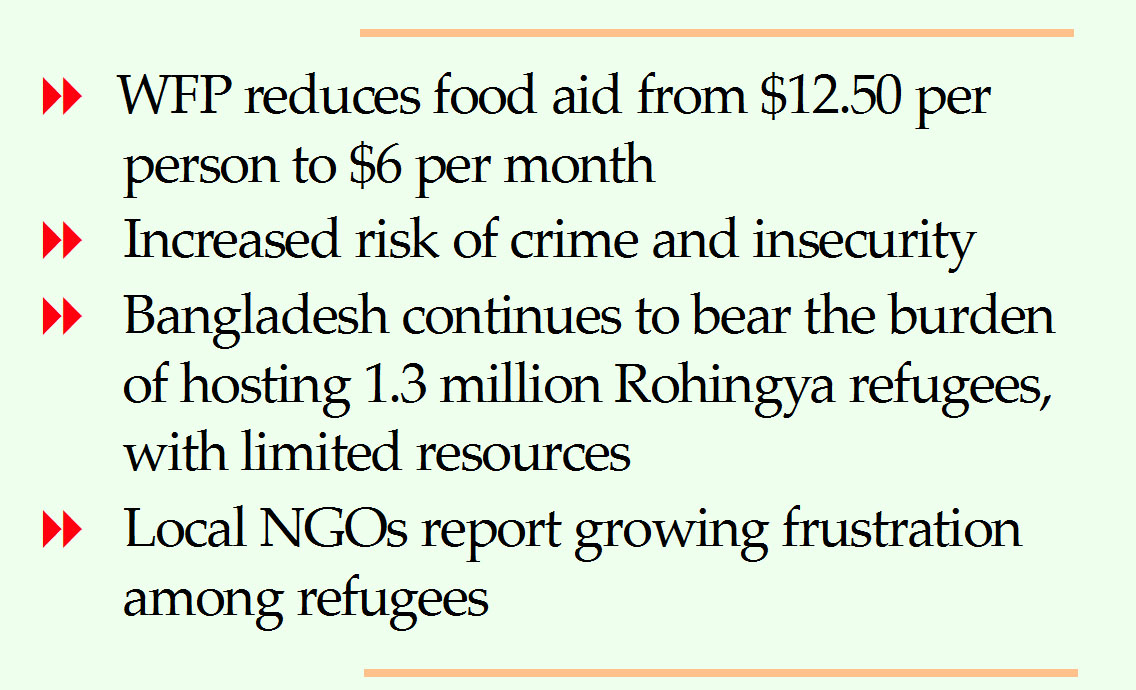
Describing this WFP’s decision as ‘alarming’, they said that the reduction in aid is expected to destabilize the already fragile situation in the Rohingya camps, potentially leading to increased criminal activities and insecurity of the local communities.
“This decision is deeply alarming.
The Rohingyas are entirely dependent on humanitarian aid, and reducing food assistance will only exacerbate their suffering and push them towards desperate measures,” Dr Delwar Hossain, Professor of Department of International Relations, Dhaka University, told the New Nation on Thursday.
He also said that the international communities are not evidently showing any visible steps to resolve the humanitarian crisis by forcing the Myanmar Junta government, rather the funds are reducing to a great extent.
“The recent cut of the WFA’s food aid to half is an injustice to the Rohingyas who are extremely vulnerable. It’s negligence to them. Such announcement would expose these people to an extreme miserable life,” he warns.
The UN’s primary food assistance body WFP has said that it would be cutting food aid for the Rohingya population.
Currently, each refugee receives $12.50 worth of food per month-already insufficient to meet proper nutritional needs.
However, the new plan would see this reduced to just $6 per person, a number so low that survival itself will become a struggle.
Dr Delwar Hossain said, “When the question of survival comes, the Rohingyas will implicate in illegal and criminal activities. It will also put pressure on the local communities for employment to earn to feed their already unprotected families.”
About the looming threats for Bangladesh, he said, “The Rohingya crisis has already created much pressure on Bangladesh. The government is trying to assist them with its limited resources. But it is difficult to continue alone.”
He said that UN has the moral obligation to stand by this huge community and they should not divert their attention.
Regarding the solution, he said that the UN is going to hold an international conference on Rohingya which is welcoming, but the resolution of the crisis through repatriation is the only solution.
Local NGOs working in the refugee camps have reported growing anxiety and frustration among the displaced population.
Many fear that without adequate food support, tensions within the camps could escalate, leading to security concerns for both the Rohingya and local Bangladeshi communities.
“Bangladesh has been shouldering this humanitarian burden for years, and further cuts in aid will only worsen the crisis,” Mustafa Kamal Akanda, Director of COAST Foundation told the New Nation.
“Due to the food aid cut, Rohingyas will now have meals for only 1.5 portions a day. Where will they get the remaining 1.5 portions? They will either seek work in the local community or resort to illegal activities,” he said.
Describing the situation on the ground, he added, “The local labours in Ukhia and Teknaf will die of hunger as they will not get work because the Rohingyas will do the same work at low pay.”
Talking on the security issue, he also warned that the law enforcers would not be able to control the Rohingyas, leading to security threat of the local people, including the tourists in Cox’s Bazar.
He said, “The Rohingya crisis is deepening. Instead of working toward a solution, the United Nations is slashing food aid, pushing 1.3 million stateless Rohingya refugees into an even more desperate situation.”
He urged the international community to step up and ensure the refugees are not abandoned and also suggested engaging the Rohingyas in small scale jobs.
Currently, Bangladesh hosts over 1.3 million Rohingya refugees, most of whom fled Myanmar in 2016-17 to escape military persecution. Despite the humanitarian efforts of Bangladesh, the strain is immense.
The overcrowded camps offer no employment opportunities, education is limited, and every cut in aid worsens the situation. The country has repeatedly urged the international community to take responsibility, but action remains slow.
Without a sustainable solution and meaningful international intervention, the Rohingya will continue to suffer, and the crisis will keep spilling over into Bangladesh and beyond, experts said.
They said the Rohingya crisis is not just a Bangladeshi problem-it is a global humanitarian catastrophe. And unless real actions are taken, the suffering of the stateless will only grow.