
Rising drug prices push families into financial crisis
Syed Shemul Parvez :
As people across the country struggle with rising commodity prices, the cost of medicines has also surged, pushing many into an increasingly dire situation.
Allegations have emerged that a powerful syndicate, including leading pharmaceutical companies, is behind this price hike.
In some cases, the cost of locally manufactured medicines is even higher than that of international alternatives.
The prices of more than fifty life-saving medicines have risen once again, with some seeing increases of up to 110% in the past few months.
It has been alleged that pharmaceutical manufacturers have not adhered to the regulations set by the Department of Drug Administration when implementing these price hikes.
According to experts, people already burdened with rising costs of daily necessities are now being forced to cut back on food expenses to afford essential medicines. The lower and middle classes, in particular, are bearing the brunt of these increases, often at the cost of their well-being.
While pharmaceutical companies claim that price adjustments were necessary due to rising fuel and currency exchange rates, experts argue that past governments have failed to regulate medicine prices effectively.
Currently, the government sets the prices for 117 essential medicines, but most other medications are priced by the manufacturers themselves.
In theory, companies must apply to the Department of Drug Administration for approval before implementing any price changes, providing justification based on factors such as raw material costs and international market rates.
However, officials from the department have stated that, much like in previous years, pharmaceutical companies have not followed these procedures. In many cases, new prices were imposed on the market before receiving approval.
Reports suggest that major pharmaceutical companies have pressured the government from the outset, leaving the regulatory body with little power to enforce fair pricing. This has resulted in unchecked price increases that have placed an additional financial strain on ordinary citizens.
For individuals like Din Islam, a daily wage worker from Khustia suffering from high blood pressure and diabetes, the cost of medication has become overwhelming. Previously, he spent Tk 4,000-5,000 per month on essential medicines, but now that cost has risen to Tk 6,000-7,000. Similarly, Nazrul, who is already struggling to afford basic food items, is uncertain how he will cope with the soaring medicine prices. Md. Shahinur, a resident of Lalbagh, has been taking medication after having a heart ring inserted two months ago. His monthly medicine expenses have increased from Tk 4,000, forcing him to reduce food expenses to afford his treatment.
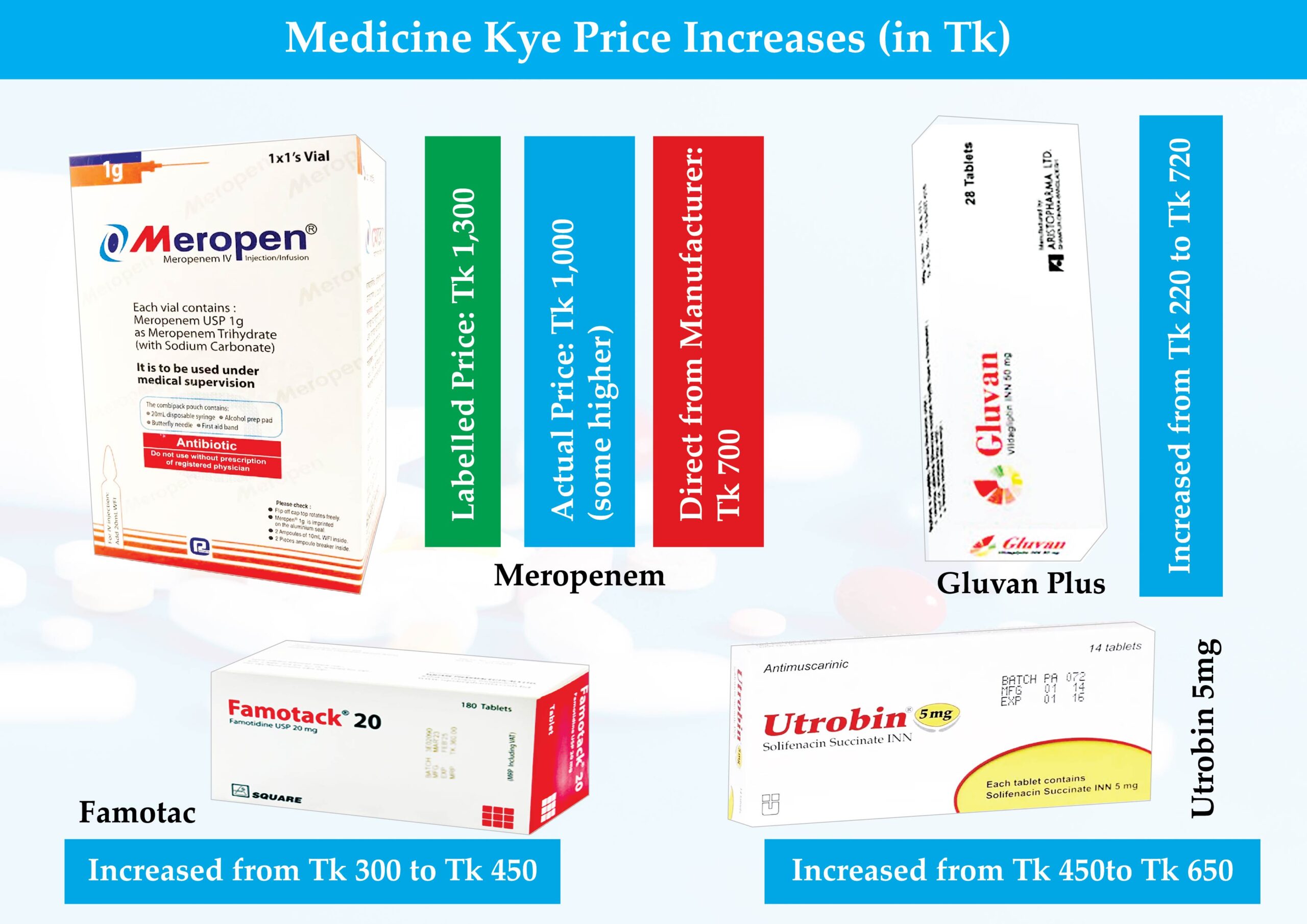
A visit to several pharmacies, including Laz Pharma in the capital, revealed alarming discrepancies in medicine prices. For example, Meropenem is being sold for Tk 1,000, despite a labelled price of Tk 1,300. However, some companies are reportedly selling the same medicine at even higher prices. Shockingly, purchasing directly from the manufacturer can bring the cost down to as low as Tk 700, exposing a major disparity in pricing.
According to pharmacy owners, the price of Amjard M Tablet (5/500 mg), used for type-2 diabetes, has increased from Tk 500 to Tk 540, while Dimicron M (30 mg) has risen from Tk 380 to Tk 420. Other significant price hikes include: Ampamet (5 mg + 500 tablet) – Increased from Tk 500 to Tk 600, Pluvan Plus (50 mg, Aristro Pharma) – Jumped from Tk 220 to Tk 720, Linaglip-M (500 mg) – Increased from Tk 360 to Tk 420, Comet (500 mg) – Increased from Tk 400 to Tk 500, Famotac (20 mg, for gastric issues) – Increased from Tk 300 to Tk 450, Motigat (10 mg) – Increased from Tk 350 to Tk 425, Anaflex Max 21 – Previously Tk 10, now Tk 50, Viodin mouthwash – Previously Tk 20, now Tk 50, Utrobin (5 mg, for urinary tract issues) – Increased from Tk 450 to Tk 600, Daflon (900+1000 mg, for piles patients) – Increased from Tk 690 to Tk 840, Anaflex (500 mg, for arthritis treatment) – Increased from Tk 9 to Tk 16, Natrilix SR (1.5 mg, for high blood pressure) – Increased from Tk 270 to Tk 330, Vastrel MR (for heart disease, Servier Pharma) – Increased from Tk 540 to Tk 720, OMG-3 capsules – Increased from Tk 270 to Tk 330 and Rosuva (5 mg, for heart disease prevention) – Increased from Tk 500 to Tk 600.
When questioned about the disparity in medicine prices across different pharmaceutical companies, Dr. Shah Mohammad Bulbul Islam explained that most companies prioritise profit. However, he pointed out that Ibne Sina, which operates under a trust, strives to keep prices within reach of lower- and middle-class families.
The continuous increase in medicine prices, allegedly driven by powerful syndicates and weak regulatory enforcement, has placed a significant burden on the population. Without stricter government intervention, affordable healthcare remains out of reach for many Bangladeshis.