Rights groups push for stronger support and political solutions for Rohingya crisis

Staff Reporter:
Civil society leaders and humanitarian experts from across the Asia-Pacific have called for urgent, sustained support for Rohingya refugees in Bangladesh and elsewhere until safe, dignified, and voluntary repatriation to Myanmar becomes possible.
They urged UN agencies, international NGOs, governments, and humanitarian actors to focus on political solutions—including repatriation—and to expand rights and services for Rohingya refugees. These include access to higher education, income-generating opportunities, travel passes, bank accounts, and the construction of prefabricated shelters in the camps.
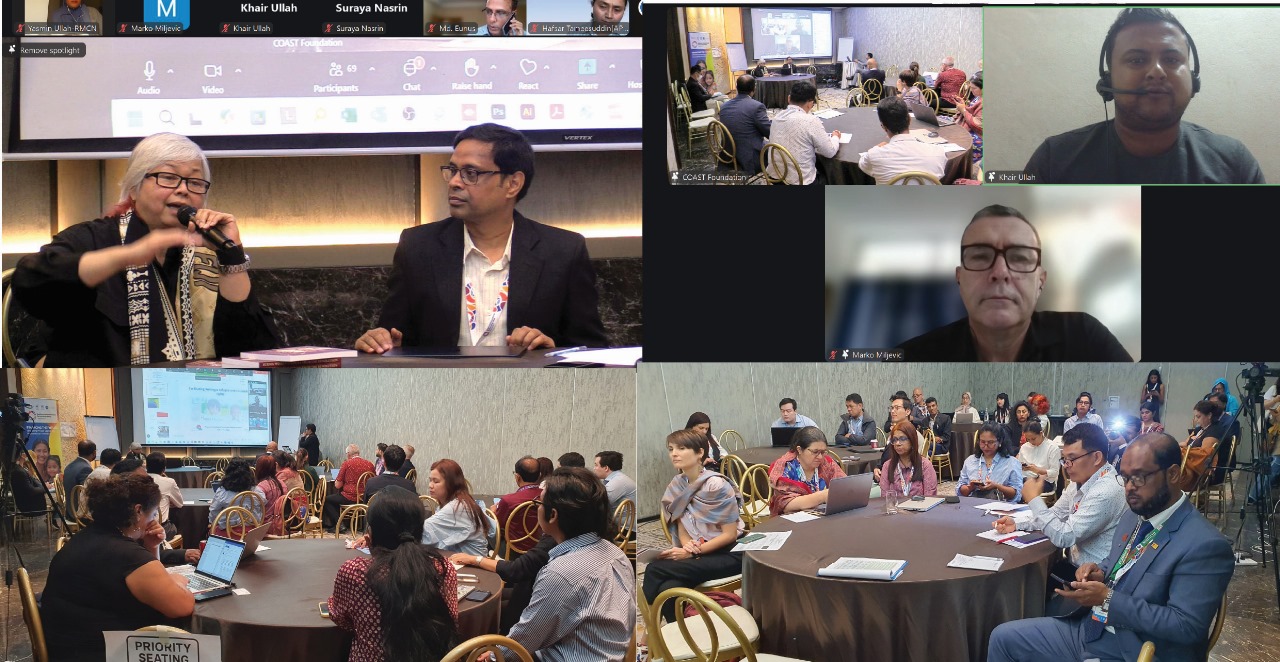
The appeal came during an international seminar hosted by COAST Foundation and the Cox’s Bazar CSO-NGO Forum (CCNF) at the Asia-Pacific Regional Humanitarian Partnership Week (RHPW) 2025 in Bangkok on Tuesday. The event is convened by ADRRN, CWSA, ICVA, and UN OCHA.
The seminar, titled Facilitating Rohingya Refugee and Citizenship Rights, brought together more than 100 participants in a hybrid format from across the region and beyond. Md Iqbal Uddin, Joint Director of COAST Foundation, delivered the keynote address and moderated the session.
Speakers included Debbie Stothard of ALTSEAN-Burma; Hafsar Tamizuddin of the Asia-Pacific Refugee Rights Network (APRRN); Marko Miljevic and Amir Hossain from the NGO Platform in Cox’s Bazar; Khair Ullah of the Resilient Refugee Alliance; Takashi Komino of the Asian Disaster Reduction and Response Network (ADRRN); Sanjiv Bhanja of Tearfund Asia; Helal Uddin of Agrajatra Bangladesh; and Yesmin Ullah of the Rohingya Maiyafuinor Collaborative Network in Canada.
In his keynote, Md. Iqbal Uddin said Myanmar’s decision to revoke Rohingya citizenship in 1982 was unlawful. Restoring citizenship, he said, requires clear political commitment and shared responsibility. He urged humanitarian actors to continue strengthening support for Rohingya refugees to ensure their basic needs are met.
Speakers across the panel stressed the urgency of coordinated regional and global political action to hold the Myanmar junta accountable and secure both repatriation and full citizenship rights for the Rohingya. Debbie Stothard underscored the need to treat Rohingya people with humanity and to address root causes to restore their rights.
Hafsar Tamizuddin thanked the Bangladesh government for bringing the issue back to global attention but warned that negative narratives are being deliberately spread about Rohingya refugees. She called for expanded access to education and essential services.
Marko Miljevic noted that the NGO Platform continues to work tirelessly to improve conditions for Rohingya refugees, adding that the crisis has become a global issue requiring strong political commitment.
Khair Ullah called for travel passes and freedom of movement within Bangladesh. Yesmin Ullah warned that failure to protect the Rohingya would represent a failure of the broader global humanitarian effort, adding that trade with Myanmar is increasing while sanctions remain insufficient.
Takashi Komino said it is “a shame” that many countries are avoiding their responsibilities by sidelining Rohingya rights and repatriation, calling this a breach of moral and political obligations. Sanjiv Bhanja said advocacy around Rohingya rights is declining and urged collective action to keep the issue alive until repatriation is achieved. Helal Uddin emphasised that the crisis is a global responsibility requiring shared solutions.