
Quick corporate entry into capital market imperative: Experts
Staff Reporter :
Experts have called on the government, private sector, and profitable foreign multinational companies to bring their shares into Bangladesh’s capital market swiftly to restore investor confidence.
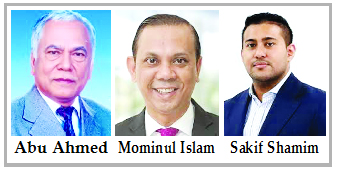
DSE Chairman Mominul Islam highlighted that corporate institutions are being encouraged to ensure their shares receive proper valuation and rapid approval to enter the market. ICB Chairman Abu Ahmed suggested that if companies fail to list, corporate taxes should be raised and privileges withdrawn. Business leader Sakif Shamim noted that shares of fundamentally strong companies are being undervalued.
A healthy capital market is vital for any economy, pooling small savings into large capital essential for industrialization, infrastructure development, and overall economic growth. In developing economies like Bangladesh, the capital market also supports employment generation, savings, investment opportunities, and government revenue.
Yet, Bangladesh’s market has never fully developed due to syndicates, conspiracies, and regulatory inefficiency, which have eroded investor confidence. Currently, there is a shortage of high-quality, profitable company shares, and reforms in regulations related to BSEC, IPOs, margin loans, and mutual funds are proceeding slowly.
Contacted, DSE Chairman Mominul Islam said the market has lagged behind others for over 15 years. Stakeholders are working on short- and long-term plans, expecting several government, private, and foreign companies to list within a year. Coordination among DSE, CSE, CDBL, DSEB, and BSEC is underway, with foreign collaboration, especially with the IMF, being pursued.
Islam outlined reforms including: increasing tax gaps between listed and unlisted companies, reducing brokerage source tax, lowering corporate tax for merchant banks, cutting BO account maintenance fees, and supporting affected investors via the Investor Protection Fund.
Weak companies will face stricter monitoring under a zero-tolerance policy for market manipulation.
Efforts are also underway to enhance technology and human resources, address structural issues like negative equity, and reduce institutional risk in margin financing. Islam expressed optimism that these measures will restore long-term investor confidence.
ICB Chairman Abu Ahmed emphasized the need for profitable government, private, and foreign institutions to enter the market. “Companies are opting for bank financing instead. If they do not come to the market, tax incentives should be withdrawn, and corporate taxes raised,” he said.
Ahmed noted that even profitable institutions like SSB Bank remain unlisted, while loss-making entities are present. He highlighted the need for adequate funds for ICB, which have been limited by previous mismanagement, and requested unrestricted funding through Bangladesh Bank via the Ministry of Finance.
When contacted Sakif Shamim, Vice President candidate of Bangladesh Federation of Chambers of Commerce and Industry (FBCCI) identified the lack of fundamentally strong companies as a core issue. Many existing shares are undervalued, and IPO processes are lengthy and costly. Post-listing, funds often go to debt repayment rather than business expansion, reducing EPS and disappointing investors. Excessive book-building premiums also create immediate losses for investors.
Shamim stressed the need for a coordinated, long-term strategy, including removing artificial floor price mechanisms, introducing T+1 settlement, implementing Securities Lending and Borrowing (SLB) to improve liquidity, and expanding market products with self-registration for bonds, ETFs, REITs, and Sukuk. Pension, insurance, and provident funds should have dedicated regulations to channel funds safely. To attract foreign investors, licensing must be streamlined, long-term policy support ensured, and tax incentives provided. Technology can help by providing free real-time information, reducing errors, and enabling quarterly enforcement dashboards for rapid prosecution of insider trading.
Shamim also highlighted that the capital market is a major source of government revenue from share transactions, dividends, and corporate taxes. Strengthening corporate governance requires compliance with regulations, regular financial disclosures, auditor rotation, and BSEC audit rankings. Equalizing taxation across deposits, bonds, funds, and shares, lowering stamp duties, simplifying investment processes, and mitigating risks for new investors are also critical for market stability.
In summary, experts urge a coordinated approach involving regulatory reform, corporate listing, technology adoption, and investor protection to develop a robust, transparent, and sustainable capital market that fuels Bangladesh’s economic growth.