
Pvt sector credit growth drops continue
Staff Reporter :
The opening of letters of credit (LCs) for imports in Bangladesh increased by 4.18 per cent to $34.89 billion during July-December of the current financial year 2024-25 (H1FY25), up from $33.49 billion in the same period of the previous fiscal year (FY24), according to the latest statistics from the central bank.
Similarly, actual imports, measured by LC settlements, rose by 2.65 per cent to $34.32 billion in H1FY25, compared with $33.44 billion in the corresponding period of FY24. This indicates a gradual recovery in business activity following the stagnation observed in July and August, although some uncertainties persist.
In the first quarter (July-September) of FY25, LC opening declined by 6.74 per cent, amounting to $15.59 billion, compared with $16.71 billion in the same period of the previous year. Correspondingly, LC settlements also fell to $16.21 billion,
down from $16.61 billion.
During July-August, the total LC opening stood at $10.03 billion, which was $1.48 billion lower than the $11.51 billion recorded in the previous fiscal year. However, in September, LC opening rebounded, rising to $6.7 billion, compared with $5.37 billion in September 2023.
Bangladesh Bank data further revealed that LC openings increased by 14.48 per cent in October and 5.27 per cent in November. The trend continued in December, when LC openings surged to $6.92 billion, marking a 30-month high due to increased imports ahead of Ramadan. This was a significant rise from $5.4 billion in December 2023.
Sector-wise Import Trends are Capital Machinery Imports. It has declined by over 27 per cent to $1.05 billion in H1FY25, compared with $1.46 billion in FY24. Industrial Raw Material Imports has been increased by 11.24 per cent to $11.82 billion, up from $10.63 billion in the same period of FY24.
Renowned economist Professor Muinul Islam noted that the Anti-Discrimination Student Movement in July and August had directly affected imports. However, from September onwards, LC openings showed an upward trend, and import payments reflected a return to economic normalcy.
He also pointed out that previous concerns over over-invoicing in LC transactions may have diminished in H1FY25 due to changing business conditions. He suggested that Bangladesh should aim for monthly imports of $5.5-$6 billion to ensure sustainable economic support.
LC openings began to decline in 2023 as the government and Bangladesh Bank (BB) introduced several measures from April 2022 to curb excessive imports and safeguard foreign exchange reserves. The BB provided dollars from its reserves to meet the high demand for government imports, putting significant pressure on the dollar market.
As per International Monetary Fund (IMF) guidelines, Bangladesh’s gross foreign exchange reserves stood at $19.8 billion on 23 October 2024, a sharp decline from $46 billion in December 2021. The BB had imposed high LC margins on non-essential and luxury imports, but these restrictions have recently been eased.
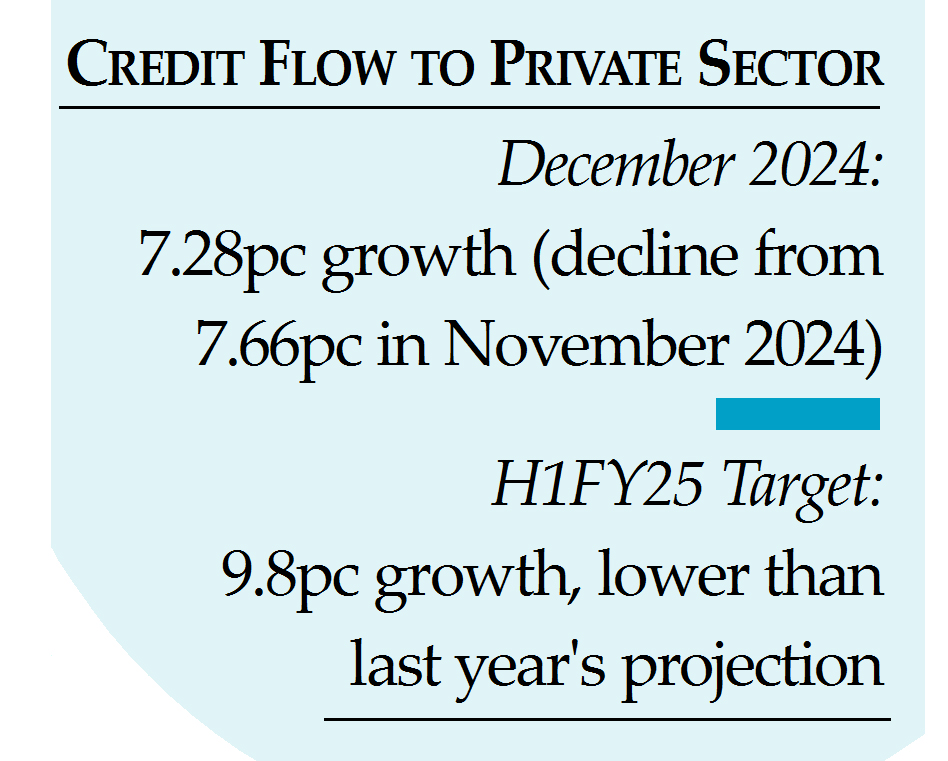
Meanwhile, credit flow to the private sector has continued to decline due to higher lending rates and business uncertainty. According to the central bank’s latest statistics (released on Thursday), private sector credit growth fell to 7.28 per cent in December 2024, down from 7.66 per cent in November.
This figure remains well below the central bank’s target. For H1FY25 (July-December 2024), Bangladesh Bank had set a lending growth target of 9.8 per cent, slightly lower than last year’s first-half projection.