
Putul’s WHO post in question over Canadian citizenship
Abu Jakir :
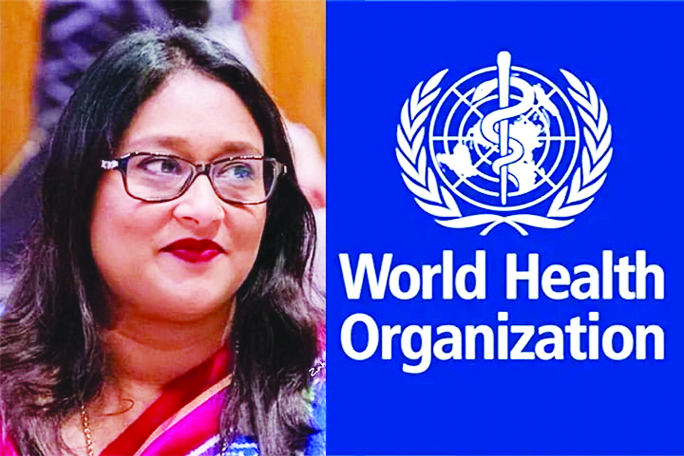
Following the high-profile resignation of Tulip Siddiq, niece of the former Prime Minister Sheikh Hasina, now Hasina’s daughter Saima Wazed Putul, the current Regional Director for South-East Asia at the World Health Organization (WHO), is facing allegations of corruption and nepotism.
Saima Wazed, known as Putul, was a Canadian citizen at the time of her nomination by Bangladesh for the position of WHO Regional Director for South-East Asia, according to the Anti-Corruption Commission (ACC).
Putul, who oversees WHO’s operations in the South-East Asia region, is alleged to have secured her position through unethical means. Critics claim that her appointment was influenced by her mother, Sheikh Hasina, during her tenure as Prime Minister of Bangladesh.
The Bangladesh Anti-Corruption Commission (ACC) has expressed concerns regarding potential abuse of political influence in the nomination process and has indicated plans to formally request WHO to reconsider Putul’s appointment.
ACC Director General Md. Akhter Hossain, addressing journalists on Sunday, confirmed ongoing efforts to bring Putul back to Bangladesh for further investigation. He stated, “The ACC’s investigation team is examining whether Saima Wazed Putul can be brought back to the country.”
He added, “Credible allegations of corruption against Saima Wazed Putul have emerged. Allowing such an individual to represent Bangladesh in a significant international role damages the nation’s reputation on the global stage.”
According to Rule 49 of the WHO Regional Committee for South-East Asia’s Rules of Procedure, candidates for the position of Regional Director must possess extensive technical and public health expertise, substantial global health experience, and a proven record of leadership. Critics argue that Putul, whose qualifications are primarily in clinical psychology, does not meet these criteria.
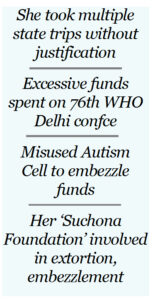
Putul’s experience in global health includes her work on autism and mental health, along with her role as chairperson of the Shuchona Foundation, an organisation focused on neurodevelopmental disorders.
However, her rival for the position, Dr. Shambhu Prasad Acharya from Nepal, possessed over 30 years of WHO experience and a doctorate in public health.
Mukesh Kapila, a Professor of Global Health and former WHO Director, has expressed support for the ACC’s investigation, stating, “The allegations surrounding Putul’s appointment warrant thorough scrutiny. The process must reflect merit, not political influence.”
Prior to the selection of the WHO Regional Director, the Bangladeshi press highlighted Saima Wazed Putul’s recognition by WHO in 2017 for her work on autism.
Her most prominent public health role was serving as the chairperson of the Shuchona Foundation, an organisation focused on mental health and neurodevelopmental disorders, a position she held from 2014 until her appointment to WHO.
Critics argue that the foundation benefited from Putul’s close ties to the Prime Minister, with Sheikh Hasina frequently soliciting donations from various banks.
A senior journalist for Himal Southasia noted in 2023, “Sheikh Hasina herself raised the funds for the foundation using her position, and then her daughter became chairperson.”
The journalist also pointed out that, despite Bangladesh having a wealth of qualified candidates for the WHO South-East Asia Regional Director role, they had little chance against Putul’s candidacy.
Many experts interviewed by Himal Southasia echoed the sentiment that Wazed was not the most qualified candidate from Bangladesh.
As the election for the position approached, Hasina’s government is believed to have actively lobbied for Putul’s candidacy at international forums.
Putul accompanied her mother on several high-profile international trips, including the ASEAN Summit in Jakarta, the UN General Assembly in New York, and the G20 Summit in New Delhi, all within a few weeks in September 2023.
In response to similar controversies, WHO’s Executive Board recently recommended expanding its code of conduct for Regional Director selections.
Proposed reforms include stricter conflict-of-interest disclosures, enhanced reference checks, and more rigorous evaluations of candidates’ credentials.
WHO spokesperson Tarik Jašarevi? stated that while national authorities have the right to investigate allegations, WHO would not comment on ongoing investigations or legal proceedings.
 Meanwhile, public health experts such as Rita Thapa have called for an overhaul of WHO’s nomination process to ensure fairness and transparency.