
Psychosomatic deaths, suicides on upswing
Syed Shemul Parvez :
Apart from the increasing number of suicides, the country is witnessing a disturbing rise in psychosomatic and other unnatural deaths, triggering grave concern among citizens and experts alike.
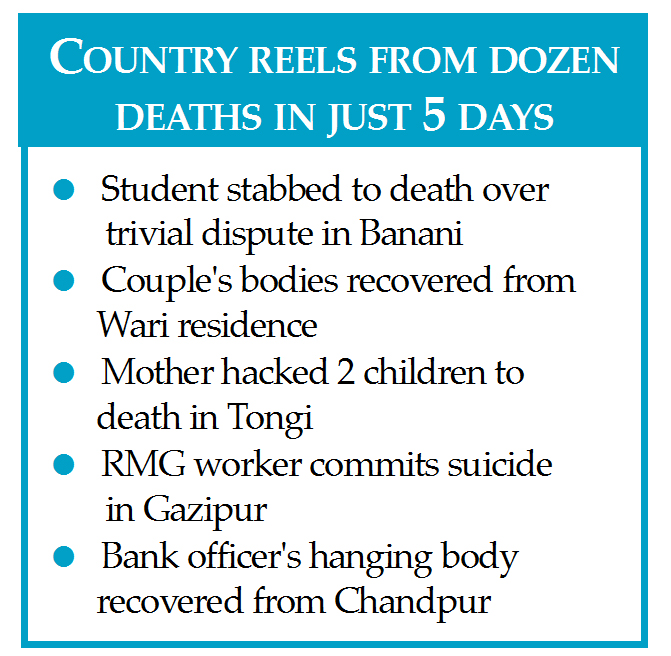
According to sources, at least a dozen suicides, unnatural deaths, and other unexpected fatal incidents were reported across the country in the past five days alone.
A recent report suggests that annually, between 10,000 to 14,000 people take their own lives in Bangladesh, making suicide the second leading cause of death after road accidents. Another study found that among students aged 13 to 17, 4.4 per cent of boys and 5.8 per cent of girls die by suicide.
Experts have identified several critical causes behind this trend, with depression emerging as a leading factor.
It is often triggered by failed romantic relationships, family disputes, academic pressure, exam failure, addiction to digital devices, negative effects of social media, and emotional detachment from parents.
They argue that government initiatives to address the issue remain inadequate. Suicide prevention, experts say, requires a structured approach involving counselling, timely intervention, and collaboration between public and private sectors in designing and implementing mental health policies.
In a horrifying incident, a mother in Gazipur allegedly murdered her two children-Maliha Akhter (6) and Md Abdullah (4)-by hacking them to death with a knife at their home in Tongi on Friday night. Police said the accused, Saleha Begum, has confessed but has not revealed the motive behind the killings.
Gazipur Metropolitan Police Additional Commissioner Zahid Hasan confirmed the incident, which occurred in a third-floor flat at Setu Villa in Arichpur Jamaibazar.
In another disturbing case, a woman in Tangail reportedly sold her four-month-old baby to fulfil personal desires, including purchasing a mobile phone, anklet, and nose ring. The woman, Laboni Akter Liza, allegedly sold the child for Tk 40,000 following disputes with her husband over financial issues. Police have since rescued the child.
On Friday night, police recovered the bodies of a married couple from their flat in Wari, Dhaka. The deceased were identified as Md Muid (35) and Ayrin Akhter (32), both from Cumilla district. Neighbours alerted police after the couple failed to respond for two days. It remains unclear whether the deaths were suicides, said Wari Division Deputy Commissioner Harun-or-Rashid.
In Banani, Dhaka, a student of Primeasia University was fatally stabbed outside the campus on Saturday following an altercation between groups of students.
In Chandpur, Rakib Hasan (28), a senior officer of Janata Bank, was found hanging in his residence on Tuesday. His body was discovered in a room on the fifth floor of Apan Plaza in Shahrasti upazila. Police and fire service officials had to force entry into the locked room.
Elsewhere in Gazipur, a factory worker reportedly died by suicide after ingesting toxic chemicals. The worker had posted a Facebook status accusing factory authorities of irregularities before taking the fatal step. The incident occurred during a night shift in a ready-made garment factory in Mouchak, Kaliakair upazila.
The factory was shut down the following day.
In Narsingdi, police recovered the bodies of a husband and wife from separate locations on Saturday night. The wife’s body was found at their home, while the husband’s body was discovered on the ledge of a nearby building.
Commenting on the crisis, Associate Professor Dr Touhidul Haque, a social crime expert from Dhaka University, told The New Nation that suicide patterns often differ depending on circumstances and social pressure.
“When people fail to achieve their goals despite investing time, money, and effort, they fall into despair. Over time, this can lead to psychosomatic disorders and, tragically, suicide,” he said.
He added that in extreme mental health crises, individuals may also harm or kill family members, including their own children.
To tackle the growing crisis, Dr Haque urged the government to take comprehensive initiatives and implement social support systems. “Authorities must recognise the struggles of the poor and underprivileged, especially those living below the poverty line,” he said.