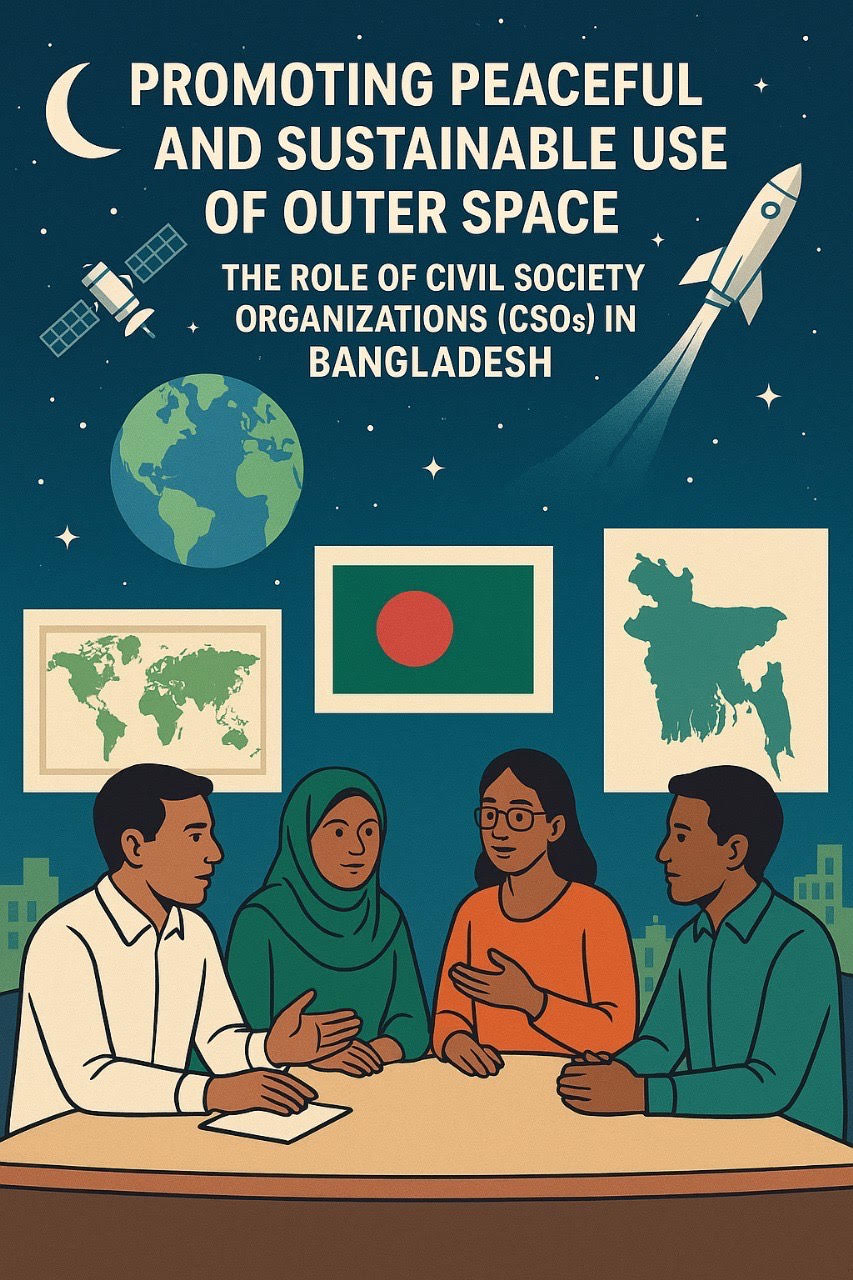
Promoting Peaceful and Sustainable Use of Outer Space: Embracing the Role of Civil Society Organizations (CSOs) in Bangladesh
AHM. Bazlur Rahman:
As we prepare for the second edition of the Space Sustainability Forum, scheduled to take place on October 7–8, 2025, in Geneva, Switzerland, we are excited about the opportunities for constructive dialogue and collaboration.
This pivotal event, organized by the ITU at the International Conference Center Geneva (CICG), aims to cultivate innovative solutions for sustainable practices in space.
The forum will bring together esteemed leaders and experts from governments, the satellite and space industries, space agencies, and other key stakeholders who are dedicated to promoting the sustainable use of space. Given the rapid advancements in space exploration and our growing reliance on space-based applications, fostering collaboration is more crucial than ever.
This forum will serve as a dynamic platform for presenting the latest developments in the space sector, sharing insights, exchanging best practices, and exploring forward-thinking solutions. It also aims to inform attendees about the progress made by various space stakeholders in addressing the challenges identified during the inaugural ITU Space Sustainability Forum in 2024.
Key discussion topics will include managing prominent satellite constellations, enhancing space situational awareness, safeguarding systems from threats, increasing resilience, ensuring sustainability, and venturing into new frontiers in space exploration—specifically focusing on the Moon and beyond. Together.
I am exploring the valuable role that Civil Society Organizations (CSOs) in Bangladesh can play in fostering collaboration among the government, industry, international organizations, academia, and other civil society groups for the benefit of the people.
By working together, we can develop and promote innovative ideas and actions that ensure the secure, sustainable, and peaceful utilization of outer space, ultimately benefiting our planet and all its inhabitants.
As our engagement with outer space continues to grow—from satellite communications and climate monitoring to navigation systems and scientific exploration—the urgency for secure, sustainable, and peaceful applications of space technology increases.
While governments and corporations often spearhead many space initiatives, civil society organizations (CSOs) in Bangladesh are poised to play a vital role in ensuring that the benefits of space are shared with the public.
By actively promoting responsible policies and empowering communities with knowledge and resources, Bangladeshi civil society organizations (CSOs) can enhance their understanding of space and its significant benefits for people’s daily lives. This approach will pave the way for a future in which outer space is recognized as a valuable ally to Earth and its inhabitants, fostering collaboration and innovation for the betterment of society.
Advocating Peaceful and Responsible Use of Space
CSOs are uniquely positioned to drive positive changes in public policy and enhance international collaboration. In Bangladesh, they can:
Champion national space strategies that emphasize peaceful and civilian applications, aligning them with global frameworks such as the Outer Space Treaty (1967).
Promote the vision of space as a global common shared resource that should remain free from militarization and the monopoly of a few powerful nations.
Advocate for increased awareness of the risks associated with space weaponization, encouraging regional cooperation in South Asia to protect the integrity of outer space.
Furthermore, CSOs can adopt a watchdog role, monitoring the utilization of Bangladesh’s space assets—such as the Bangladesh satellite—ensuring transparency and accountability in public and private sector activities.
Building Public Awareness and Engagement
Many communities in developing countries have a limited understanding of the importance of space science and its practical applications. CSOs in Bangladesh can effectively bridge this knowledge gap by:
Launching public education campaigns that illustrate how space technology enhances daily life—through improvements in weather forecasting, crop monitoring, disaster management, education, and telecommunications.
Organizing events such as Space Awareness Week, exhibitions, and community dialogues to engage youth, women, and rural populations.
Creating accessible content in local languages to foster inclusive discussions regarding the significance of space for development and peace.
By actively engaging the public and promoting awareness, CSOs can mobilize a collective demand for ethical and inclusive governance of outer space, ensuring that its benefits are realized for all.
Promoting STEM Education and Research
To pave the way for the peaceful and sustainable use of space, Bangladesh is poised to nurture a new generation of scientists, engineers, and policy experts. Civil Society Organizations (CSOs) can play a vital role by:
Collaborating with schools, colleges, and universities to elevate STEM (Science, Technology, Engineering, and Mathematics) education, particularly in the context of space exploration and technology.
Empowering underrepresented groups, especially girls and rural youth, to pursue exciting careers in space science and related fields.
Organizing engaging workshops, coding boot camps, and internships that provide students with hands-on experience with remote sensing, satellite data, and entrepreneurial opportunities in space.
These proactive initiatives will not only enhance skills and knowledge but also align seamlessly with Bangladesh’s Vision 2041, which aims for digital transformation and innovation.
Strengthening Climate Resilience through Space-Based Solutions
Considering Bangladesh’s vulnerability to climate change, leveraging space technologies can significantly bolster resilience. CSOs can contribute by:
Partnering with government agencies and international stakeholders to harness satellite data for effective early warning systems during emergencies like floods, cyclones, and landslides.
Utilizing remote sensing to monitor critical issues such as deforestation, coastal erosion, crop health, and urban expansion.
Advocating open access to space-based data to strengthen climate justice and empower communities in their local decision-making processes.
Through these efforts, CSOs will help translate advanced space technologies into actionable tools that promote sustainable development and enhance community resilience.
Facilitating International Cooperation and Global Dialogue
CSOs in Bangladesh can amplify the perspectives of the Global South in international forums, such as the United Nations Committee on the Peaceful Uses of Outer Space (COPUOS). They can:
Participate in global networks that address critical issues such as space ethics, debris mitigation, and equitable access to space resources.
Foster South-South cooperation to exchange best practices for the peaceful use of space, particularly with neighboring nations in Asia and Africa.
Advocate for the meaningful representation of Bangladesh’s civil society in shaping fair international governance frameworks for space.
By actively participating in these dialogues, CSOs will strengthen Bangladesh’s influence on the global stage, promoting democratic and equitable governance of outer space.
Encouraging Innovation and Ethical Use of Technology
CSOs serve as excellent incubators for fostering ethical innovation in the space sector. They can:
Support the development of open-source tools and platforms that make space data readily accessible to local NGOs, researchers, and startups.
Promote ethical guidelines for the use of satellite data, emphasizing the importance of privacy, surveillance sensitivity, and human rights considerations.
Collaborate with technology communities to create low-cost space technology solutions, such as weather balloons or community-driven GIS mapping. By intertwining ethics with innovation, CSOs ensure that technology serves not only as a tool for efficiency but also to promote equity and responsibility.
In Conclusion
Outer space presents a realm of immense potential and challenges. As Bangladesh increasingly embraces space technology for development, this journey must remain peaceful, inclusive, and sustainable. Civil Society Organizations can play a crucial role in realizing this vision.
Through their dedicated efforts in advocacy, education, capacity-building, climate action, international collaboration, and ethical innovation, CSOs will help ensure that the benefits of outer space are equitably shared, uplifting everyone on Earth as we collectively reach for the stars.
Writer: Chief Executive Officer, Bangladesh NGOs Network for Radio and Communication (BNNRC).He can be reached at [email protected] | +880 1711 881647