
Polls expected mid-February next year
Abu Jakir :
The interim government led by Nobel Laureate Dr Muhammad Yunus is aiming to hold Bangladesh’s next parliamentary elections in the second week of February 2026, firmly rejecting any extension of its tenure, according to officials from the Chief Adviser’s Office.
Despite concerns from political parties over potential delays and deteriorating security conditions, sources indicate that the Yunus administration remains resolute in its commitment to restoring democratic governance through a credible election process.
“There is no appetite for clinging to power. The roadmap is clear-election, not extension,” said a senior official on condition of anonymity.
However, recent incidents – including the broad-daylight killing of a trader in Old Dhaka and a fatal military jet crash at a school in Uttara-have begun to test the interim authority’s ability to maintain public confidence.
Political stakeholders are also expressing increased scepticism over the government’s ability to ensure both electoral integrity and public safety.
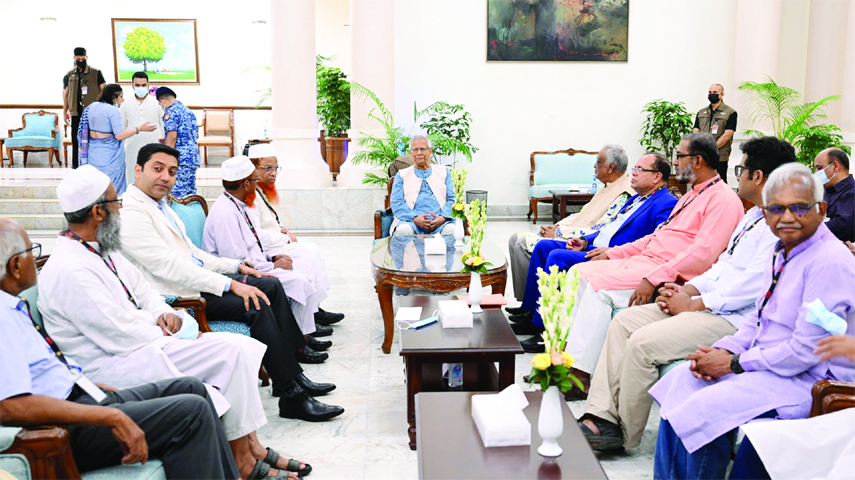
Speaking at a consultation with leaders of 14 political parties held Saturday at the State Guest House Jamuna, Chief Adviser Dr Yunus warned of “defeated forces” allegedly trying to destabilise the electoral process.
“These fallen elements are repeatedly seeking to create disorder and derail the road to elections,” Dr Yunus said.
“If pro-democracy forces fail to unite and deliver a proper election, we will miss a historic opportunity.”
Though he did not name any group, Dr Yunus alleged that attempts to provoke unrest tend to intensify each time preparations for elections advance. He reaffirmed the government’s determination to stay the course, citing growing unity among democratic actors.
He also appealed to all political groups for their cooperation in holding fair and inclusive elections. While leaders at the meeting expressed cautious support, they also raised serious concerns about recent lapses in governance.
The government’s recent challenges include the 9 July killing of Md Sohag (alias Lal Chand), a scrap trader, in front of Mitford Hospital, which many viewed as indicative of persistent law enforcement shortcomings.
Public anxiety was further fuelled by the military jet crash at Milestone School in Uttara, which resulted in fatalities and raised questions over regulatory oversight.
During the meeting, several party leaders criticised the government’s handling of law and order, calling for more decisive and transparent measures in the lead-up to elections.
“We told the Chief Adviser that the government must stop reacting to crises and begin acting with clarity,” said Mostafizur Rahman, leader of the Bangladesh Labour Party. “Law enforcement is failing-when will that change?”
While an exact date for the polls has yet to be announced, government officials close to Dr Yunus have confirmed that February 2026 remains the target.
Mostafa Jamal Haider, chairman of the Jatiya Party (Kazi Zafar faction), told reporters after Saturday’s meeting that the Chief Adviser had “categorically assured” party leaders that an election date would be announced within four to five days.
“There could be no better news. Election is the only way out of the current instability,” Haider said.
Leaders from other parties, including Fariduzzaman of the National People’s Party and Aminul Haque Tipu of the National People’s Front, echoed the same assurance-reporting that Dr Yunus had confirmed his intent to hold elections before Ramadan, which begins in early March 2026.
This aligns with earlier statements by Chief Adviser’s Press Secretary Shafiqul Alam, who had noted on 8 July that elections would be held either in February or April 2026, with a final decision expected by early August.
Yet not all parties remain optimistic. Ganosamhati Andolon leader Zonayed Saki accused the government of entertaining plans to delay the polls, calling on Dr Yunus to announce the election date without further delay and unveil the long-promised “July Charter”-a blueprint for institutional reforms-by 5 August.
The BNP, though part of an earlier understanding with the government, has also expressed fresh doubts.
A private meeting in June in London between Dr Yunus and BNP Acting Chairperson Tarique Rahman produced a joint statement affirming elections before Ramadan.
However, BNP sources suggest the party is increasingly wary of internal efforts to push the timeline further back.
Reports indicate that while some advisers favoured an April election, Dr Yunus insisted on February, with his decision guided by political consensus and concerns over the risks of prolonged uncertainty or potential sabotage.
The interim government was installed following the August 2024 mass uprising that toppled the Awami League regime.
It inherited a state apparatus plagued by administrative paralysis, law enforcement breakdowns, and deep public distrust.
It took nearly six months to restore basic stability, after which the government began rolling out its promised reform agenda.
A key part of this effort-the “July Charter” on state restructuring-is expected to be published in the coming weeks. Officials say the government remains committed to ensuring justice for alleged abuses committed under the previous regime.
While political uncertainty remains, the Yunus government maintains that timely, credible elections are the only path forward for Bangladesh’s democratic recovery.