
Political landscape shifts as Islamic parties mobilise
Abu Jakir :
Following the ousting of Sheikh Hasina’s government on August 5, Bangladesh’s Islamic political parties have experienced a resurgence, intensifying their activities across the country.
These groups, which faced severe restrictions under the previous regime, have resumed discussions, workers’ conferences, rallies, and public outreach programmes to consolidate their support base.
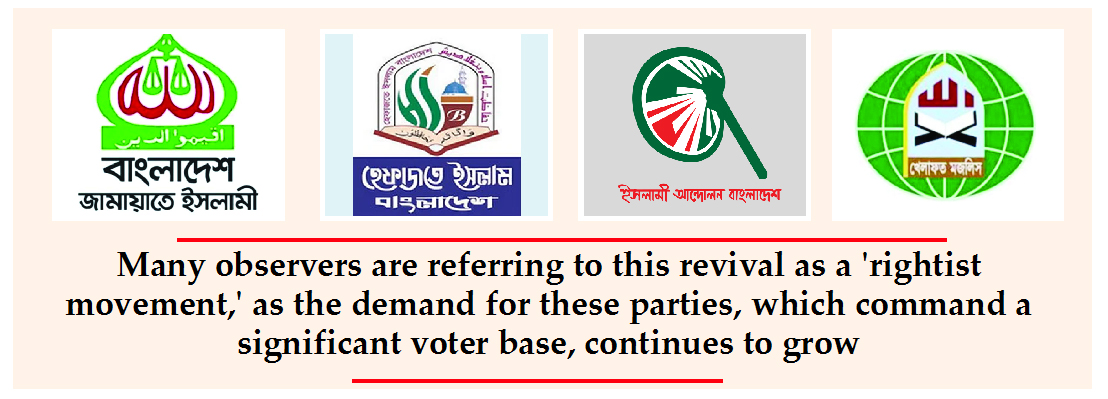
Many observers are referring to this revival as a “rightist movement,” as the demand for these parties, which command a significant voter base, continues to grow.
As the Dr Yunus-led interim government plans to hold the next general elections by December this year or mid-next year, political parties across the spectrum are engaging in strategic preparations.
They are exchanging views and exploring alliances to strengthen their positions.
Among these parties, Bangladesh Jamaat-e-Islami, one of the major Islamic political groups, has been particularly active, organising extensively at the grassroots level.
Party insiders have indicated that Jamaat aims to foster greater unity among Islamist groups and contest the upcoming elections as a united force.
In a significant recent development, the political landscape is abuzz following a courtesy meeting between Syed Muhammad Rezaul Karim, the Ameer of Islami Andolan Bangladesh, and Shafiqur Rahman, the Ameer of Jamaat-e-Islami.
This meeting has sparked speculation about the formation of an electoral alliance among Islamic parties.
Leaders of these parties believe that Jamaat and other Islamic groups have established a solid footing, with the potential to influence the political landscape.
According to Syed Muhammad Rezaul Karim, also known as the Charmonai Pir, discussions are ongoing with Jamaat and several other Islamic parties to unify their votes under a single banner.
“We are in talks with parties such as Khilafat Majlis, Jamiat Ulema-e-Islam, and Nezam-e-Islam, among others.
It is true that there are differences and disagreements among us on various issues. However, I am hopeful that through discussions, we can reach a consensus or form an electoral alliance,” he stated.
Jamaat-e-Islami spokesperson Motiur Rahman Akand confirmed that dialogues are progressing and that a clearer picture would emerge once the election date is announced.
The unity efforts extend to other Islamic parties, including those associated with Hefazat-e-Islam, a Qawmi madrasa-based organisation. Azizul Haque
Islamabadi, the organisational secretary of Hefazat-e-Islam and joint secretary-general of Nezam-e-Islam Party, highlighted that the “process of unifying Islamic parties has made significant progress.”
Azizul Haque pointed out that the seeds of the current unity were sown during their time in prison under Sheikh Hasina’s government.
“Many Islamic leaders were incarcerated at that time, and this allowed us to build camaraderie and discuss shared goals. This facilitated the unity process post-August 5,” he explained.
Meanwhile, the BNP has also initiated efforts to strengthen ties with Islamic parties as part of its broader strategy to rally anti-government forces. Last Wednesday, the BNP held a formal meeting with Khilafat Majlis.
Sources within the party revealed that this initiative aims to engage Islamic groups in light of the upcoming elections and the political environment shaped by the August 5 student-led uprising. Additional meetings with other parties are expected in the coming weeks.
This meeting took place just a day after the courtesy interaction between Jamaat-e-Islami’s Shafiqur Rahman and Islami Andolan’s Rezaul Karim in Barishal. Speaking about the BNP’s outreach efforts, Nazrul Islam Khan, a member of the party’s Standing Committee, remarked, “Anyone engaged in politics in Bangladesh can consider collaborating with those who share similar views to further their political agenda. There is no reason for anyone to be concerned about this.”