
December vs June: Political impasse deepens
Abu Jakir :
As summer storms sweep through Dhaka, political tempests are brewing far stronger.
With the streets soaked and city halls shut, the standoff between Nobel laureate Professor Muhammad Yunus’s interim government and the Bangladesh Nationalist Party (BNP) has sharpened into a defining political crisis, threatening to drag the nation into deepening unrest.
The dispute centers on a single question: when will Bangladesh vote again?
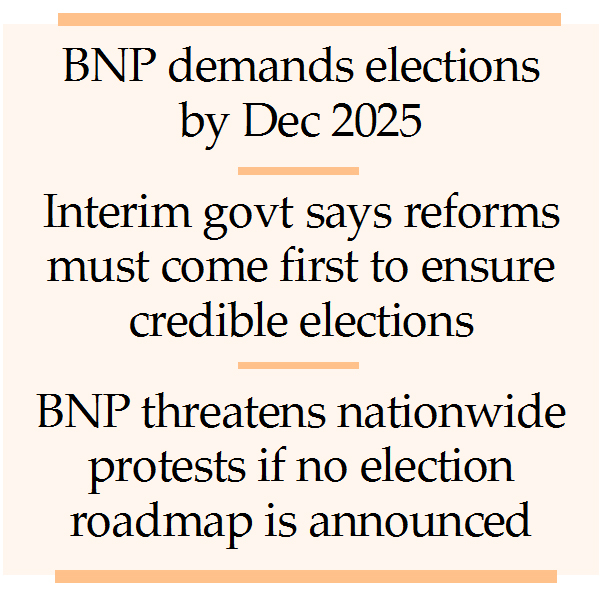
The BNP, emboldened by the absence of its longtime rival Awami League, has drawn a firm red line: general elections must be held by December.
But Professor Yunus, the interim government’s chief adviser, insists that a rushed vote would undercut vital electoral and institutional reforms. His government, appointed in the wake of the Awami League’s ouster, is instead aiming for a June 2026 election-six months later.
“There is no shortcut to stability,” Yunus told an international audience at the Nikkei Forum in Tokyo yesterday, where he reaffirmed his non-partisan role and underscored the need for meaningful reforms. “We cannot rebuild the people’s trust in this process through haste.”
But for the BNP, patience is wearing thin. The party’s exiled leader Tarique Rahman addressed a massive rally in Dhaka’s Nayapaltan on Wednesday with an unmistakable ultimatum: “There must be elections by December. No delays. No excuses.”
Party insiders say BNP’s leadership has instructed its grassroots network to prepare for nationwide demonstrations if the government fails to announce an election roadmap within weeks.
The pressure campaign, they say, will escalate from rallies to sustained agitation.
And already, the pressure is visible.
A mayoral protest becomes a political symbol
In Dhaka’s Nagar Bhaban, the headquarters of the South City Corporation, protestors loyal to BNP leader Ishraque Hossain have maintained a dramatic sit-in for over two weeks, demanding that Hossain-who won a court battle confirming his electoral victory-be formally sworn in as mayor.
Despite torrential rains, his supporters again took to the streets yesterday, chanting: “Swear-in Ishraque now!” The gates of Nagar Bhaban remain locked since May 14, as unions of city workers joined the protest.
The demonstration, while focused on municipal authority, has come to embody a broader political grievance: the belief that the interim government is dragging its feet-not just on local mandates, but on national ones.
“This is not just about a mayor,” said one protestor. “It’s about our right to vote, to govern, to choose our leaders.”
Government officials have remained silent on the standoff. But analysts say it represents a new flashpoint that could further undermine public confidence in the Yunus administration.
Pressure from all sides In recent weeks, Professor Yunus has met with representatives from 22 political parties in an attempt to calm rising tensions after reports emerged that he had considered resigning.
Those talks, according to officials, helped defuse immediate fears of a collapse. Yet they failed to resolve the growing distance between the interim government and two of its most critical stakeholders: the BNP and the military.
Sources close to the army say the chief of staff, General Waqar-uz-Zaman, has privately backed a December vote, raising fresh questions about the government’s ability to maintain a consensus among power centers.
The general’s remarks, made during a closed-door meeting with senior officers earlier this month, came just days after BNP’s rally paralyzed parts of the capital.
Political analyst Zahed-ur-Rahman believes these parallel pressures-from street and state-have forced Yunus’s administration into a defensive posture. He said, the government has issued a warning to two of its key stakeholders-BNP and the military.
As a result, tension and discomfort persist. He referred to the language used in the advisory council’s statement to support this observation.
“This government is breathing, but it’s short of oxygen,” he said.
A statement issued by the interim advisory council last week hinted at the government’s growing frustration.
Warning of “coordinated attempts to destabilize the government,” the statement accused unnamed actors of being “fueled by defeated domestic forces and foreign conspiracies.”
BNP leaders have interpreted that language as a veiled threat-and a rebuke aimed squarely at them.
A race against expectations The BNP’s demand for December elections is rooted in its belief that the political playing field has never been more favorable. With the once-dominant Awami League sidelined and the left fragmented, the BNP sees a clear path to power.
But critics warn that the party is already showing signs of premature triumphalism. Reports of extortion, local turf wars, and vigilante-style justice by BNP activists in rural areas have begun to surface-prompting the party’s top leadership to expel or discipline some local operatives.
Still, the momentum within BNP appears to outweigh such internal tremors. “We are on the doorstep of government,” one party strategist told this correspondent. “And we won’t let Yunus or anyone else shut that door in December.”
Some within BNP also suspect deeper games are being played. They accuse Yunus of favoring the National Citizen Party (NCP), a small centrist bloc that has called for elections only after a full accounting of past corruption cases, including those tied to former Awami League ministers. According to BNP, this delay tactic is a strategic ploy to weaken their ascendancy.
They also view Islamist parties like Jamaat-e-Islami as adopting a wait-and-see approach, reluctant to confront the interim government directly but unwilling to throw full support behind the BNP. “A web of conspiracies is forming,” said senior BNP leader Abdul Moyeen Khan. “And we will resist them all.”
The Clock Ticks With barely six months until December, the stakes are rapidly rising.
If the Yunus government refuses to budge, and BNP intensifies its protests, Bangladesh may be heading into a dangerous political impasse-one that could spiral beyond Dhaka’s streets into a nationwide standoff.
For now, the Nobel laureate remains calm under pressure, publicly reiterating his commitment to elections, but only when reforms are “deep, credible, and lasting.”
But in a country where deadlines have always been political instruments, the difference between December and June could become the difference between democracy and disruption. And with every passing week, that gap is getting harder to bridge.