
‘People will reject conspiracies against polls’
Staff Reporter :
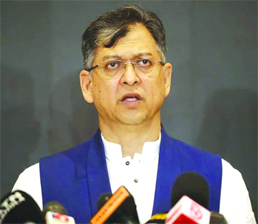
BNP Standing Committee Member Salahuddin Ahmed on Tuesday said the people will firmly reject any conspiracy targeting the upcoming national parliamentary elections.
“The citizens of this country will not accept any political maneuver designed to delay or obstruct the election,” he told journalists in the evening.
Highlighting the people’s long struggle for voting rights, Salahuddin said, “For the last 16-17 years, our people have fought continuously, shed blood, and sacrificed thousands of lives. Why? To secure the right to vote, to uphold democratic and constitutional rights, to build a just society, and to reform the state system. All of this can only be achieved through a fair and neutral election that brings forth a democratically elected national government.”
Calling some political movements contradictory, he remarked, “The National Consensus Commission has scheduled its next meeting for tomorrow. People will naturally question how logical it is to call for street protests over the same demands while these discussions are actively underway.”
Salahuddin further clarified that the commission never discussed adopting a proportional representation (PR) system for the lower house elections. “There was no discussion on the PR system in the commission meetings. Interestingly, those now agitating for PR also took part in those very discussions,” he noted.
He added that BNP strongly opposes introducing PR in either chamber of parliament. “We have already explained why we do not support the PR system in Bangladesh. If any political group pushes this demand in public, we will counter it through the democratic process.”
Explaining the party’s stance, Salahuddin said, “The PR system does not align with Bangladesh’s political culture or electoral history. Around the world, PR is practiced in many variations, and we can observe its impact in a neighboring country. Under such a system, governments often remain weak, struggling to achieve a simple majority. This results in fragile coalition setups, unstable governance, and an inability to fulfill the nation’s aspirations.”