
Over 4,500 illegally ‘pushed back’ from India to BD
Staff Reporter :
More than 4,500 individuals who are Muslim in religion have been pushed unlawfully into Bangladesh from India between June 2024 and June 2025, according to official statements, media reports, and rights groups with hundreds of them reportedly sent to the border at gunpoint, particularly from the Indian state of Assam, under a sweeping crackdown that critics call discriminatory and illegal.
The expulsions reached in an alarming pace in May 2025 under a campaign initiated by India’s Bharatiya Janata Party (BJP)-led governments in states like Assam, West Bengal, Gujarat, and Delhi.
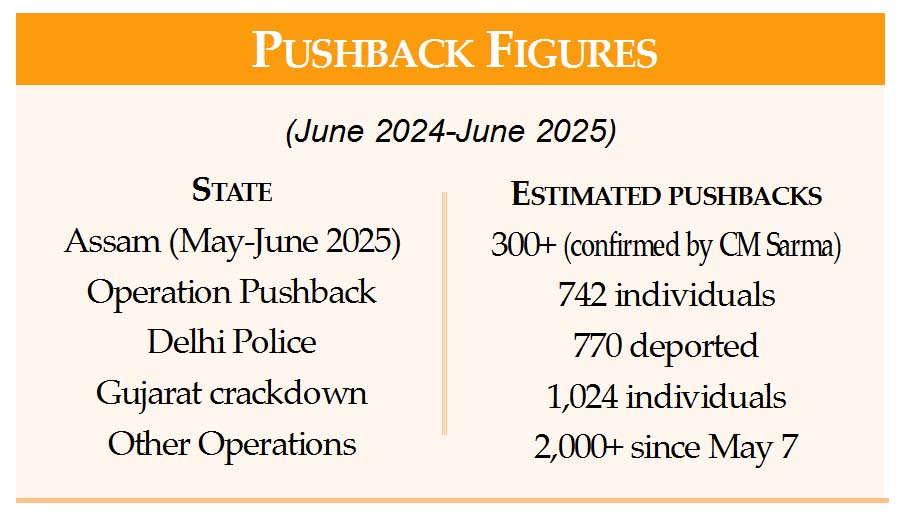
The highest number of expulsions came from Gujarat and Delhi, where over 1,000 and 770 individuals respectively were deported in large-scale police operations between April and June.
In Assam, Chief Minister Himanta Biswa Sarma confirmed that over 300 Muslims were “pushed back” across the border, while another 742 individuals were sent back in May alone under “Operation Pushback.”
Nationwide, the total number of Muslims expelled, deported, or abandoned at the Bangladesh border crossed 4,500 individuals over the past 12 months, making it one of the most aggressive campaigns of extrajudicial pushbacks in the region’s recent history.
“These pushbacks will be intensified. We have to be more active and proactive to save the state,” said Assam Chief Minister Himanta Biswa Sarma in early June, addressing the legislative assembly.
Several individuals claim they were picked up from their homes or workplaces and transported hundreds of kilometers to border areas before being forced into no-man’s land – often without food, legal recourse, or basic rights.
Ufa Ali, a 67-year-old bicycle mechanic from Assam’s Morigaon district, was forcibly taken to the India-Bangladesh border on May 27, 2025, and left stranded in swampy fields with 13 others, including five women. “We saw hell underneath the blue sky,” he told Al Jazeera. “They shot at us with rubber bullets when we begged them not to push us into the other side.”
Despite having his name in the National Register of Citizens (NRC), Ali was declared a foreigner in 2013 by a tribunal due to inconsistencies in his father’s name. He spent two years in detention and was again targeted this year, allegedly without a fresh legal review.
Rahima Begum, another victim from Golaghat, reported being beaten by Bangladeshi guards after being forced across the border by Indian Border Security Forces (BSF). She says the BSF threatened to shoot her if she didn’t move.
Rights groups and journalists, such as Jiten Chandra Das from Bangladesh’s Rowmari border town, confirmed that BSF officers used rubber bullets and live fire to force “Indian nationals” into Bangladeshi territory.
While the Indian government claims the crackdown is aimed at undocumented migrants, opposition leaders and civil rights defenders say it disproportionately targets Muslims, especially Bengali-speaking Muslims in Assam and West Bengal.
“Muslim identities in any form are synonymous with terrorism in India under the BJP government,” said Apoorvanand, a professor at Delhi University.
Meanwhile, BJP officials have openly said they do not push back undocumented Hindus, citing “religious persecution” as justification – a move critics say violates the principle of equal treatment under the law.
India’s northeastern state of Assam has long been the epicenter of migration-related tensions, fueled by colonial-era movements and the 1971 Bangladesh Liberation War.
The cut-off date for proving citizenship is March 24, 1971, and those unable to provide documentary proof are labeled “foreigners,” often facing arbitrary rulings from Assam’s controversial Foreigners Tribunals.
In 2019, Assam’s NRC process excluded nearly 2 million residents, about 700,000 of them Muslims.
With over 4,500 Muslims expelled, detained, or pushed across the Bangladesh border in the last 12 months often without due process human rights observers warn that the situation is not only escalating tensions between the two nations but also violating international norms on statelessness, migration, and minority rights.
Bangladesh’s government has formally protested several of these pushbacks, terming them “unilateral” and “unacceptable,” and is preparing to raise the issue at diplomatic levels.