
Online job scams fuel cyber slavery in Bangladesh
News Desk :
What seemed like a dream job abroad turned into a brutal nightmare for Faysal, a 26-year-old Bangladeshi who was promised a high-paying position in Thailand. Instead, he was trafficked across borders and forced into a cyber slavery ring operating out of Myanmar – one of many young Bangladeshis falling prey to a growing regional web of digital forced labour.
Faysal, who had previously worked in Dubai as a graphics designer, saw the Thailand offer as a chance to rebuild after losing his job during the pandemic. Recruiters promised to cover all expenses, including visa processing and flights. But when he landed, armed men met him at the airport, drove him for hours, and forced him at gunpoint into Myanmar.
Inside a heavily guarded scam compound, Faysal was forced to participate in online fraud schemes. When he failed to meet his targets, he was tortured – once with an electric shock device applied to his genitals. “They had beaten one person to death,” he recalled. “I heard that one woman committed suicide there.”
Faysal was eventually freed in a joint Thailand-Myanmar military operation that rescued 92 people. But the trauma lingers. He still suffers from ligament injuries sustained during a failed escape attempt. His story is part of a growing pattern of deception and abuse, as traffickers exploit young Bangladeshis’ economic desperation and dreams of a better future.
With poverty still widespread and local job markets limited, Bangladesh has become a prime source country for cyber slavery recruitment. Trafficking rings target young, digitally literate individuals – especially those with basic English skills – promising them jobs in technology, translation, or customer support abroad.
Many victims are recruited through social media platforms such as Facebook, Instagram, or messaging apps like WhatsApp and Telegram. They are enticed by offers of salaries ranging from US$1,000 to US$1,500 – amounts far beyond what many could earn at home. The job ads often use fake logos and staged interviews to appear legitimate.
Once recruited, victims typically travel on tourist visas arranged by agents, with their documents and travel appearing fully legal. Upon arrival, they are handed over to syndicates operating near the Thailand-Myanmar border, where they are stripped of their passports and forced into scam centers.
“These syndicates make it easy, telling victims they don’t have to spend anything,” said Bernard Olalia, undersecretary at the Philippines’ Department of Migrant Workers, whose comments apply to similar trafficking cases across Asia. “And victims grab the opportunity without verifying anything.”
According to BRAC’s Migration Programme, Bangladeshi trafficking networks are actively involved in the recruitment process. “Every link in this chain participates in the trafficking process,” said Rayhan Kabir, a sector specialist at BRAC. He noted that trafficked individuals are often moved through border hotels, then ferried across the Moei River into Myanmar, where armed groups control scam compounds.
Law enforcement complicity is also a major concern. “In many places, police are corrupt,” said Olalia. “Even government officials themselves are part of the syndicate.”
Once inside the scam centres, escape is rare. Victims are often held in facilities surrounded by barbed wire and armed guards, where movement is strictly monitored, and abuse is common.
Combating this form of transnational human trafficking presents significant legal and logistical challenges. According to Mostafizur Rahman, additional superintendent of police at Bangladesh CID, cross-border cybercrime investigations are difficult to pursue. “We can take immediate action when it happens inside Bangladesh,” he said, “but when it’s an international crime or involves multinational parties, we must go through appropriate channels, which takes time and makes things very challenging.”
Even when victims return, legal support can be limited. Since many voluntarily travelled abroad under the promise of work, proving coercion or forced labour becomes complicated under existing trafficking laws.
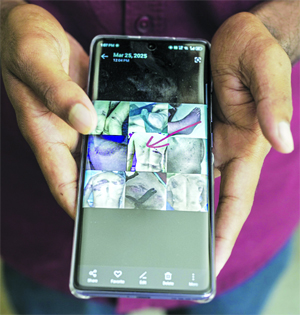
Faysal’s ordeal is a chilling reminder of the hidden cost of global cybercrime. Now back in Dhaka, he shares photos of injuries he and others suffered during their captivity. His scars tell a story of betrayal, violence, and a system that preyed on hope.
He is among thousands of Bangladeshis who have been lured into cyber slavery networks across Southeast Asia, where they are forced to commit fraud under brutal conditions. For many, what begins as a job offer becomes a trap – one with few exits and lasting trauma.
“For the first year, I couldn’t talk about what happened without breaking down,” Faysal said. “But I have to speak out now – so others don’t fall into the same trap.”
(Based on a report published in Global Press Journal).