
Jamaat meets CA: Objects on few advisers’
Staff Reporter :
Bangladesh Jamaat-e-Islami has raised objections about a few advisers in the interim government, alleging that some of them are misleading Chief Adviser Professor Muhammad Yunus and working in favour of a particular political group. The party, however, did not disclose the names of the advisers in question.
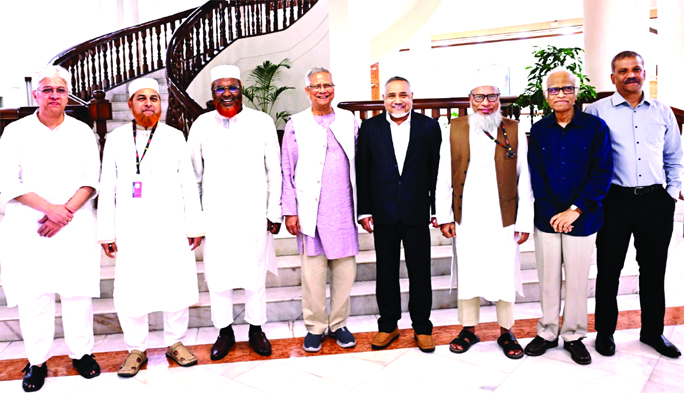
Speaking to reporters after a meeting with the chief adviser at the State Guest House Jamuna on Wednesday evening, Jamaat’s Nayeb-e-Ameer Syed Abdullah Muhammad Taher said his party had drawn the chief adviser’s attention to what it described as “partisan influence” within the advisory council.
“We did not speak about all the advisers — only some,” Taher said. “We told him that a few people around you are misleading you. We have faith in you, but we believe some individuals close to you are working in favour of a certain party. You should be cautious about them.”
Taher said the party did not demand the removal of any adviser at this stage but has warned the chief adviser to stay alert.
“We are only drawing attention for now — not asking for anyone’s removal,” he told journalists. “We are giving you time and the opportunity to hear from us. But if things do not change, we will consider our next steps.”
The Jamaat leader also clarified that the party had not raised any demand for a caretaker government, noting that the issue is currently under hearing at the Supreme Court.
“We are waiting for the court’s verdict,” Taher said.
“If the ruling remains unchanged, we hope this interim government will function in the spirit of a caretaker administration.”
Asked how the chief adviser responded to Jamaat’s concerns, Taher said Professor Yunus assured them that he was carefully considering the matter and would take whatever action is necessary.
“The chief adviser said he is thinking deeply about these issues and will do whatever needs to be done, Insha’Allah,” Taher added.
During the meeting, the two sides also discussed the implementation of the July Charter, the planned national referendum in late November, and the possible issuance of an “extra-judicial arrangement” to ensure the charter’s execution, according to Taher.
Taher led a four-member Jamaat delegation in the meeting, which took place as part of the interim government’s ongoing political dialogue with major parties ahead of the upcoming parliamentary elections.
The meeting came a day after the BNP raised similar objections about several advisers, urging the chief adviser to remove those perceived as partisan and to ensure the government’s complete neutrality during the election period.