
‘No place for extreme poverty in just society’
Staff Reporter :
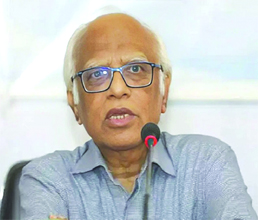
Planning Adviser Dr. Wahiduddin Mahmud emphasized that in a just society, extreme poverty should not exist, as every individual must be ensured the basic necessities required for survival.
“We are poorer in terms of income than in terms of expenditure. Every year this poverty rate is rising. A large number of people may not be poor, but they are living just above the poverty line.
Their situation is not sustainable; with a slight shock they can fall into poverty,” he said.
The Planning Adviser said, “Some people are standing in water up to their noses. A small wave will drown them. They are surviving somehow in a highly vulnerable condition.”
He made these remarks on Monday while speaking as the chief guest at the opening ceremony of the three-day National Conference on Social Protection 2025 at the China-Bangladesh Friendship Conference Centre in Sher-e-Bangla Nagar, Dhaka. Disaster and Relief Management Adviser Faruk-e-Azam attended the event as a special guest.
Wahiduddin Mahmud further said: “In a justice-based society, extreme poverty cannot exist. No country can be so poor that it cannot at least provide the basic necessities of life to all of its people. At this stage, we can no longer show excuses that we cannot provide minimum social security for all. Therefore, eradicating this poverty must be adopted as one of our main objectives. At the same time, we must pledge from now to treat it as both an economic and political goal.”
Half of Allowance Recipients Are Fake or Politically Favored
Pointing to major flaws in identifying beneficiaries for social allowances, Wahiduddin Mahmud said that currently, 50 percent of those receiving such benefits are not eligible. Many are “ghost” recipients or are included based on political considerations.
If a nationally integrated list is prepared and closely monitored at the grassroots level, the genuine and deserving beneficiaries will emerge.
He said in an equitable society, along with education and healthcare, everyone must be provided with the minimum required to survive. “For someone who has no means of survival, it is useless to offer schooling or healthcare – they are not in a position to avail them. These matters are interlinked. The central spirit of the Liberation War of 1971 and of last year’s July mass uprising was also about building a just society. Incomes may not be equal, but opportunities must be equal.”
New Poverty-Prone Areas Emerging: The Planning Adviser noted that there are poverty-prone regions in the country. Rangpur was once known for seasonal poverty, widely referred to as monga. Between 2003-05, there was intense media coverage about monga. Earlier, the government even denied its existence. It was due to media pressure that the government finally acknowledged monga and introduced various programs to address it.
He said: “Now, seasonal hunger is no longer as acute in Rangpur, although poverty persists.”
However, new poverty-prone areas have emerged in districts such as Netrakona, Sunamganj, Satkhira, and Patuakhali. He stressed the need to design targeted programs for these regions.
Disaster and Relief Management Adviser Faruk-e-Azam said it is essential to identify vulnerable groups and work specifically with them. The very purpose of the Ministry of Disaster Planning Commission’s General Economics Division member Monzur Hossain said that the coverage of social protection programs must be expanded. “In the last decade, we have achieved significant GDP growth – about 6.5 percent on average.”
Other speakers at the event included Senior Secretary of the Ministry of Public Administration Mokhles Ur Rahman, Secretary of the Cabinet Division’s Coordination and Reform Department Zaheda Parveen, Stefan Liller (UNDP Representative in Bangladesh), Michele Cretu (Head of the EU Delegation to Bangladesh), and Clinton Popky (Deputy High Commissioner of Australia in Dhaka).
The keynote paper was presented by Additional Secretary Md. Khaled Hasan.