
No need to go abroad: Jamaat Chief undergoes successful open-heart surgery in Dhaka
Staff Reporter :
In a country where political elites have long opted for medical treatment abroad, a high-profile open-heart surgery performed in Dhaka is drawing renewed attention to Bangladesh’s growing healthcare capabilities.
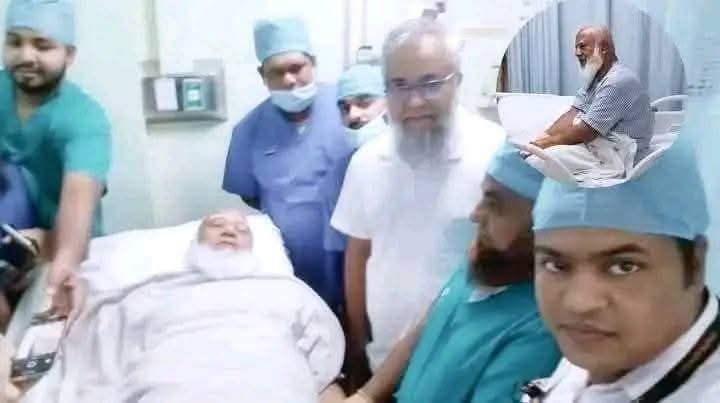
Dr. Shafiqur Rahman, the Ameer (chief) of Bangladesh Jamaat-e-Islami and a physician himself, successfully underwent a complex open-heart surgery at United Hospital in the capital on Saturday. The procedure involved four coronary artery bypasses in two severely blocked arteries. He is expected to return home within a week.
The operation, led by prominent cardiothoracic surgeon Dr. Jahangir Kabir, was completed without complication. Dr. Kabir later stated that Dr. Rahman’s confidence in local physicians should inspire greater public trust in the country’s medical infrastructure.
“His decision to undergo surgery here in Bangladesh, rather than seeking treatment overseas, sends a powerful message,” Dr. Kabir told reporters. “It affirms that we have the expertise, equipment, and conditions to manage high-risk cardiac procedures on our own soil.”
Dr. Rahman fell ill during a speech at a mass rally in Suhrawardy Udyan on July 19. Subsequent angiography revealed five to six blockages in his coronary arteries—three of which were over 80 percent blocked. Physicians initially considered placing stents but ultimately concluded that open-heart surgery was the safer option.
The move to remain in Bangladesh for such a major operation breaks from a long-standing trend among the nation’s political class. Successive governments have seen ministers and senior officials fly abroad—primarily to India, Singapore, or London—for even moderately complex treatments. This practice, often criticized as elitist and dismissive of domestic healthcare, has fed public skepticism about the quality of care available at home.
Jamaat leaders praised both the surgeons and what they described as divine providence for the successful outcome. In a public statement, the party’s central leadership expressed gratitude to the medical team and urged the public to recognize the strength of the nation’s health sector.
“Dr. Shafiqur Rahman has demonstrated through his own example that high-quality medical care is available within the country,” the statement read. “We hope this will inspire many to reconsider the assumption that critical treatment requires going abroad.”
Health analysts have echoed that sentiment, calling the surgery a symbolic milestone. “This may not just be a medical success—it’s a psychological one too,” said one Dhaka-based public health expert. “It challenges a deep-seated cultural bias that foreign healthcare is inherently superior.”
As Bangladesh invests further in its medical sector—with modern facilities, training, and public-private partnerships—the decision by a figure as visible and influential as Dr. Rahman to entrust his life to local doctors could mark a turning point.
For now, the successful surgery stands as a rare intersection of politics, medicine, and national self-reliance—an event with implications well beyond the operating room.