
‘No Dream Too Big’
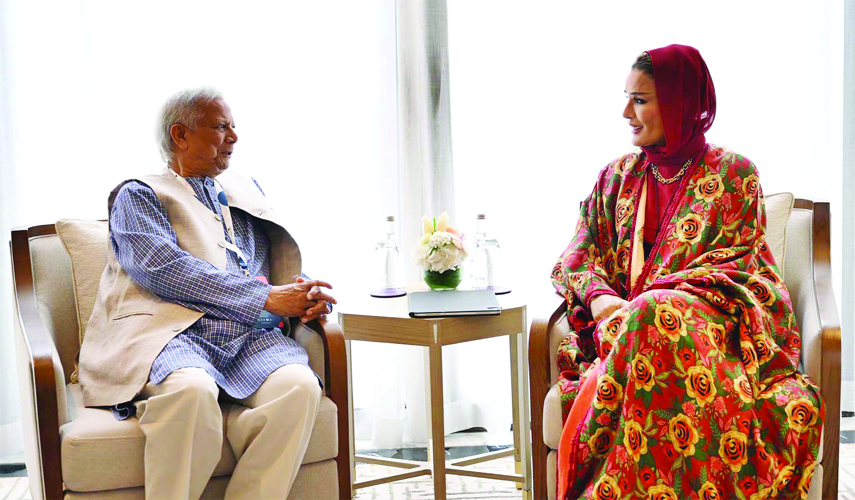
Staff Reporter :
Chief Adviser Professor Muhammad Yunus on Tuesday emphasised that poverty is not a result of individual failure, but a consequence of systemic flaws within the global economic framework.
Speaking at the Earthna Summit, organised by the Qatar Foundation, Prof. Yunus delivered a keynote titled ‘Exploring the Role of Social Business, Financial Inclusion, and Microfinance in Fostering Sustainable Development and Economic Opportunities for Marginalised Communities’.
“There is no person too poor to dream, and no dream too big to achieve,” he declared, underscoring the transformative potential of social business in lifting millions out of poverty. “We recognise that poverty is not created by the poor.
It is the outcome of an economic system that channels resources upward, concentrating wealth in the hands of a few,” said Prof. Yunus.
The Nobel Laureate stressed that the current economic model must be re-evaluated to prioritise inclusion and sustainability.
He highlighted that social business, in conjunction with financial inclusion, has already proven effective in breaking poverty cycles and creating long-term economic opportunity.
Citing the success of Grameen Bank, which he founded, Prof. Yunus explained how microcredit has empowered some of the world’s most economically marginalised communities.
The bank provides collateral-free loans-primarily to rural women-enabling them to establish income-generating activities and achieve financial independence.
To date, Grameen Bank lends over US$2.5 billion annually to 9 million women, with a repayment rate close to 99%. The model’s success has been replicated globally, including through Grameen America, which has disbursed over US$600 million in loans to more than 86,000 low-income women in the United States, also maintaining a repayment rate above 99%.
Platforms such as Kiva have further amplified the reach of microfinance, facilitating more than US$960 million in loans across 82 countries by linking individual lenders with entrepreneurs.
Prof. Yunus showcased a range of social business ventures inspired by the Grameen model, including Grameen Danone Foods, which addresses child malnutrition in Bangladesh, and Grameen Euglena, which promotes nutrition and supports local agriculture.
International examples included Uganda’s Golden Bees, which links smallholder farmers to broader markets, and Impact Water, which provides clean drinking water in schools.
He also cited Human Harbor Corporation in Japan, a recycling initiative employing former prisoners, and Campo Vivo in Colombia, which combats food waste and supports local farmers.
“These initiatives reflect the practical application of business as a force for good-driven not by profit but by purpose,” said Prof. Yunus.
Looking ahead, Prof. Yunus advocated for a global push towards “three zeroes”: zero poverty, zero unemployment, and zero net carbon emissions-adding a fourth: zero waste.
“Zero waste is not a utopian ideal, but a practical framework that prioritises design and systems which eliminate waste at the source,” he noted.
He urged businesses, governments, and individuals to adopt models that promote reuse, recycling, and composting over landfill or incineration, thereby reducing environmental impact and improving economic efficiency.
He further underscored the importance of traditional knowledge and cultural heritage in creating sustainable solutions.
“In many cases, traditional approaches offer the most effective remedies to modern challenges. Sustainable development must be grounded in this wisdom to ensure lasting impact,” he concluded.
The summit was attended by global dignitaries, including Sheikha Moza bint Nasser, Chairperson of Qatar Foundation, and Sheikha Hind bint Hamad Al Thani, Vice Chairperson and CEO of the Foundation.