


Trump, Xi, Putin end historic trilateral with ‘peace declaration’

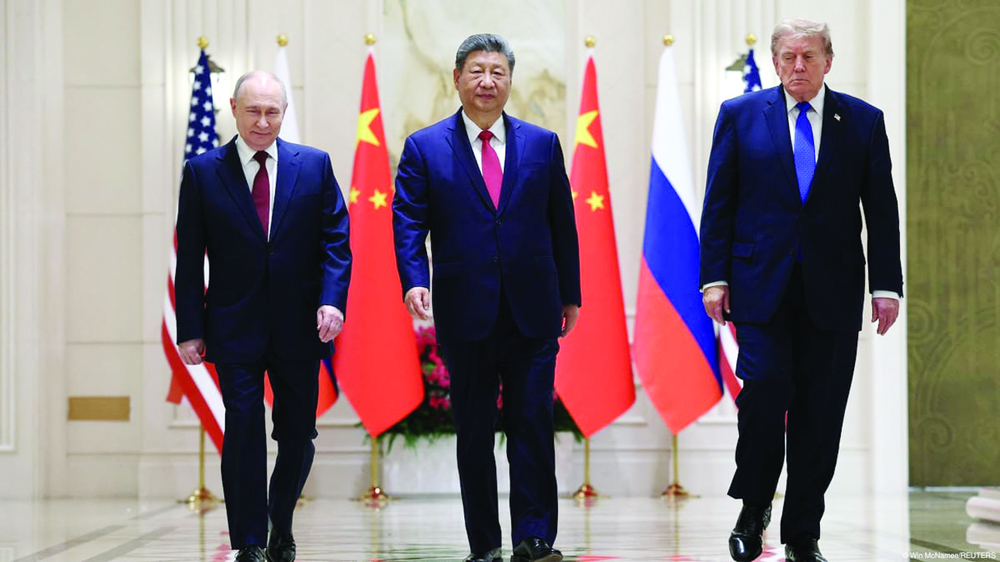
China, the United States and Russia issued a “peace declaration” Thursday after an unprecedented summit in Shenzhen, pledging to pursue talks on nuclear risks, increase petroleum supplies and advance U.N. reforms, according to Chinese and Russian officials.
The statement, published by Chinese state media and the Kremlin, did not mention the wars in Ukraine or Iran, which President Donald Trump said he discussed with Chinese President Xi Jinping and Russian President Vladimir Putin. The White House has not released any document yet.
The leaders committed to upholding strategic stability and international security, increasing the production and supply of refined petroleum products and maintaining stable energy flows.
They also pledged to “engage in dialogue on reducing nuclear risks and preventing nuclear proliferation.”
The declaration called for U.N. reforms “to more effectively address global challenges” and criticized the International Criminal Court, saying it and similar institutions “must not abuse their jurisdiction.” It also emphasized state consent and diplomatic immunity for officials.
Putin is wanted by the court, while the Trump administration has imposed sanctions on the ICC and its officials over investigations involving the United States and its allies, including Israel.
The summit lasted more than an hour on the sidelines of the Asia-Pacific Economic Cooperation summit. Trump promoted the first three-way meeting with Xi and Putin as an opportunity to pursue nuclear arms controls and begin resolving the wars in Ukraine and Iran.
“We are really making history,” Trump said. “The United States, Russia and China are uniquely positioned to discuss how to reduce the number of nuclear weapons on Earth and also to lessen the risk of those weapons being used.”
Xi described the meeting as “positive, constructive, and fruitful,” according to China’s official Xinhua News Agency.
“The three countries share a common perspective on safeguarding world peace,” he said.
Putin invoked their shared history as “victors in World War II,” saying “we hold joint responsibility for maintaining international peace.”
New START, the last nuclear arms pact between Russia and the United States, expired in February. Trump has called for “a new, improved and modernized” agreement that includes China.
Beijing has less incentive to accept limits, however, because its arsenal of more than 600 warheads is far smaller than the more than 5,000 believed to be in each of the U.S. and Russian stockpiles.
Daryl Kimball, executive director of the Arms Control Association, said the summit could, at best, begin a process leading to sustained negotiations on reducing nuclear arsenals.
“We need more than diplomatic theater and photo opportunities between Xi, Putin and Trump at APEC,” Kimball said. “And one meeting will not likely produce dramatic breakthroughs.”
Before the trilateral summit, Trump met separately with Xi for their third substantial meeting this year.
Trump praised their friendship and emphasized their shared interest in keeping oil flowing through the Strait of Hormuz, a crucial Middle Eastern shipping route repeatedly shut because of attacks during the Iran war. He also suggested he would press China to buy more U.S. agricultural products.
Xi said U.S.-China relations had been “generally stable and improved” during Trump’s presidency. Xinhua reported that he also discussed Taiwan and called for better communication on economic and trade issues.
Earlier, Trump held a separate meeting with Putin lasting roughly 40 minutes, their first talks since discussions in Alaska last year failed to produce an agreement on Russia’s war in Ukraine.
“Wonderful things can come out of this – or at least start,” Trump said, calling Putin “my friend.”
“We’ve had a great relationship for many years,” he added after they shook hands.