


Poultry feed prices jump Tk225 per sack in Kishoreganj

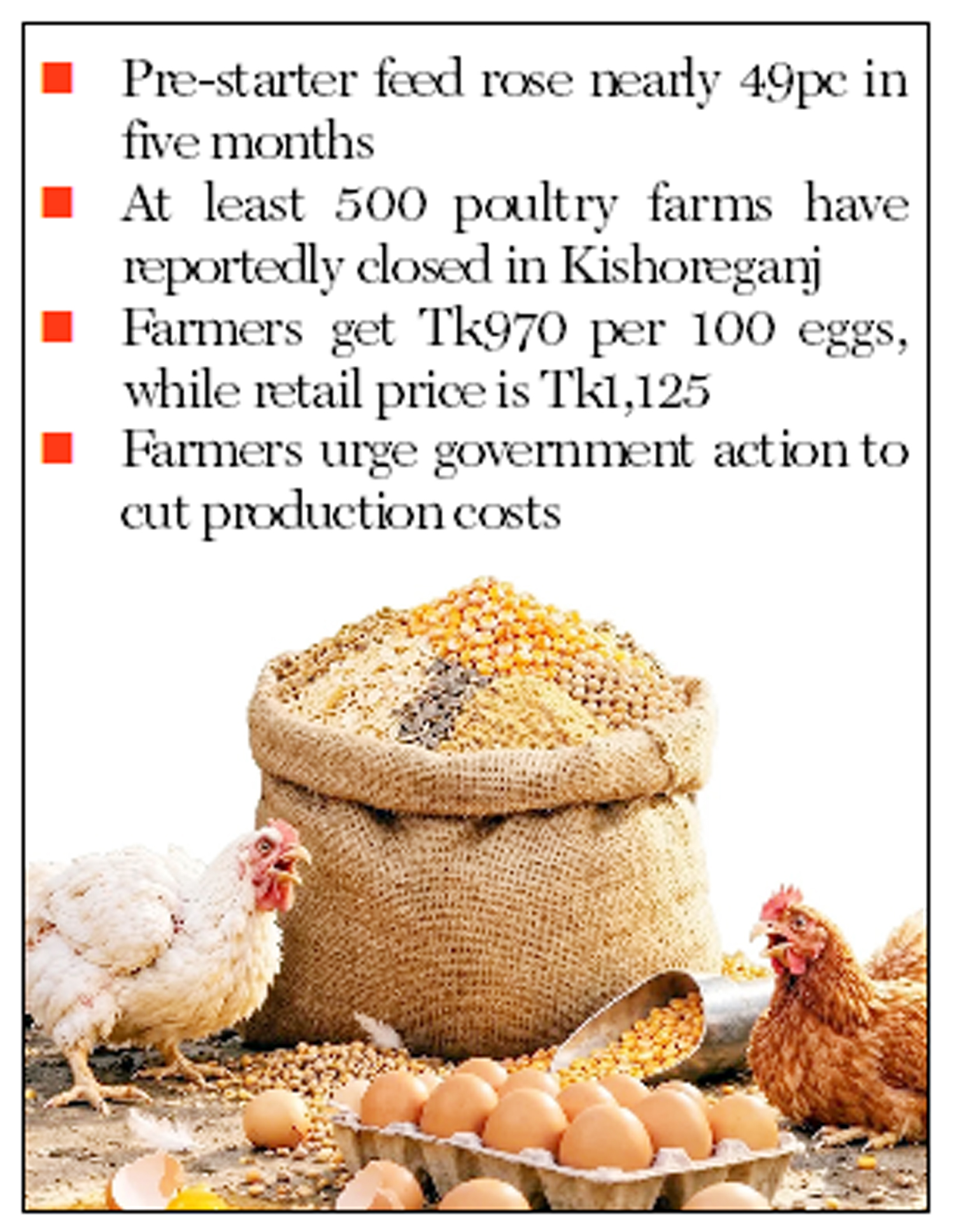
Poultry feed prices have risen sharply, adding to the financial pressure on farmers already struggling with high production costs and low returns from egg sales.
Farmers said the rising prices of key raw materials, including maize, millet and wheat, had pushed up feed production costs. They also blamed increased demand for agricultural products for E20 ethanol production for creating shortages in the market.
According to farmers, large companies are procuring these crops through agricultural societies under long-term contracts, further tightening supplies.
Around five months ago, a 50-kg sack of pre-starter poultry feed cost Tk1,850. It now sells for Tk2,750, marking an increase of nearly 49 per cent. A sack of starter feed costs Tk2,715.
Farmers in Kishoreganj said they were already facing losses due to rising prices of chicks, feed, medicines and other farm essentials. Several farms have shut down as producers failed to receive fair prices for eggs. Repeated attempts to draw attention to their problems through human chains and memorandums have brought little relief, they alleged.
The latest increase in feed prices, which farmers linked to higher fuel and electricity costs, has pushed small-scale poultry operators into deeper financial trouble.
The situation was evident during visits to several farms in Danapatuli Union of Kishoreganj Sadar upazila on Tuesday.
Farmers said the district had more than 3,000 registered poultry farms, including over 200 along both sides of the Kishoreganj-Nikli road. While some farms are still producing eggs, many others remain closed because of fears of further losses.
Shamsu Mia, a senior farmer from Paschim Mathia village in Sadar upazila, said he had 10,000 layer chickens on his farm.
Around 5,000 of them lay eggs daily, while the remaining birds are expected to start laying soon.
He said farmers used feed from different companies, including Quality, Paragon and Provita. Depending on the company, a 50-kg sack currently costs between Tk2,987 and Tk3,021.
Following increases in fuel prices, feed costs have risen by at least Tk225 per sack over the past three months, putting additional pressure on farmers, he said.
Similar difficulties were reported by Mosharraf Hossain of Danapatuli and Sohel Mia of Mahishber village. Of Mosharraf’s 1,630 chickens, 1,350 lay eggs daily, while 810 of Sohel’s 1,000 chickens produce eggs.
Farmers said they sold 100 eggs to local traders for Tk950 last Sunday.
The price increased by Tk20 to Tk970 on Tuesday, but remained insufficient to cover production costs.
They estimated that 400 chickens require one sack of feed daily, costing around Tk3,000. Even if all 400 chickens lay eggs, the revenue would be Tk3,880 at the rate of Tk970 per 100 eggs. In reality, however, not every chicken lays an egg daily.
After adding medicine, electricity bills, workers’ wages and farm maintenance costs, farmers said their earnings fell short of expenses, forcing them to cover the losses from their own pockets.
Meanwhile, consumers are paying considerably more for eggs at retail markets. A market survey found that eggs were selling for Tk45 each, equivalent to Tk1,125 per 100 eggs. This creates a Tk155 difference per 100 eggs between the farm-gate and retail prices.
Kishoreganj District Livestock Officer Dr Abdul Mannan said around 3,000 poultry farms were registered in the district, alongside several unregistered ones.
He acknowledged that several farms had closed due to rising feed and other production costs. The livestock department was providing farmers with various forms of support, including technical advice, to help them sustain their businesses, he added.
Sadequr Rahman, president of the Kishoreganj Poultry Farm Association, said prices of chicks, feed and medicines had increased, while egg prices had not risen at the same pace.
Around 500 farms in the district had already closed due to losses, he said, adding that the sector had also created employment opportunities for many young people.
He urged the government to intervene to reduce the prices of raw materials and help poultry farmers survive.