From ODA to EPA: Redefining Bangladesh-Japan relations

Dr. Nasim Ahmed :
Bangladesh and Japan share a long-standing relationship that has evolved from diplomatic ties to deep economic collaboration.
Over more than five decades, Japan has consistently been among Bangladesh’s most significant development partners, investors, and trading partners.
Japan’s early support was anchored in development assistance, which helped the newly independent country with rehabilitation and infrastructure development.
Over the subsequent decades, Japan’s involvement expanded to include development finance, human capital development, and trade facilitation.
By the early 2000s, Japan had emerged as one of Bangladesh’s largest bilateral development partners, with total loans and grants amounting to tens of billions of dollars across sectors such as transport, power, health, education, and water supply. Japan also became a major source of foreign direct investment.
Japanese enterprises have invested in Bangladesh’s manufacturing, energy, fast-moving consumer goods, financial services, and pharmaceuticals sectors.
Despite these strong ties, Bangladesh and Japan had not concluded a comprehensive bilateral trade agreement by 2026.
Most trade was governed by Japan’s duty-free access for Least Developed Countries (LDCs), under which Bangladesh enjoyed preferential market access to Japan for many products, even in the absence of a formal trade agreement.
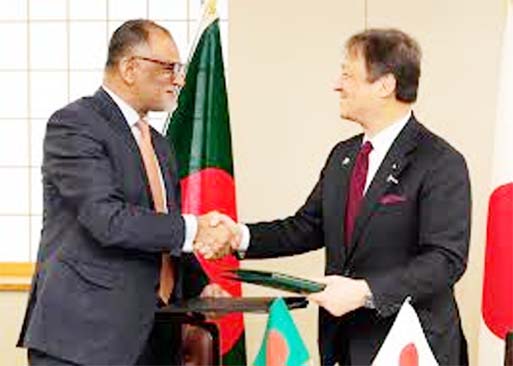
The most pivotal recent development in Bangladesh-Japan economic relations is the signing of the Bangladesh-Japan Economic Partnership Agreement (EPA) in Tokyo on February 6, 2026, Bangladesh’s first comprehensive EPA with a developed country.
This agreement marks a strategic shift from historical development cooperation to an integrated economic partnership that extends beyond tariff arrangements to include trade in services, investment, and regulatory cooperation.
Under the EPA, Bangladeshi exports of 7,379 products will enjoy immediate duty-free access to the Japanese market upon the agreement’s entry into force, thereby preserving preferential treatment as Bangladesh graduates from LDC status.
In return, Japan will receive duty-free access for 1,039 products in Bangladesh, thereby broadening Japanese manufacturers’ reach in a rapidly expanding South Asian market.
Both countries have agreed to open multiple service sectors, with Bangladesh opening 97 sub-sectors and Japan opening 120, thereby fostering deeper integration of trade in services and business linkages.
The EPA not only preserves Bangladesh’s market access previously secured under LDC preferences but also institutionalizes a stable, predictable legal framework for future trade and investment.
The agreement commits both nations to a free, open, fair, and rule-based economic system, emphasizing labor and environmental standards alongside trade liberalization.
The EPA with Japan offers several potential economic benefits for Bangladesh, as outlined below:
1. Duty-free access to a high-value, quality-oriented market like Japan incentivizes Bangladeshi exporters, particularly in apparel, textiles, jute goods, leather products, and processed agricultural exports, to improve quality and diversify their product offerings. This is critical as Bangladesh prepares to compete with other regional exporters, such as Vietnam and Indonesia, in global value chains.
2. The EPA is expected to attract Japanese investors seeking to use Bangladesh as a production base or export hub. Japanese capital, known for its emphasis on quality and technology transfer, can boost Bangladesh’s manufacturing sophistication, particularly in light manufacturing, automotive components, and electronics.
3. Opening up the service sectors creates opportunities in IT, logistics, tourism, and professional services. These sectors align with Bangladesh’s demographic dividend, where a large youth population seeks skilled employment.
4. As Bangladesh transitions from LDC status in 2026, the EPA cushions potential trade disruptions and anchors Bangladesh’s development trajectory within structured trade and investment frameworks, thereby mitigating the risk of losing preferential access.
While trade liberalization is a major recent development, Japan’s role as a development partner remains robust.
Japan continues to provide significant Official Development Assistance (ODA), including loans and grants for large infrastructure projects, such as the $630 million loan for the Joydebpur-Ishwardi dual-gauge railway project, and broader budgetary support exceeding $1 billion for economic reforms and infrastructure upgrades in Bangladesh.
The Bangladesh-Japan economic partnership also has a geostrategic dimension. Stronger economic ties with Japan diversify Bangladesh’s external economic relations and reduce overreliance on any single partner.
Japan’s strategic interest in Bangladesh aligns with its broader Indo-Pacific economic and security framework, in which economic cooperation is a pillar of regional stability.
Furthermore, Japan’s role in regional institutions and supply chains enhances Bangladesh’s integration into broader economic networks beyond bilateral relations, thereby strengthening resilience to external shocks and market uncertainties.
Bangladesh-Japan economic relations have evolved from traditional development assistance to a comprehensive strategic partnership anchored in trade, investment, infrastructure, and shared development goals.
The 2026 EPA marks a historic milestone, securing Bangladesh’s export prospects after LDC graduation and catalyzing deeper economic engagement with one of the world’s largest advanced economies.
As both countries implement the agreement, realizing its full potential will depend on Bangladesh’s ability to upgrade industrial capacity, improve product quality, and enhance the business environment.
For Japan, the agreement signals confidence in Bangladesh’s growth trajectory and offers a gateway to South Asia’s expanding markets.
Together, this partnership exemplifies how evolving economic diplomacy can drive sustainable development in an increasingly interconnected global economy.
(The author holds a PhD in Public Policy from Ulster University in the UK and currently works as Associate Professor of Public Policy at the Bangladesh Institute of Governance and Management (affiliated with the University of Dhaka). Email: [email protected])