
NBR protest called off as service declared essential
Staff reporter :
Officials of the National Board of Revenue (NBR) have withdrawn their protest movement following the Anti-Corruption Commission’s (ACC) decision to launch an inquiry into alleged misconduct by six senior NBR officials, including the president of the NBR Reform Unity Parishad.
The announcement was made by ACC Director General Akhtar Hossain during a press briefing held at the commission’s headquarters in Segunbagicha, Dhaka, on Sunday.
In parallel, the interim government has declared all positions within the NBR-spanning customs houses, inland container depots (ICDs), bond commissionerates, and customs stations-as part of the country’s “essential services.”
The move effectively prohibits any form of work stoppage under the Essential Services (Maintenance) Act.
In light of these developments, NBR officials have formally ended their movement, which had been demanding the resignation of the NBR Chairman and structural reforms of the board rather than its complete dissolution.
Sehela Siddiqua, Secretary General of the NBR Reform Unity Council, confirmed the decision to withdraw the protest on Sunday night.
Amid an intensifying standoff between officials of the National Board of Revenue (NBR) and the interim government, all roles under the NBR – including those in customs houses, inland container depots (ICDs), bond commissionerates, and customs stations – have been officially designated as “essential services.”
The government issued a statement on 29 June warning officials engaged in the ongoing nationwide protest to resume duties immediately or face strict legal action under the Essential Services (Maintenance) Act of 1952 and the Essential Services (Second) Ordinance of 1958.
These laws prohibit strikes or disruptions in services deemed vital to public interest.
“Officials and employees must return to work and refrain from activities that are illegal or detrimental to national interests. Failure to do so will compel the government to take strong action to safeguard the public and the economy,” the statement read.
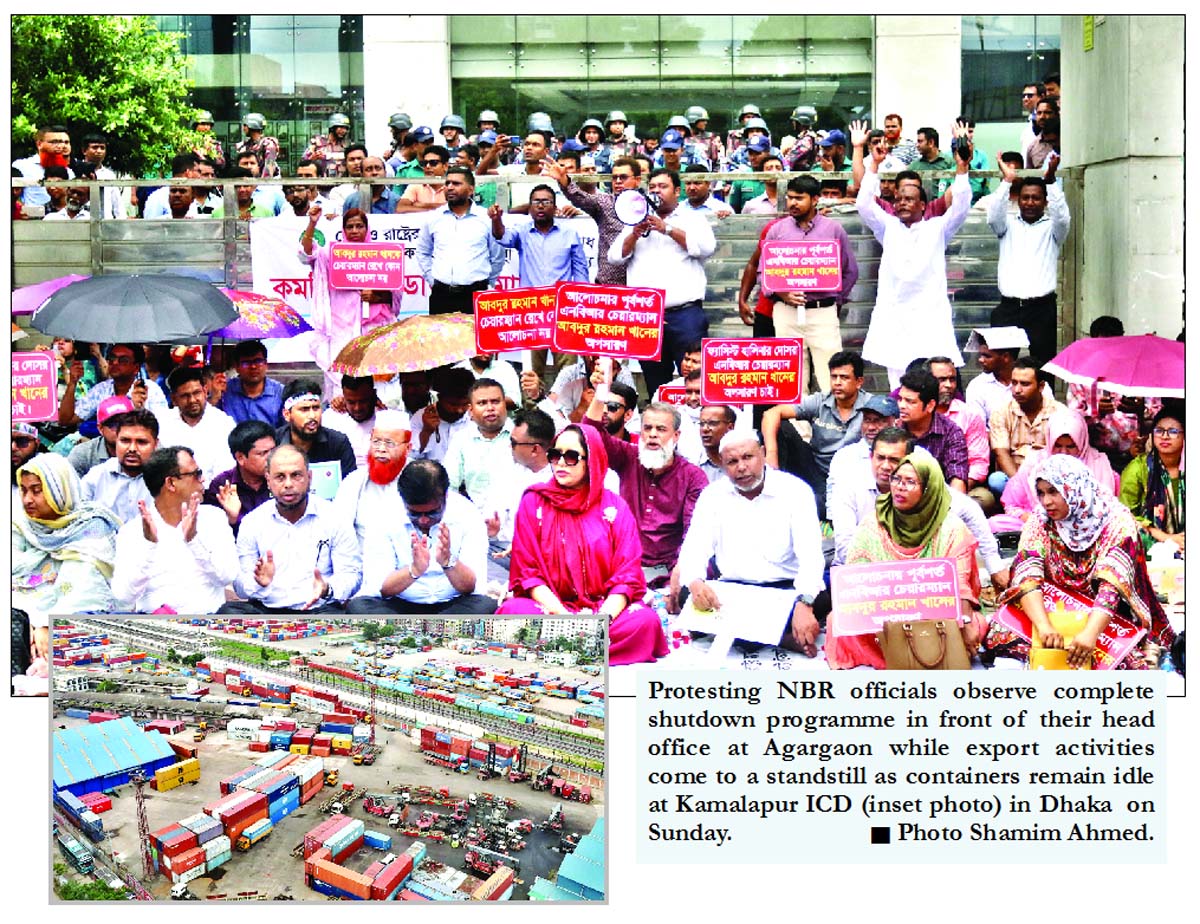
The protest, organised by the NBR Reform Unity Parishad, has paralysed customs, VAT, and income tax operations nationwide – exempting only international passenger services.
The shutdown began in response to a government ordinance issued on 12 May, which dissolved the NBR and the Internal Resources Division, replacing them with two new entities: the Revenue Policy Division and the Revenue Management Division. Protesters are calling for the resignation of the current NBR chairman and wider structural reforms.
The disruption has brought trade operations at key points, including the Chattogram Customs House, to a standstill.
Business leaders have voiced serious concerns over delays in imports and exports, as well as the impact on revenue collection at a time when the economy is under pressure.
In a bid to contain the fallout, Finance Adviser Salehuddin Ahmed held an emergency meeting with representatives from major business organisations, including the International Chamber of Commerce Bangladesh (ICC-B), Dhaka Chamber of Commerce and Industry (DCCI), Metropolitan Chamber of Commerce and Industry (MCCI), BGMEA, BKMEA, and others.
Business leaders urged the government and protesting officials to resolve the impasse swiftly to prevent further damage to trade and economic activities.
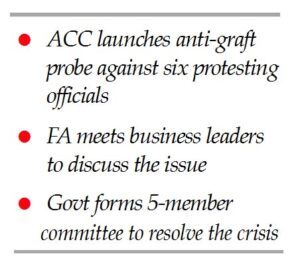
Besides, the interim government has established a five-member advisory committee led by Energy Adviser Fouzul Kabir Khan.
Other members include Housing Adviser Adilur Rahman Khan, Labour Adviser Brigadier General (Retd) M Sakhawat Hussain, Environment Adviser Syeda Rizwana Hasan, and Commerce Adviser Sk Bashir Uddin.
While the Cabinet Division has announced the formation of the committee, its precise terms of reference have yet to be made public.
In a parallel development, the Anti-Corruption Commission (ACC) has launched an investigation into six senior NBR officials, most of whom are prominent figures in the protest.
The inquiry focuses on allegations of long-standing corruption, abuse of authority, and accumulation of wealth beyond known sources of income.
The officials under investigation include AKM Badiul Alam (Member, Income Tax Policy), Mirza Ashiq Rana, Mohammad Morshed Uddin Khan, Monalisa Shahreen Sushmita, Reform Unity Parishad President Hasan Tarek Rikabdar, and Sadhan Kumar Kundu.
They are accused of facilitating tax evasion, accepting bribes, and engaging in retaliatory practices against those who refused to pay illicit fees.
While the ACC maintains that the timing of the investigation is coincidental and not directly linked to the protest, the overlap has drawn significant public scrutiny.
“Should further allegations surface, they will also be thoroughly investigated,” said ACC Director General Akhtar Hossain.
The government has reiterated its readiness for dialogue but has criticised the protest as “pre-planned and politically motivated,” insisting that the country’s economic stability must take precedence.