
Nationwide fever outbreak burdens health sector
Reza Mahmud :
A widespread outbreak of a mysterious viral fever is gripping Bangladesh, leaving both hospitals and households overwhelmed as large numbers of patients continue to fall ill across the country.
Reports from various districts and social media platforms, particularly Facebook, reveal that almost every family has at least one member suffering from the fever. Common symptoms include high temperatures, persistent cough, intense body aches, and fatigue, with many patients seeking treatment at home due to hospital overcrowding.
Tamanna Hossain, 23, from Bongshal in Dhaka, shared her ordeal: “I had a fever that lasted for days, fluctuating between 103°F and 104°F, accompanied by severe headaches and pain in my neck, shoulders, arms and legs. I was on medication, but the body pain was so intense I couldn’t walk or even stand without discomfort.”
Tamanna’s uncle, Mohammad Siraj, 52, is also unwell and struggling with weakness to the point where he is unable to walk properly.
In Nababpur, Dhaka, several residents have echoed similar experiences. Rezwana Bonny, 38, said, “This fever feels like it has shaved years off my life. I’ve had a constant temperature of 103-104°F for days. Even paracetamol doesn’t seem to help. The pain is unbearable, and I can barely manage to sip water.”
From Faridpur’s Boalmari upazila, Hasan Iqram described how his entire family, including his young daughter, was affected. “My daughter had a 105°F fever for several days, and then both my wife and I fell sick. We’ve recovered now, but we’re still too weak to carry out normal daily activities,” he said.
Similar accounts have been reported from Madaripur’s Shibchar upazila. Eighth-grade student Samy Mahmud and his younger brother suffered bouts of fever, with Samy falling ill again just two days after recovery.
While many patients are being treated at home, hospitals in Dhaka and other regions have reported a sharp rise in viral fever admissions.
Public health experts are referring to the illness as Pyrexia of Unknown Origin (PUO) – a condition characterised by prolonged fever exceeding 38.3°C (101°F) for at least three weeks, where the underlying cause remains undiagnosed despite thorough investigation.
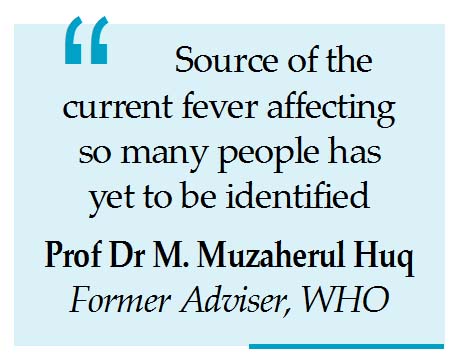
Speaking to The New Nation, Professor Dr M. Muzaherul Huq, former Adviser to the World Health Organization (WHO), stated, “The source of the current fever affecting so many people has yet to be identified.” He recommended symptom-based treatment tailored to individual patient needs.
Other experts, including Professor Dr Be-Nazir Ahmed, former Director of the Directorate General of Health Services (DGHS), called on the government to launch a nationwide investigation. “Patient samples must be collected and analysed to determine the root cause of the outbreak. A comprehensive guideline is urgently needed to contain the spread,” he said.
Dr Ahmed also highlighted that changing weather patterns due to climate change may be contributing to the spread of viral infections. He expressed concern over the state of diagnostic services in the country, noting, “Many facilities use outdated equipment and low-quality reagents, which may fail to accurately identify emerging diseases.”
Sources indicate that this year’s monsoon has brought erratic weather – frequent shifts between heat and rainfall – creating favourable conditions for viral transmission. While seasonal viral fevers are not uncommon during monsoon, experts say the scale and severity of this year’s outbreak are far greater than in previous years.