
July Uprising Anniversary: Nation celebrates fall of fascist regime
Reza Mahmud :
Bangladesh is set to observe the first anniversary of the historic fall of the fascist regime, led by Sheikh Hasina, following the culmination of last year’s July Uprising. The government has declared Monday a national holiday, with commemorative events planned across the country.
While many citizens expressed relief at living in what they describe as a “fascist-free” environment, others noted that their expectations for deeper reform remain only partially fulfilled.
Known among student-led movements as “36 July,” the date marks a turning point in the nation’s recent political history. The uprising, which reached its peak on 5 August 2024, came at a heavy cost: 844 people lost their lives, including 133 children, and approximately 18,000 others were injured during the protests.
Following the fall of the former government, hopes remain high among citizens for a more just and equitable Bangladesh. To mark the anniversary, the interim government is set to unveil the long-anticipated July Declaration on Tuesday at 5 pm in front of the South Plaza of the Jatiya Sangsad Bhaban. Chief Adviser Professor Muhammad Yunus will read the declaration at the official event.
According to a government statement released on Sunday, the declaration is the result of months of national consultations and political dialogue. Sources say it acknowledges the efforts of opposition parties, including the BNP and Jamaat-e-Islami, during Sheikh Hasina’s 15-year rule.
It also outlines the context and motivations behind the July Uprising, shaped largely by the anti-discrimination student movement. The declaration includes 26 to 27 points and will be retroactively effective from 5 August 2024.
Speaking at an event on Saturday, Interim Government Adviser Asif Mahmud noted that the declaration will go beyond being a political statement and is expected to be granted constitutional recognition.
In anticipation of large public turnout at the anniversary event, Bangladesh Railway has arranged eight pairs of special trains from different parts of the country.
The Traffic Commercial Division issued a directive on 3 August to facilitate the movement of students and other citizens to the capital.
The anniversary serves not only as a day of remembrance but also as a renewed call for the structural reforms championed by those who participated in the movement.
Political analysts say that, with the fall of the previous regime, Bangladesh now has a real opportunity to move toward a more inclusive and democratic future.
Speaking to The New Nation, BNP Standing Committee Member Dr Khandaker Mosharraf Hossain said, “While not all aspirations of the people have been fulfilled in the past year, the potential remains vast. The interim government must now clarify its reform roadmap. A fair and credible election would be a major milestone.”
Nahid Islam, Convener of the National Citizen Party (NCP), echoed similar sentiments at a recent rally in Moktarpara, Netrokona. “Despite the regime’s fall, many of the same systems remain in place.
The people, especially the youth, will not accept cosmetic change. We need structural reform, justice for past abuses, and a new constitution that breaks from past ideologies and ensures human rights.”
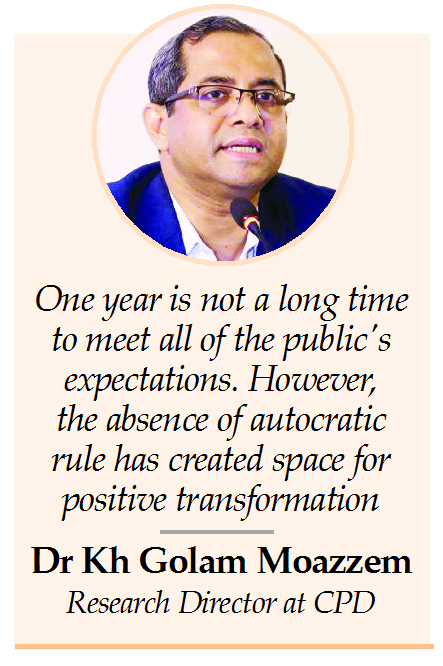
Prominent economist Dr Khondaker Golam Moazzem, Research Director at the Centre for Policy Dialogue (CPD), told The New Nation, “One year is not a long time to meet all of the public’s expectations.
However, the absence of autocratic rule has created space for positive transformation. What is needed now is political commitment and an elected government to drive sustainable economic development.”
As the country commemorates this pivotal moment, many view the July Uprising not just as a rupture from the past, but as the beginning of a still-unfolding journey towards lasting democratic change.