
Nation adieus Hadi amid mass mourning
Staff Reporter :
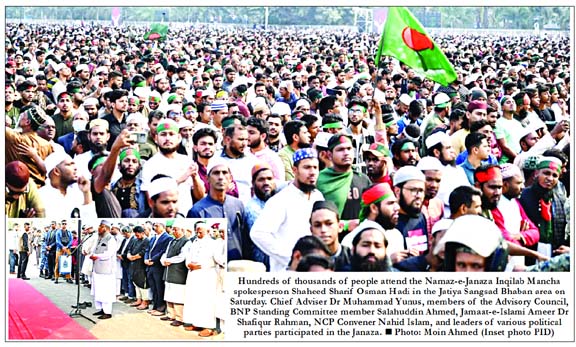
The whole nation witnessed an outpouring of grief, remembrance and resolve as tens of thousands of people gathered in the capital to pay tribute to Sharif Osman Bin Hadi, the slain spokesperson of Inqilab Mancha and a prominent leader of the July Uprising.
From the South Plaza of the Jatiya Sangsad to Dhaka University and distant districts, the day unfolded as a solemn yet defiant national farewell to a figure many regarded as a fearless voice against repression and injustice.
The largest gathering took place at the South Plaza of the National Parliament, where the namaz-e-janaza of Hadi was held in the afternoon amid tight security. From early morning, Manik Mia Avenue and its surrounding areas filled with mourners arriving in small processions.
People came from different parts of the capital and beyond, many using the Metro Rail from dawn, creating heavy passenger pressure at key stations. By the time the funeral prayer began, the plaza was overwhelmed with people carrying grief, anger and determination.
As Hadi’s body was brought to the South Plaza, slogans echoed through the crowd, with mourners chanting pledges to complete what they described as his unfinished struggle and declaring that his blood would not go in vain.
The atmosphere reflected not only sorrow over his death, but also a collective assertion of the ideals he had stood for. For many present, the gathering was as much a political statement as it was a final prayer.
Chief Adviser to the interim government Professor Muhammad Yunus attended the janaza, joined by members of the Advisory Council, Army Chief General Waker-Uz-Zaman, Jamaat-e-Islami Ameer Shafiqur Rahman and secretary Mia Golam Parwar, BNP Standing Committee member Salahuddin Ahmed, NCP convener Nahid Islam, and leaders of other political parties.
Before the prayer, Professor Yunus, Religious Affairs Adviser AFM Khalid Hossain and an Inqilab Mancha leader addressed the gathering. Hadi’s brother, Abu Bakar Siddique, led the namaz-e-janaza at around 2:30pm.
To ensure security during the massive gathering, the Dhaka Metropolitan Police deployed a large contingent of officers, supported by members of Border Guard Bangladesh at key points across the capital.
Around 1,000 body-worn cameras were used to monitor the situation and prevent any untoward incident.
Vehicular movement was suspended on several roads around the parliament complex, and authorities requested attendees not to carry bags or heavy items.
Flying drones were strictly prohibited in and around the area during the funeral prayer.
After the janaza at the parliament complex, Hadi’s body was taken in a procession to Dhaka University for burial.
For security reasons, all entry points to the campus were kept closed, and additional police and army personnel were deployed to maintain law and order.
Preparations for the burial had begun earlier in the day beside the grave of national poet Kazi Nazrul Islam, near the Dhaka University Central Mosque, with grave-digging starting around late morning.
At around 3:30pm, Sharif Osman Hadi was laid to rest beside national rebel poet Kazi Nazrul Islam’s grave, fulfilling the wishes of his family.
The choice of burial site carried deep symbolic meaning for many, placing the fallen activist beside the rebel poet whose words and life had long inspired resistance and defiance in the country’s history.
Among those present at the burial were Dhaka University Vice-Chancellor Professor Niaz Ahmed Khan, Dhaka University Central Students’ Union Vice-President Md Abu Shadik Kayem and National Citizen Party Chief Organiser (South) Hasnat Abdullah.
After the burial, Professor Niaz Ahmed Khan said Hadi had become a part of history and prayed that Allah would accept the sacrifice he made for the country.
Describing Dhaka University as having embraced one of its own, the vice-chancellor said the institution had accepted Hadi as a child of the university by laying him to rest beside the national poet.
His remarks reflected the sentiment shared by many students and teachers who see Dhaka University as a historic centre of political movements and sacrifice.
Beyond the capital, the nation observed a one-day state mourning in honour of Hadi.
The national flag was flown at half-mast at all government, semi-government and autonomous offices, educational institutions, private buildings and Bangladesh missions abroad.
Special prayers seeking forgiveness for his departed soul were organised in mosques across the country after Jumma prayers, while other places of worship also arranged prayers in his memory.
In different districts, people held gayabana janaza prayers, allowing those unable to travel to Dhaka to participate in the national mourning.
Meanwhile, Inqilab Mancha Member Secretary Abdullah Al Jaber called on supporters to proceed to Shahbagh after the funeral to press for justice.
“We did not come here just to mourn. We came to demand justice for our brother,” he said.
Urging discipline, Jaber asked supporters not to respond to any provocation or calls for violence, adding, “All future decisions and programmes will be announced by Inqilab Mancha.”
He said those responsible for Hadi’s killing had still not been arrested, even a week after the incident.
“It has been seven days, yet the attackers are still at large,” Jaber said, demanding that the home affairs adviser and special assistant to the chief adviser, Khoda Baksh Chowdhury, “brief the nation within the next 24 hours on what steps have been taken so far.”
Sharif Osman Hadi, 32, was a convener of Inqilab Mancha and a leading figure in the 2024 July Uprising.
He was also preparing to contest the upcoming national election as a prospective independent candidate from the Dhaka-8 constituency.
Hadi was shot in the head on December 12 while travelling in a rickshaw in the capital’s Puratan Paltan area, a day after the Election Commission announced the February 12 national election, the first since the ouster of former prime minister Sheikh Hasina last year.
He was first taken to Dhaka Medical College Hospital, later shifted to a private hospital, and then airlifted to Singapore on December 15 for advanced treatment, where he died from his injuries on the night of December 18. His death sparked widespread protests in Dhaka and several other districts.
Saturday’s scenes of mourning and tribute showed how deeply Hadi’s life and death have resonated across the country.
From mass prayers at the heart of the capital to quiet supplications in distant towns, the nation’s farewell to Sharif Osman Hadi blended grief with a renewed sense of purpose, as supporters vowed to remember him not only as a victim of violence, but as a symbol of resistance whose voice would echo beyond his grave.