
Nahid rejects Mujib as ‘father of nation’
Staff Reporter :
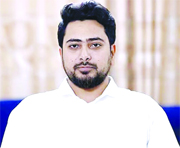
In a move certain to deepen political divides and unsettle decades of state-sanctioned history, Nahid Islam, convener of the National Citizens’ Party (NCP), has declared that Sheikh Mujibur Rahman – widely celebrated in official narratives as Bangladesh’s “Father of the Nation” – does not merit the title.
The statement, delivered Friday in a lengthy Facebook post, denounced the designation as a product of partisan mythmaking rather than popular will, accusing the Awami League of using it to sustain a personality cult.
“The title ‘Father of the Nation’ was not born from the people’s will,” Nahid wrote. “It was manufactured by the Awami League to sanctify a personality cult. We reject this political mythology. Sheikh Mujibur Rahman is not the Father of the Nation.”
While acknowledging Mujib’s leadership during the 1971 Liberation War, Nahid sharply criticized his post-independence governance, from the adoption of what he called a “constitution forced upon the people” to the erosion of democratic freedoms, economic mismanagement, and the creation of BAKSAL – the one-party system established in early 1975.
He accused Mujib’s government of turning Bangladesh into a “client state of India,” undermining sovereignty in foreign and security policy, and presiding over lawlessness and political violence. His harshest criticism was reserved for what he termed “Mujibism” – not a liberation legacy, he said, but an ideological system that the Awami League used for decades to consolidate power and suppress dissent.
“Mujibism today means enforced disappearances, extrajudicial killings, institutional decay, corruption on a national scale, and the weaponization of history,” Nahid wrote. “They’ve turned a national leader into a deity and the country into a family estate. For 15 years, they ruled without accountability – stealing, repressing, and rewriting history.”
Nahid credited the 2024 People’s Uprising – a youth-driven movement that forced the Awami League from power and led to sweeping constitutional reforms – with dismantling what he called a “feudal-style regime” rooted in dynastic rule and ideological monopoly.
“That revolution broke the chains of personality cults,” he declared. “From now on, no individual, family, or ideology will be allowed to hijack the state, erase pluralism, or impose fascism in the name of liberation.”
Arguing that the Liberation War was the achievement of millions – farmers, students, workers, women, religious minorities, and fighters across ideological lines – Nahid warned against attributing victory to a single leader or party. “The war was won by the people, not by a single party. To claim otherwise is to betray the martyrs,” he wrote.
He called for a political, cultural, and ideological transformation to ensure that no leader stands above the Constitution, no party monopolizes the 1971 narrative, and no family treats the state as private property. His manifesto included a defense of equal citizenship for Muslims, Hindus, Buddhists, Christians, indigenous peoples, atheists, and secularists – and a rejection of attempts to monopolize patriotism or history.
Nahid also urged resistance to what he called the “toxic elements of Mujibism” – from land grabbing against minorities and the erosion of judicial independence to the sale of national assets to foreign powers. “Our goal is not to erase history,” he concluded, “but to reclaim it from myth and restore power to the people.”