
Mudslinging in politics will tarnish democracy
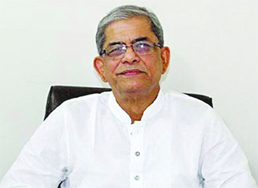
Staff Reporter :
BNP Secretary General Mirza Fakhrul Islam Alamgir on Thursday said a lack of mutual understanding among political parties leads to bitterness in politics.
He said, “There must be a mutual understanding among the parties. Without it, mud-slinging in politics will increase. Democracy will be tarnished by mud-slinging. Many things will be said. But there needs to be a limit to this. Otherwise, a kind of bitterness emerges, which in the long run further contaminates politics. I hope that in the coming days, we can move towards building a better Bangladesh.”
He made these remarks while speaking at a discussion meeting marking the anniversary of the historic July-August mass uprising, organized by the National Press Club. The BNP Secretary General said that after a long struggle, a new opportunity has emerged to build a democratic Bangladesh. “I deeply believe in democracy. Those who lead revolutions will form revolutionary parties, organize revolutionary groups, and by forming a revolutionary government, they will bring success to the revolution,” he added.
“I believe we will come to power through elections with the support of the people. We will try to fulfill the promises made to the people. Then we will return to the people again – if they accept us, we will come back, if not, we will not. Everyone must be allowed to express their opinions, everyone must have the right to speak. An ordinary person has the right to fair justice, the opportunity to establish dignity in society. But today, not just in Bangladesh, liberal democracy is declining globally,” he said.
Mirza Fakhrul said that with technological change, people’s mentality and everything else gradually changes.
“Due to this change, it is becoming difficult to sustain politics without altering the current political structure. Recently, I visited China with senior BNP leaders. Every time I visit China, I see a different China – it is changing every day. Their system is different from ours. America’s political system is also not the same as ours,” he added.
The BNP leader stated, “We have in fact been freed from slavery – from British rule in 1947. Then came Pakistani rule. And now, once again, we are enslaved under new masters in Bangladesh. We are still in that bondage. Slaves tend to develop a narrow mindset. They cannot think big. I believe we should try to think big. We want a free society. We want to build a free state.”
Fakhrul criticized the interim government for failing to prepare a list of martyrs from the July uprising, even after one year. He said, “Those currently in charge of the state – have they not been able to identify them in a year? Those who gave their lives and blood to change this country – you couldn’t even prepare a list and ensure proper recognition and rehabilitation?”
He called for quickly handing over state responsibility to an elected government through an election.
Emotionally recalling a child injured in the mass uprising in Savar, Fakhrul said in a choked voice, “Yesterday, a child suddenly came up and hugged me. The child said, ‘I don’t have a skull, it’s plastic.’ They made an artificial skull from plastic and fitted it. What greater sacrifice could there be than this? If we cannot stand firmly, we are undoubtedly committing a great betrayal to these children and our mothers and sisters.”
Referring to the consensus among political parties on fundamental reforms of the state as a “positive” development, he said, “There are core issues, and by resolving them, we’ve gained a rough idea of an upcoming election. If elections are held in February, we can overcome internal differences and reach a common ground.”
In recognition of their suffering and harassment during the past 15 years of anti-fascist movements and the July uprising, awards were presented to Matiur Rahman Chowdhury, editor of Manabzamin; Mahmudur Rahman, editor of Amar Desh; Nurul Kabir, editor of New Age; Shafik Rehman, editor of Jaijaidin; and Abul Asad, editor of Sangram. Among them, Matiur Rahman and Mahmudur Rahman received crests from National Press Club President Hasan Hafiz and General Secretary Abdul Bhuiyan, along with committee members. The others could not attend due to being abroad or ill.
The meeting was presided over by National Press Club President Hasan Hafiz. Others present included BNP Standing Committee Member Dr. AZM Zahid Hossain, and Jugantor Editor Abdul Hai Shikdar, among others.