
May brings relief on inflation, pressure on reserves
Farrukh Khosru :
Bangladesh’s economic landscape presented a mixed picture in May 2025, with encouraging signs of easing inflation and robust remittance inflows, offset by continued pressure on foreign exchange reserves and mixed trends in market prices.
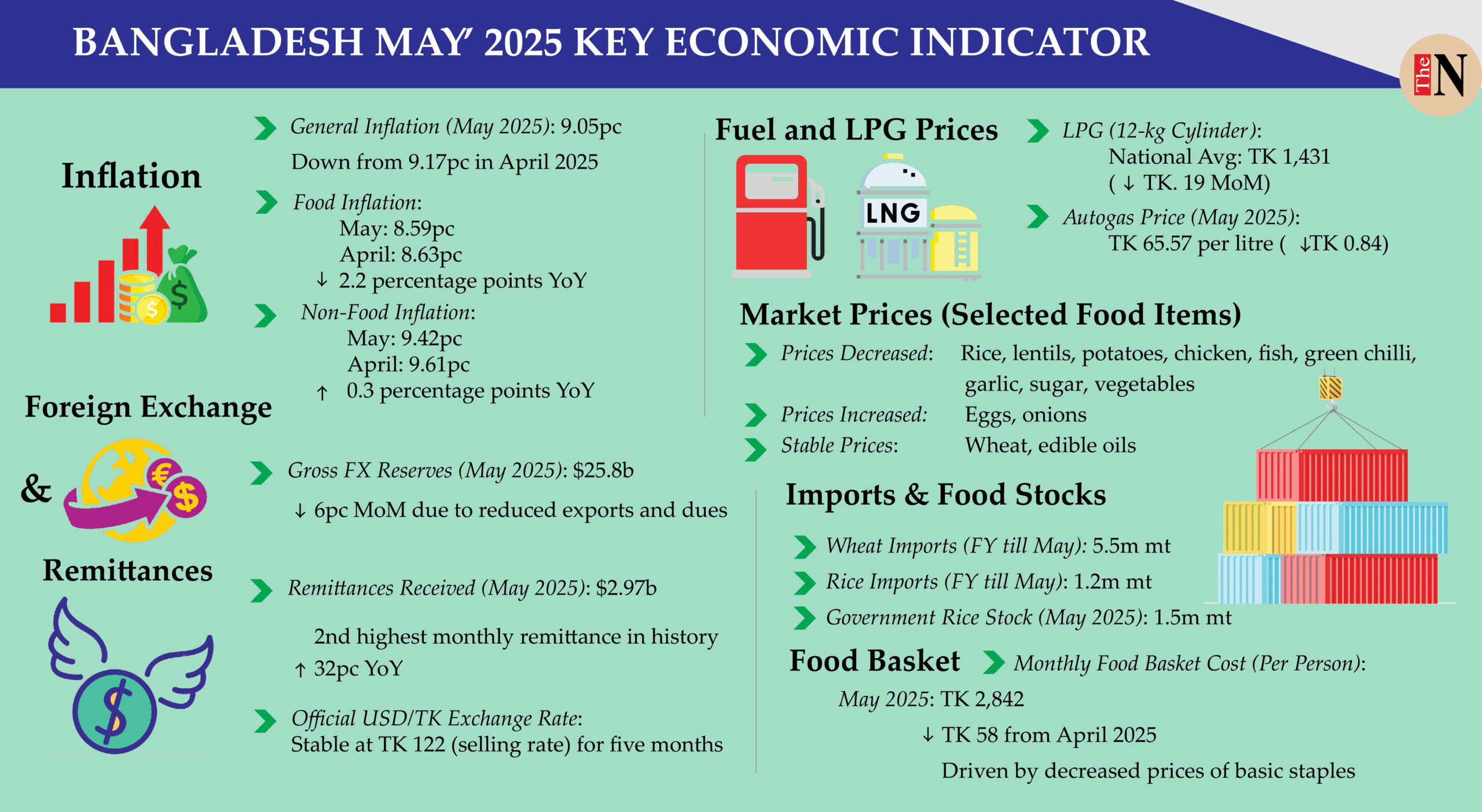
The general inflation rate in Bangladesh edged down to 9.05 per cent in May 2025, a marginal decline from 9.17 per cent in April, continuing a steady downward trajectory that began in December 2024 – with a brief uptick in February. This easing trend was reflected in both food and non-food sectors.
Food inflation dipped slightly to 8.59 per cent in May, down from 8.63 per cent the month before. Non-food inflation also declined, falling to 9.42 per cent from 9.61 per cent in April, signalling a modest reduction in the overall cost of living. Economists credit the fall to a combination of supply-side interventions and demand-management strategies implemented by the government.
A closer look reveals contrasting dynamics between urban and rural areas. Rural food inflation dropped to 8.3 per cent, while urban food inflation ticked up to 9.3 per cent. Year-on-year, food inflation fell by 2.2 percentage points, while non-food inflation recorded a 0.3-point increase.
Despite a strong showing in remittance inflows, Bangladesh’s gross foreign exchange reserves saw a sharp decline, falling to $25.8 billion in May – a six per cent drop from the previous month. The decrease is attributed to lower export earnings and the settlement of international payments.
On a more positive note, remittances surged to $2.97 billion in May, marking the second-highest monthly inflow in the country’s history after March 2025.
The 32 per cent year-on-year growth in remittance earnings has been linked to the stability of the US dollar exchange rate, increased overseas employment, and the pre-Eid-ul-Adha period, which traditionally sees a rise in money transfers from expatriate workers. The official exchange rate has remained stable at $122 to the US dollar for the past five months.
Fuel prices offered some relief to consumers in May. The Bangladesh Energy Regulatory Commission (BERC) lowered the average national price of Liquefied Petroleum Gas (LPG) by $19, setting the rate at $1,431 for a standard 12-kg cylinder. Autogas, used in motor vehicles, also saw a slight reduction of $0.84, falling to $65.57 per litre.
These adjustments followed a drop in global crude oil prices, particularly from major exporters such as Saudi Arabia. However, local LPG pricing remains sensitive to exchange rate fluctuations and VAT policy. In Cox’s Bazar, the LPG price saw an even steeper decline of $ 33, settling at $1,427 for a 12-kg cylinder.
Retail food markets experienced a general cooling of prices in May. Staples such as rice, lentils, potatoes, chicken, fish, green chilli, garlic, sugar, and various vegetables showed month-on-month declines. However, the prices of eggs and onions rose, while wheat and edible oils remained largely unchanged.
In Cox’s Bazar, a similar pattern was observed, though lentils, fish, and edible oils saw localised price increases.
Bangladesh’s wheat imports continued to rise, reaching 5.5 million metric tonnes (mt) by May in the ongoing fiscal year.
The increase is largely attributed to falling global prices, improved supply chains, and higher domestic demand. Rice imports also stood at 1.2 million mt over the same period, aimed at shoring up reserves and containing market volatility.
Government rice stocks were reported at 1.5 million mt in May, with procurement from the ongoing Boro harvest expected to boost reserves further. In a proactive measure, authorities have relaxed public procurement regulations to ensure a stable food supply and prevent future price shocks.
The national average monthly cost of a basic food basket decreased by $58 in May, reaching $2,842 per person. This decline reflects falling prices in essential food categories including rice, lentils, potatoes, poultry, fish, sugar, and fresh vegetables.
Overall, while challenges remain – particularly in terms of foreign exchange reserves and certain market price pressures – May 2025 offered signs of economic resilience and cautious optimism for Bangladesh’s short-term outlook.