
Koyra Union: Living with impact of disasters on coast
Khulna Bureau :
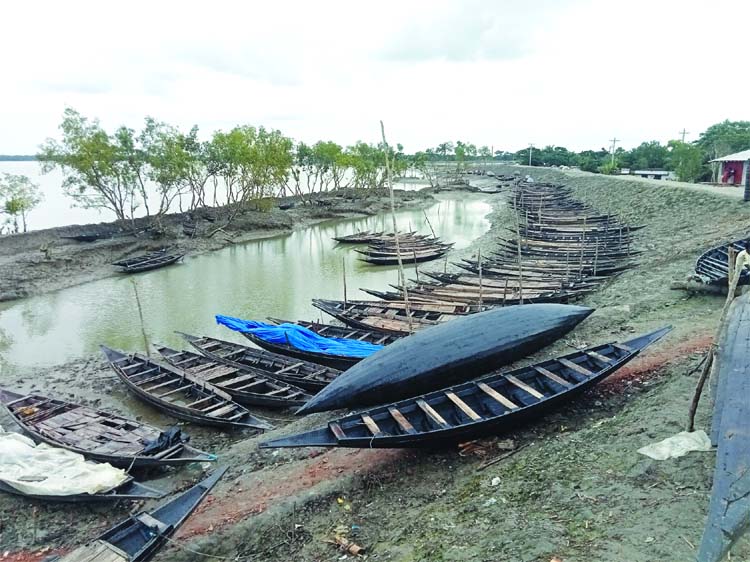
Dakshin Bedkashi Union of Koyra is a coastal township “near the lap of the Sundarbans”. The Kapotaksha, Shakbaria and Arpangasia rivers surround this land from three sides.
When you go to Dakshin Bedkashi, the first thing you see is the broken embankment. The tides of the river and the onslaught of cyclones have become a part of life here.
Disasters like Aila in 2009 have left people destitute, while Sidr, Amphan and Yas have created new wounds. Every time houses are washed away, you have to build anew.
Local school teacher Maulana Mahfuzur Rahman said, “If the embankment breaks here, everything is washed away, and there are not enough shelters.
People have to live in constant fear. Uncertainty of livelihood: The livelihood of the people in the area is based on the river and the Sundarbans.
The family survives by collecting fish, crabs and honey. But there is also the fear of tigers and crocodiles, the rules of the forest department, and The power of forest robbers.
A fisherman said, “For seven days, the forest department has to pay 2,700 taka to get a pass. But when you go to the forest, you have to pay 4,000 taka per trip to the ‘Dulabhai Bahini’ or ‘Chhot Jahangir’ or ‘Bard Jahangir’ armies.”
Lack of clean water: According to many in the South Bedkashi area, the shortage of clean water is also serious. Ordinary tubewells do not provide water for several months of the year. Those who have submersibles are somewhat relieved.
Reflection of struggle in women’s lives: The story of a housewife named Rafiun Nesa is a reflection of the entire coast.
After her husband died, she started living in a risky hut next to the embankment with her four children. Despite the disasters like Sidr, Aila, and Amphan that swept away her family, she has stood up again and again.
Paubo says that the rehabilitation work of Polder No. 14/1, which borders the Bedkashi Union in South Koira on three sides, is underway.
In addition to repairing the damaged embankment at a cost of about Tk 35 crore, it is being strengthened by installing blocks. Paubo Executive Engineer Abdur Rahman Tazkia said, “The project started in January this year and will be completed by November. If it is completed, people’s lives will be at least somewhat safer.”