
Let humanity bloom, not only focusing on result-oriented education?
Mohammad Zahidul Islam Mian :
Education is a lifelong process which is dedicated to shaping a person into a complete human being. It is the most powerful tool to move a nation forward. However, while education has historically been one of the cornerstones of human civilisation, unfortunately, it is gradually being reduced to something narrow, limited to obtaining GPA-5 certificates or securing jobs. Being truly educated and passing exams are not the same. As a result, while the passing rate continues to rise but the quality of education shows little improvement.
We are hardly paying any attention to how humane or well-rounded our children are becoming. Instead, everyone is preoccupied with personal interest. Education acquired in exchange for money has been stripped of patriotism, politeness, civility, and human values. There is now a severe shortage of people with the moral courage to call the right “right” and the wrong “wrong.” This is why I feel our national slogan should be: “Let humanity flourish, not only focus on result-oriented education.”
Education that does not broaden one’s vision, awaken the conscience, expand the horizon of thought, and instil a sense of humanity cannot be called true education. Education must therefore be rooted in morality and humanity, improving students’ ethical standards while awakening their inner values. A person who lacks morality, no matter how knowledgeable, cannot play a meaningful role in social reform or in upholding the values of society. The development of a student’s moral and humane qualities depends on the triangular relationship between students, teachers, and parents.
In the current context, we must ask: what is the true social impact of education today? Does merit or money control our society? Who commands greater respect – the wealthy or the wise? Do people chase money or wisdom? What is the backbone of our nation – education or economy? Is education shaping a society or building an empire? Who are our role models – corrupt individuals or those seeking shallow popularity? Is education solving problems or merely teaching us to blame others? Is it expanding our conscience or pushing us toward blind imitation?
These questions are deeply relevant, as our families, communities, and nation are witnessing a severe degradation of values. Morality and compassion are fading rapidly. Society is becoming corrupt, selfish, and intolerant. Humanitarian vision is disappearing while self-interest dominates everything. Today’s young generation faces a crisis – the absence of role models. Whom will they follow? Whose character will they emulate? Whose guidance will help them build their dreams? In many cases, the worst offenders in society are not uneducated. They are often well-versed in academic knowledge yet morally bankrupt. Love, compassion, and empathy have almost vanished. Corruption and immorality dominate social life.
Jealousy, hatred, violence, murder, rape, snatching, and abduction have disrupted the rhythm of daily life. Crimes such as drug abuse, teenage gangs, extortion, child abuse, and violence against women are increasing alarmingly. This unhealthy competition in wrongdoing is leaving our children and youth mentally scarred and increasingly misguided – a terrifying prospect for any nation.
The family is the cradle of a person’s thoughts, actions, and behaviour. Respect for others, morality, and the ability to embrace differing opinions are first learned at home. A child’s first school is the family, and the first teacher is the parent. Thus, parents play the most important role in instilling family values, shaping character, and raising their children to become honest and ideal citizens. For this to happen, family members themselves must embody ethical qualities.
Unfortunately, in today’s world, parents are often preoccupied with their own lives. They expect their children to come home early while they themselves return late at night. Many parents, instead of emphasising moral education, push their children into a destructive race focused solely on certificates and grades. Since birth, a child is thrust into an unhealthy competition for scoring the highest marks or getting admitted to prestigious schools or merely looking for a job. Rarely is it our point of discussion how to raise children to be moral, compassionate, and patriotic individuals.
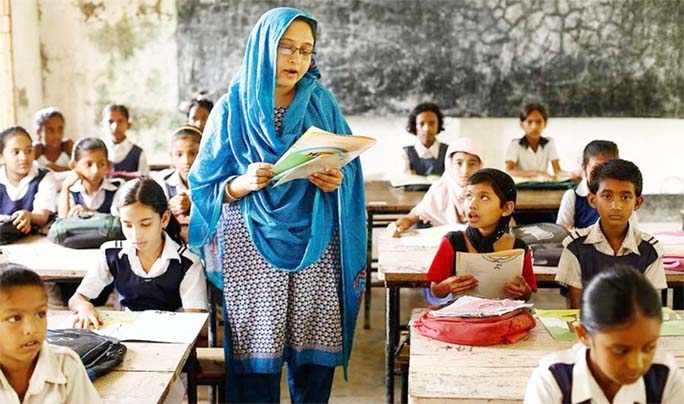
Teachers hold a blessed responsibility. They are not just lesson-givers but guides, mentors, and moral examples. A good teacher inspires a student to think freely, to dream big and to stand for justice. But today, our schools too often chase grades and passing rates. Coaching centres and private tutoring sometimes overshadow the classroom. Learning becomes exam-centred, not life-centred.
Students, in turn, come to perceive education as a burden rather than a source of delight. Stress and frustration rise. It can sometimes escalate into violence. Respect for teachers has dwindled, and pupils now lack role models to look up to.
If we truly want to build a developed, humane, and just society, our education system must be joyful and participatory. It must improve a student’s moral standards while awakening their inner humanity. Educational institutions should foster an atmosphere of celebration and mutual respect. Teachers must become role models, and parents must aim not just for their children to earn good grades but to grow into ideal human beings – intelligent, humane, morally sound, and patriotic. Relationships among parents, teachers, and kids should be founded on love and respect, not fear.
We must embrace technological advancements wisely, using them to improve skills and adapt to global standards. True education will awaken humanity and conscience, ensuring not only employment but also a profound appreciation for the beauty of life. Only then will our nation be safe for future generations, and only then shall we achieve the Bangladesh we aspire to build. Thus, the youth of today will shape the Bangladesh of tomorrow.
(The writer is Deputy Commissioner, Narayanganj).