
No Real Reforms: Legitimacy crisis, looming threat of authoritarian return
Special Report :
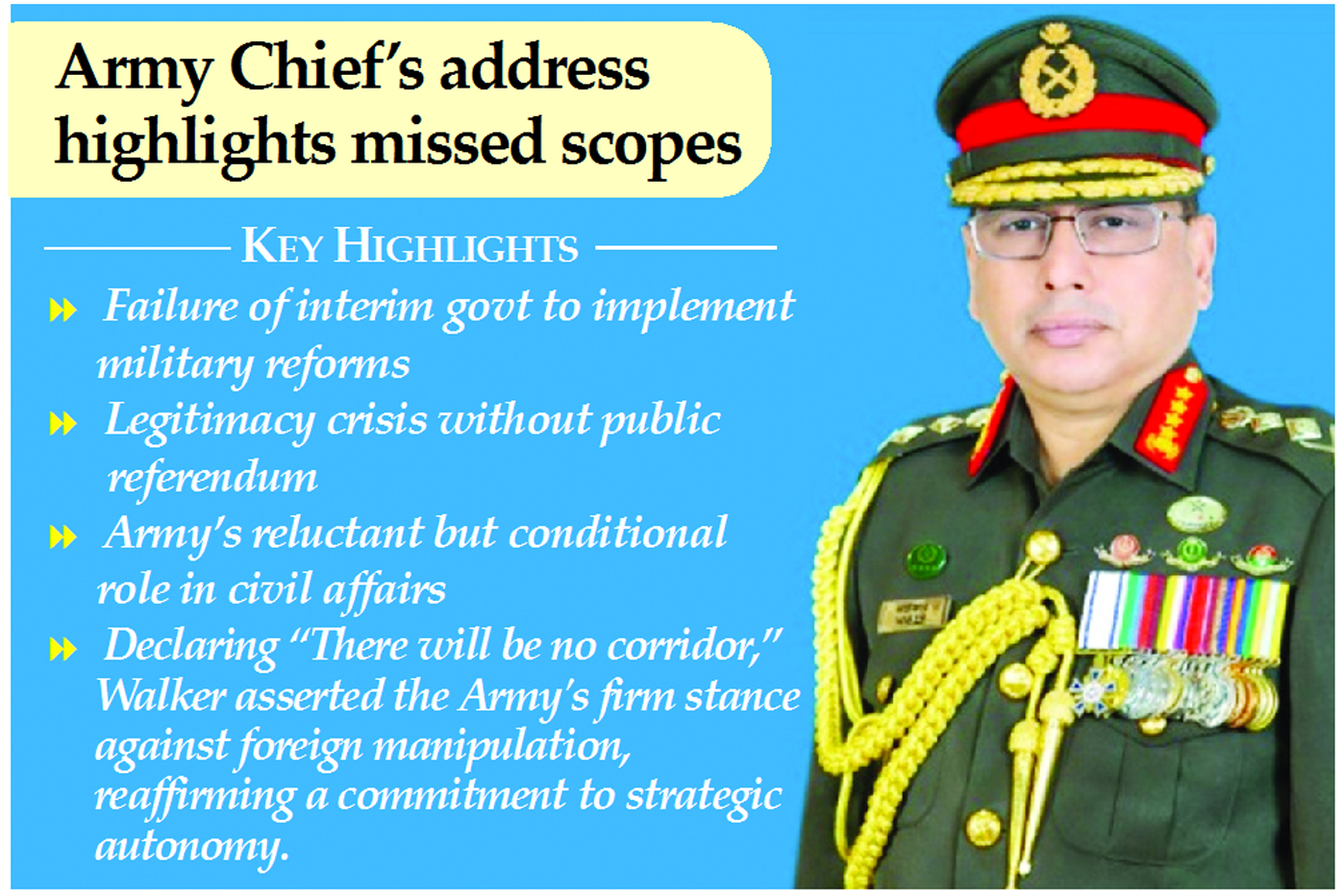
In a candid and far-reaching address to officers of all ranks, Bangladesh’s Chief of Army Staff, General Walker, laid bare the growing unease within the country’s most disciplined institution.
While reaffirming the military’s apolitical stance and commitment to national stability, he exposed the deep failures of the current interim administration — especially its inability or unwillingness to implement vital reforms or chart a legitimate course to democratic governance.
Though intended as a reassurance of military restraint, the speech served as a warning: without structural safeguards and a public mandate, Bangladesh remains dangerously exposed to a resurgence of authoritarian rule.
In a striking admission, General Walker acknowledged that the military’s proposals for reform had gone unheeded: “Even after ten months, no significant reforms have been seen.”
This declaration points to a missed historic opportunity. The ousting of Sheikh Hasina’s regime — widely condemned for its autocratic practices, mass human rights abuses, and large-scale corruption — created a unique window to re-engineer state institutions.
Expectations were high that the interim government would prioritize electoral reform, judicial independence, and institutional accountability. None of this materialized.
More troubling is what General Walker did not say. At no point did he address how any reform or election under an unelected interim government could acquire legal or moral legitimacy without the endorsement of the people through a referendum.
This silence has only deepened the constitutional crisis. Without a referendum, any election organized by the interim administration risks being declared void — domestically and internationally. The lack of democratic ratification renders both the process and outcome vulnerable to legal and political challenge.
This looming threat is already taking shape. The recently deposed fascist regime of Sheikh Hasina, which ruled through three consecutive rigged elections, continues to assert its authority. Hasina fled amid public outrage and international scrutiny, yet never formally resigned.
Her son, SajeebWazed Joy, who recently acquired U.S. citizenship via his now-divorced American wife Christina, has publicly claimed that Hasina remains the legitimate Prime Minister.
These statements, while legally unfounded, are part of a broader narrative aimed at undermining the legitimacy of any future administration formed without electoral reforms or public validation.
In matters of national sovereignty, General Walker was unequivocal: “There will be no corridor.” This declaration reflects the Army’s commitment to defending the country’s strategic autonomy against foreign manipulation — and a broader warning against turning Bangladesh into a pawn in regional power plays.
He emphasized that the Army will not entertain any informal or unofficial corridor arrangements with foreign entities or their proxies, nor will it be influenced by embassy directives.
Meanwhile, political parties are growing increasingly anxious as the prospect of election date announcements draws closer. In the absence of reforms, the old game is set to resume — and with it, the lucrative business of selling party nominations, which in past elections reached into thousands of crores of taka.
Without electoral reforms, party leaderships — often unaccountable and unelected — will once again auction nominations to the highest bidder, reducing democratic participation to a transactional affair.
This toxic practice, widely known but never prosecuted, further erodes the public’s faith in electoral politics and opens the door for unqualified, corrupt, and criminal candidates to return to power.
Referencing the painful memory of the 2007–2008 caretaker period, General Walker stated: “We don’t wish for anything like that again.” This sentiment underscores the Army’s reluctance to take on governance responsibilities — yet it also reflects their discomfort with standing idle while politicians gamble with the nation’s stability.
The Chief also confirmed that while the military intends to return to cantonments, it may still need to assist the civilian government for several months post-election to ensure law and order. Street violence, he warned, will no longer be tolerated.