
Laws in place but safe food still elusive
Noman Mosharef :
No one can predict when the struggle of the people of the country for safe food will come to an end, even though consuming safe food is considered a basic right.
While the government has undertaken a few initiatives to reduce the availability of contaminated food in the market, statistics from the last five years indicate that the consumption of adulterated food has been on the rise.
According to the International Centre for Diarrhoeal Disease Research, Bangladesh (ICDDR,B), around 70 per cent of the population consumes contaminated food, leading to various diseases such as cancer and others. This has resulted in an increase in hospital admissions across the country.
The government has enacted several laws aimed at ensuring safe food for the population. In 2009, the first comprehensive consumer rights protection law was introduced, leading to the establishment of the Directorate of National Consumers Rights Protection (DNCRP).
In 2013, the Safe Food Law was passed, and the Bangladesh Food Safety Authority (BFSA) was formed to coordinate efforts among 18 ministries and 486 agencies involved in food safety.
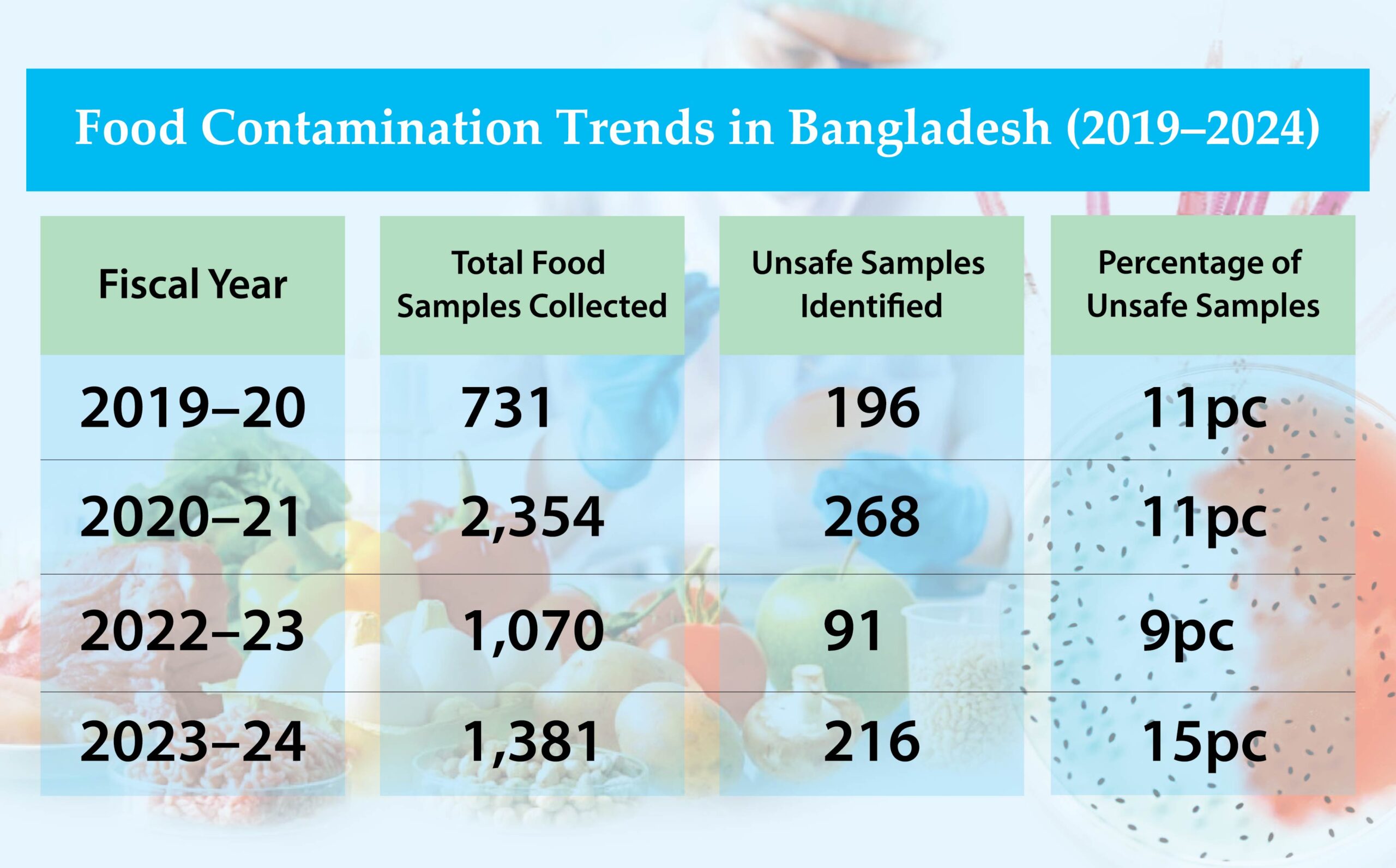
However, findings from BFSA reveal that the trend of consuming adulterated food continues to rise. Of the food samples tested by BFSA over the past five years, the highest percentage of unsafe food was identified in the 2023-24 fiscal year. For instance, in the fiscal year 2019-20, BFSA collected 731 food samples, of which 196 (11 per cent) were found to be unsafe. By the 2023-24 fiscal year, the percentage of unsafe samples had risen to 15 per cent, with 216 out of 1,381 samples failing to meet safety standards.
Similarly, in the 2022-23 fiscal year, 1,070 samples were collected, and 91 (9 per cent) were deemed unsafe. In 2020-21, 268 unsafe samples were identified out of 2,354 tested, maintaining an 11 per cent failure rate. Among the most contaminated food items were honey, ghee, processed foods, bread, sweets, and related products.
A report by Welthungerhilfe, a German-based non-profit organisation, highlighted that 60 per cent of vegetables in the market contain excessive pesticides, 67 per cent of bottled soybean oil contains trans fats, and a lack of organic matter in soil across most districts further complicates the production of safe crops. This poses a significant threat to food security in the country.
Speaking to The New Nation, Mohammad Nazim Uddin, a senior scientific officer at the Bangladesh Agricultural Research Institute, pointed out that the overuse of fertilisers and chemicals at various stages of food production-from field to plate-has created serious safety concerns.
He emphasised the need for a radical transformation of the agriculture and food systems, which would involve not only policy changes but also shifts in practice, as well as clearer approaches to policymaking that focus on either transformative or regenerative solutions.
Despite nearly 15 existing laws designed to ensure safe food, food safety remains unachieved. Nazim Uddin stressed that every step of the food production process, including the materials used and the environment in which food is prepared, must be made safe at all costs.
Professor Mohammad Saiful Islam Bhuiyan of Sher-e-Bangla Agricultural University noted that people have become hostages to certain companies. He remarked that although some safe foods are available, they remain inaccessible to the majority.
“Almost all food items are contaminated from production to consumption,” he stated. He also advocated for the promotion of local crop varieties, which are highly beneficial for the country’s population, and suggested leveraging social media platforms to raise awareness and strengthen the safe food movement in Bangladesh.
Suraiya Begum, Director at Research Initiatives, Bangladesh, highlighted the critical issues of food politics and food sovereignty. She explained that global politics have affected the country’s autonomy over food production, leading to the loss of thousands of local paddy varieties due to the intervention of international organisations. She called for better coordination among platforms working to promote safe food awareness.
Zakaria, Chairman (Additional Secretary) of the Bangladesh Food Safety Authority, acknowledged the challenges in ensuring food safety, stating that their journey has just begun compared to the scale of the task. He cited shortages of manpower and laboratory facilities as key obstacles but mentioned that steps are being taken to address these issues.
“With the help of JICA, we are setting up accredited laboratories at departmental levels, and this work will begin soon. Additionally, we are launching mobile labs and increasing manpower. We are also reforming and harmonising laws and regulations to align them with global standards,” Zakaria added.